

 Srbija
 Hrvatska
 Slovenija


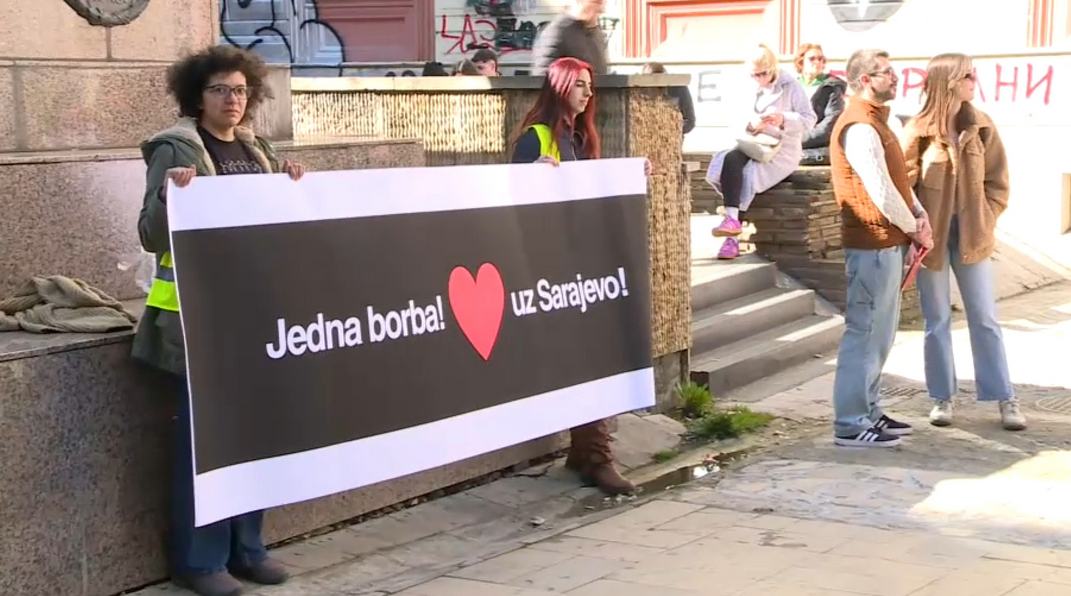
The Youth Initiative for Human Rights (YIHR) organised a solidarity march in Belgrade on Saturday to honour those killed and injured in a recent tram accident in Sarajevo, as well as what organisers described as “all victims of infrastructure neglect across the region.”
The initiative recalled that on February 12, a young student was killed and several others injured after a tram derailed in Sarajevo.
The gathering, titled “One Struggle, With Sarajevo in Our Hearts,” began at Studentski Trg (Students’ Square), where citizens assembled before marching together to the Sebilj fountain in Skadarlija - a replica of Sarajevo’s iconic fountain, gifted to Belgrade in 1989. The march concluded there.
Participants carried banners reading “One Struggle – With Sarajevo in Our Hearts,” featuring a stylised red heart symbolising solidarity between the two cities.
Speaking to around 100 attendees at the starting point, activists expressed support for Sarajevo residents demanding accountability for the tram accident, drawing parallels with citizens in Serbia who have also protested following the deadly infrastructure collapse in Novi Sad on November 1, 2024.
Organisers said that in Serbia, too, “people have to worry whether a ceiling might collapse above them or a bridge might fail,” highlighting what they described as systemic infrastructure failures and lack of accountability.
Activists warned against nationalist narratives and criticised what they called the silence that divides people across borders, arguing that solidarity among citizens today represents “an act of resistance that knows no borders.”
They also noted that Sunday marks the 30th anniversary of the end of the Siege of Sarajevo in 1996 - the longest siege of a capital city in modern history - emphasising the symbolic importance of standing with Sarajevo at this time.
“For 30 years, people on both sides of the Drina River have struggled to live normal lives due to nationalism, corrupt systems and institutional decay,” one activist said.
YIHR stated earlier that the solidarity march was dedicated not only to the victims of the recent tram accident in Sarajevo, but also to “all victims of infrastructure neglect across the region.”
The organisation said the tragedy was “not merely the result of a technical failure,” but rather “a consequence of years of public safety neglect, lack of accountability, and systemic disregard for human life.”
Organisers emphasised that solidarity among cities and societies in the region is not only an expression of compassion, but also “a shared struggle for safety, accountability and dignity.”
They added that the Sebilj fountain - a symbol of Sarajevo’s historic ties with Belgrade - was chosen deliberately as the final destination of the march to send a message that “tragedies know no borders, and neither should solidarity.”
Meanwhile, Sarajevo residents held their eighth protest on Friday since the February 12 tram accident, in which a 23-year-old student from Brcko was killed and four others injured, one seriously.
Sarajevo endured a nearly four-year siege from 1992 to 1996, during which the Army of Republika Srpska fired an average of 329 shells per day. The International Criminal Tribunal for the former Yugoslavia later determined that civilians were subjected to a prolonged campaign of terror, as residents lived without electricity, water or heating and were constantly exposed to sniper fire.
Kakvo je tvoje mišljenje o ovome?
Učestvuj u diskusiji ili pročitaj komentare


Kakvo je tvoje mišljenje o ovome?
Učestvuj u diskusiji ili pročitaj komentare