

 Srbija
 Hrvatska
 Slovenija


The alliance between Croatia and Bosnia and Herzegovina was driven by the genocide in Srebrenica and ultimately saved Bihac - the besieged town and its region in Bosnia's northwest, and brought peace to the country through the Dayton Treaty, it was emphasised on Saturday in Dubrovnik during an international forum.
One of the panels within the Dubrovnik Forum was about the topic "30th Anniversary of the Split Declaration: The Alliance Between Croatia and Bosnia-Herzegovina That Made Peace Possible".
The Split Declaration, signed in 1995 by Croatia and Bosnia and Herzegovina, marked a turning point in the war, shifting its trajectory towards peace.
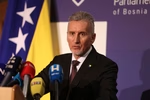
Former Croatian Foreign Minister Mate Granić recalled that Turkish President Süleyman Demirel, after learning of the atrocities committed in Srebrenica, urgently requested a meeting with Croatian President Franjo Tuđman.
“Demirel had tears in his eyes during the meeting. I had never seen such a saddened man. He pleaded with Tuđman for Croatia to help the Bosniaks, who were on their knees. Because if help didn’t come, what happened in Srebrenica would happen in Bihać as well, which at that moment was the most endangered area," Granić recounted.
Tuđman consulted Defence Minister Gojko Šušak and Granić, asking for their opinion.
"We both said Croatia should help, and he agreed. He asked Šušak whether we were ready, to which Šušak confirmed. He then asked me how the international community, particularly the US, would respond. I told him the reaction would be positive if everything was carried out in accordance with international law," Granić said.
The plan had three components, Granić explained: a meeting between Tuđman and (Bosnia President) Alija Izetbegović, the signing of a legally binding international agreement, and Izetbegović’s formal request to Tuđman for assistance, especially military. Izetbegović accepted all three.
The plan had three components, Granić explained: a meeting between Tuđman and Alija Izetbegović, the signing of a legally binding international agreement, and Izetbegović’s formal request to Tuđman for assistance, especially military. Izetbegović accepted all three.
“On 22 July, they met at Villa Dalmacija (in the city of Split) agreed on the content and signed the Split Declaration. By 26 July, we had already decided to take action. Croatia helped Bosnia and Herzegovina liberate 20% of its territory and saved Bihać. We were halted just 20 kilometres from Banja Luka," Granić said.
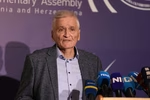
Former US Ambassador to Croatia, Peter Galbraith, said there is a direct connection between Srebrenica, the Split Declaration, and Operation Storm (Oluja), and finally to the Dayton Peace Agreement.
The cooperation between the Croatian Army and the Army of Bosnia and Herzegovina reversed the course of the war and brought about peace. Operation Storm changed the facts on the ground, Galbraith stated.
He added that he played a small role in the Split Declaration by ensuring it was clear that the Government of Bosnia and Herzegovina had explicitly requested Croatian assistance under Article 51 of the UN Charter, which permits both individual and collective self-defence. The military offensive in the Livanjsko Polje (Livno Valley) followed shortly afterwards.
Galbraith also revealed that the US government had refused to give the green light to Croatia back in November 1994, when Bihać was surrounded by forces from Krajina and Bosnian Serbs. However, after the fall of Srebrenica, that position changed.
The decisive argument was that 80,000 people could be killed in Bihać. I went to the Brijuni islands to meet Tuđman and conveyed the message that the US appreciated Croatia’s willingness to break the siege of Bihać, with the classic warning that, if anything went wrong, they couldn’t count on us. That was the green light for Operation Storm. Srebrenica changed everything, he said.
Mladić thought he was a brilliant military strategist when he ordered the execution of 8,000 men and boys. But instead, he made a catastrophic error, Galbraith went on to say.
Kakvo je tvoje mišljenje o ovome?
Učestvuj u diskusiji ili pročitaj komentare


Kakvo je tvoje mišljenje o ovome?
Učestvuj u diskusiji ili pročitaj komentare