

 Srbija
 Hrvatska
 Slovenija

Bosnia: Gas pipeline still out of sight, disputes erupt over who will buy gas


The plan to connect the gas networks of Croatia and Bosnia and Herzegovina via the new Southern Interconnection pipeline has again become politicised, amid disputes over who will buy gas for Bosnia and Herzegovina, with Milorad Dodik, long opposed to the project, having joined the discussion.
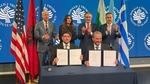
Bosnia's Foreign Minister Elmedin Konakovic and BiH Federation entity Energy Minister Vedran Lakic sharply criticised a statement by Israel's Abraham Group, which announced a memorandum of understanding to supply liquefied natural gas (LNG) to Mostar's Aluminij plant. The memorandum, signed this week in Washington during a transatlantic gas security summit by Abraham Group president Amir Gross Kabiri and Atlantic Sea LNG Trade president Alexandros Exarchou, sets the framework for a future LNG supply contract, expected to be finalised by the end of 2026.
Atlantic Sea LNG Trade aims to become a key intermediary for US LNG supply to Southeast Europe via Greek ports, targeting buyers in Albania, North Macedonia, Bulgaria, Romania, Hungary, Moldova, Austria, and potentially Ukraine.
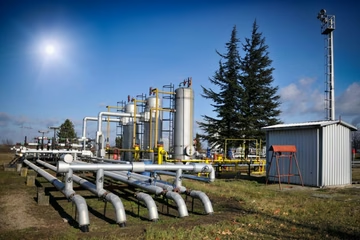
How Bosnia and Herzegovina, and specifically Mostar's Aluminij, fits into this remains unclear, as the country currently has only a single pipeline supplying Russian gas via Serbia. Plans to build the Southern Interconnection, which would link BiH to Croatia's gas network at Zagvozd and give it access to the Krk LNG terminal, are still under consideration.
The project is strongly promoted by the current US administration, aiming to make Bosnia a user of American LNG.
Although the pipeline does not yet exist and is not expected to be operational before the end of 2027, disputes have already emerged over who would purchase the gas if and when the project is completed.
Konakovic described the Abraham Group's memorandum as deceptive, stating that the company has no legal basis or permission to buy gas for BiH.
He emphasised that only the government of the BiH Federation entity, through an official regulation, can authorise gas imports and sales, currently limited to Energoinvest, until a national gas law is passed.
Lakic echoed this, stressing that energy security is governed by law and responsibility, not marketing.
The leader of the ruling party in the Republika Srpska entity, Milorad Dodik, on Thursday joined the debate. Dodik has long advocated relying exclusively on Russian gas and as early as 2015 categorically rejected the idea of connecting BiH to the Croatian gas network via Slavonski Brod and Bosanski Brod.
Now, however, he congratulated Kabiri "on an important agreement that opens new energy prospects and brings stability and development to the region".
Due to obstruction by Dodik's appointees in the Council of Ministers of BiH, the country still does not have a national gas law, despite pressure from the European Union.
Kakvo je tvoje mišljenje o ovome?
Učestvuj u diskusiji ili pročitaj komentare


Kakvo je tvoje mišljenje o ovome?
Učestvuj u diskusiji ili pročitaj komentare