




 Srbija
 Hrvatska
 Slovenija


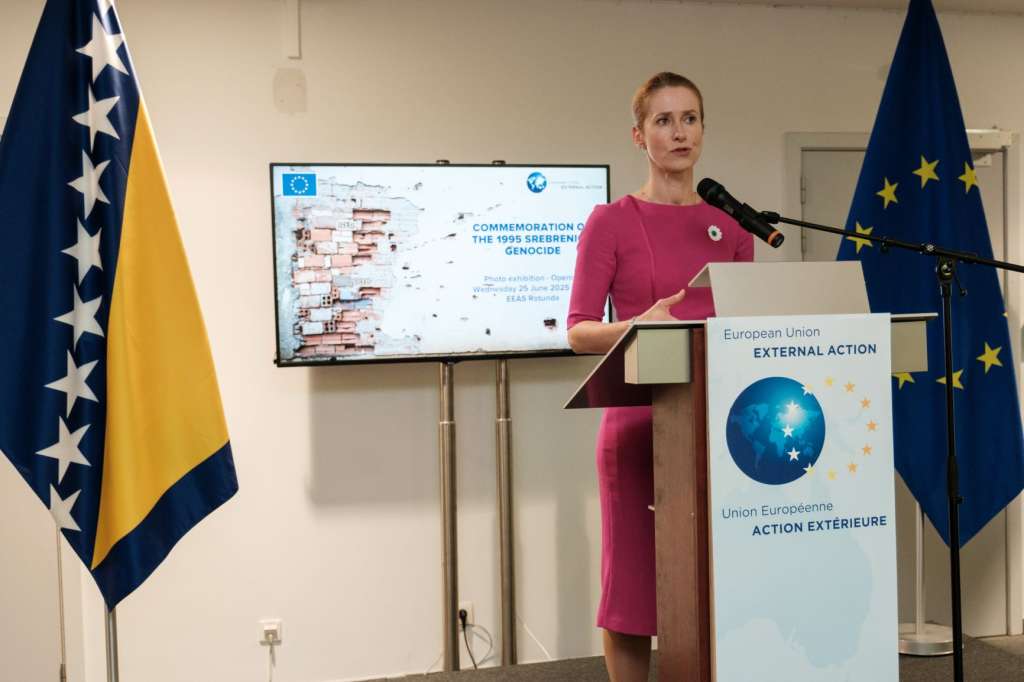
The exhibition ‘MEMENTO: Fragments of the Srebrenica Genocide’ was officially opened last night at the headquarters of the European External Action Service (EEAS) in Brussels. The event was inaugurated by Kaja Kallas, EU High Representative for Foreign Affairs and Security Policy and Vice-President of the European Commission, as part of the commemorative activities marking the 30th anniversary of the Srebrenica genocide.
MEMENTO presents a deeply moving collection of personal stories told through everyday objects recovered from mass graves and personal archives. Each artefact is displayed alongside a portrait and testimony of a survivor or a family member who lost loved ones in the genocide, offering an intimate, human perspective on the atrocities of July 1995.
The exhibition is a collaborative effort between the EEAS, the Sarajevo-based Post-Conflict Research Centre (PCRC), the Srebrenica Memorial Centre, and the Mechanism Information Programme for Affected Communities in The Hague.
At the opening, HR/VP Kallas remarked that there are no words that can fully express the depth of emotion in the face of enduring evil. “That’s why the images in this exhibition are so powerful,” she said.
“A pocket watch frozen in time. A pair of teenage boy’s shorts, never to be worn again. The words of a mother still searching for her eldest son, thirty years on. I want us all to remember what happened in Srebrenica,” Kallas said.
Reflecting on her recent visit to Sarajevo, Kallas emphasised action and solidarity.
“I visited Sarajevo in April this year, delivering a clear message: the European Union is committed to keeping Bosnia and Herzegovina safe. Bosnia and Herzegovina is part of our European family.”
Thanking the exhibition’s organisers, she added:
“Despite the monstrous intent to erase the Bosniak people in Srebrenica, the legacy of the victims lives on—through our memories, and through these mementoes. As this exhibition teaches us, remembrance is not just an annual ritual. It is a daily commitment to confronting hatred, intolerance, and injustice. That is how we uproot atrocity.”
Velma Saric, founder of the Post-Conflict Research Centre and host of the exhibition tour, highlighted the importance of remembering both genocide and survival.
“This exhibition honours over 8,000 Muslim men and boys killed in Srebrenica. These stories remind us of Bosnia’s ongoing journey toward peace and justice. Through our work, we aim to inspire young people to learn from the past, to promote peace, and to stand against hatred and violence—today and in the future.”
Mirela Osmanović of the Srebrenica Memorial Centre also spoke at the opening, underlining that for survivors and those working in remembrance, the genocide is not history—it is lived reality.
“Thirty years later, justice and dignity are not things you bury and leave behind. They are built over time, with truth and care. At a time when denial is growing louder—when war criminals are glorified and hate speech is met with silence—this exhibition stands as a testament that truth is not an opinion, but a matter of record and moral responsibility.”
As part of the wider commemorative programme, the documentary “Samir Mehić Bowie – Letters from Srebrenica” will be screened at the Bozar Centre for Fine Arts in Brussels on 1 July 2025 at 18:00. The screening will be followed by a panel discussion.
╰┈➤ Program N1 televizije možete pratiti UŽIVO na ovom linku kao i putem aplikacija za Android /iPhone/iPad
Kakvo je tvoje mišljenje o ovome?
Učestvuj u diskusiji ili pročitaj komentare


Kakvo je tvoje mišljenje o ovome?
Učestvuj u diskusiji ili pročitaj komentare