

 Srbija
 Hrvatska
 Slovenija


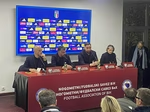
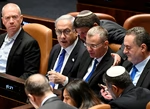
Political leaders from Bosnia and Herzegovina’s main parliamentary parties on Tuesday outlined their proposals for resolving the country’s political crisis to members of the Peace Implementation Council (PIC) Steering Board, but the talks ended without agreement on a clear path forward.
The body overseeing the implementation of the Dayton Agreement and providing guidance to the High Representative invited the leaders of HDZ BiH, HDZ 1990, the Bosniak-civic coalition, and three opposition parties from Republika Srpska to the meeting in Sarajevo. The Alliance of Independent Social Democrats (SNSD), led by Milorad Dodik, was not invited.
Ilija Cvitanovic, the leader of HDZ 1990, told journalists after the two-hour meeting that all participants reaffirmed their support for Bosnia and Herzegovina’s European path and the need to stabilise the political and financial situation in the country.
However, key political issues remain unresolved, especially electoral law reform, which he said must be addressed by autumn.
Cvitanovic noted that there were no indications the High Representative would take immediate action, as an internal agreement is still expected, although sanctions, such as those recently announced by the German ambassador against Dodik’s regime, may be forthcoming.
"There was a clear condemnation by the Steering Board members of all destructive policies towards Bosnia and Herzegovina," Cvitanovic said.
Foreign Minister Elmedin Konakovic, who also leads the People and Justice party (Narod i pravda -NiP), stated that the situation in Bosnia and Herzegovina is "boiling, but beginning to untangle", emphasising the importance of removing Dodik’s SNSD from power.
"There is a qualified majority to resolve the problems," Konakovic asserted.
Kakvo je tvoje mišljenje o ovome?
Učestvuj u diskusiji ili pročitaj komentare


Kakvo je tvoje mišljenje o ovome?
Učestvuj u diskusiji ili pročitaj komentare