Srbija
 Hrvatska
 Slovenija

Soreca: BiH has lost a year on EU path, faces further cuts to Growth Plan funding


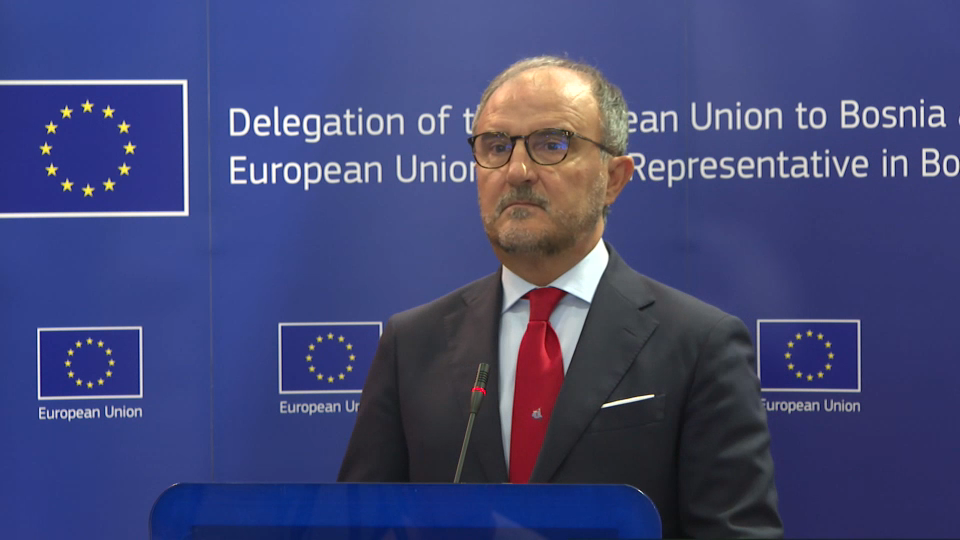
Bosnia and Herzegovina has practically lost another year in terms of tangible progress on its European path, and if domestic authorities fail to meet the necessary conditions for implementing the Growth Plan for the Western Balkans by the end of the year, the country will face a further reduction in European Union funding, Luigi Soreca, Head of the EU Delegation and EU Special Representative in BiH, warned.
Presenting the European Commission’s 2026 Report on Bosnia, which he handed to the Chairwoman of the BiH Council of Ministers, Borjana Kristo, Soreca said that EU integration formally remains the country’s strategic goal, but that BiH is simultaneously moving further away from its European path.
“The main message of this year’s report is unequivocal: European integration remains Bosnia’s declared strategic goal, but at the same time, the country is moving further away from its European path,” Soreca said.
He emphasized that, in the run-up to the General Elections held on October 4, political divisions and anti-EU rhetoric intensified, while political statements and actions did little to advance the reform process.
“Essentially, when it comes to tangible progress, this has been a lost year,” he said.
Nevertheless, according to Soreca, this year’s report also recognizes certain positive developments, including progress in combating organized crime, protecting intellectual property and customs policies, as well as the fact that BiH has maintained full alignment with the EU’s Common Foreign and Security Policy.
However, he stressed that the overall picture shows that BiH is missing important opportunities and falling behind neighboring countries.
“Above all, Bosnia and Herzegovina needs to address long-standing shortcomings in the areas we call fundamentals, namely the judiciary, the fight against corruption and freedom of expression,” he said.
He particularly warned that BiH is the only Western Balkan country that has yet to receive a single euro from the Reform and Growth Facility under the EU Growth Plan.
“The lack of progress on the European path has real consequences for the everyday lives of citizens. These include outdated digital infrastructure, high levels of pollution, jobs requiring low skill levels, unfinished transport corridors, and underfunded schools and hospitals,” he explained.
Asked by a journalist whether the Growth Plan was already a missed opportunity or whether there was a possibility of extending the deadlines, Soreca recalled that the European Union had clearly warned from the beginning of the year that the deadline for meeting the necessary conditions was the end of 2026.
“Since the beginning of the year, I have repeatedly emphasized that the deadline is the end of this year. Unfortunately, without genuine progress that would provide the legal basis for implementing the Growth Plan, a decision to reduce funding is inevitable,” he warned.
He pointed out that this model of financial support conditioned on the implementation of reforms would be applied increasingly in the European Union’s next budget cycle, from 2028 to 2034.
Speaking about opportunities for BiH’s gradual integration into European structures, Soreca emphasized that citizens could experience tangible benefits from closer ties with the EU even before formal membership.
Among the most important opportunities, he cited access to the Single Euro Payments Area (SEPA), which would enable cheaper and faster cross-border payments; the “Roam Like at Home” initiative, which envisages eliminating roaming charges; and closer cooperation with European agencies Europol, Eurojust and Frontex.
He also highlighted the importance of expanded opportunities under the Erasmus+ program for students and academic staff.
“It is crucial for the benefit of the citizens of this country that Bosnia and Herzegovina fully takes advantage of these opportunities. Other countries in the region are implementing reforms and building key infrastructure that will ensure their future success, and it is not too late for Bosnia and Herzegovina to join them,” he said.
Soreca said that, following the elections, he expected the rapid formation of new governments and the return of EU integration to the center of political decision-making.
He stressed that the European Union remained ready to assist Bosnia and Herzegovina, but that domestic authorities must take responsibility for implementing reforms.
“We are here to help, provide support and ensure that all opportunities are available, but a change in the approach of domestic authorities is needed. We are ready to consider new strategies and ways to achieve progress, because it is clear that Bosnia and Herzegovina has been at a standstill on its European path for several years,” he said.
Asked whether a different approach toward the entity of Republika Srpska was possible, particularly in light of Milorad Dodik’s statements on EU integration and the position of the entity, Soreca said that the EU cooperates with all institutions in Bosnia and Herzegovina and expects constructive engagement from the RS entity.
He stressed that BiH’s constitutional and institutional decision-making system requires cooperation with all levels of government, but also pointed to the problem of political messages coming from the entity of Republika Srpska in recent months.
“In recent months, we have heard strong anti-European rhetoric coming from Republika Srpska. However, our goal remains the same: to bring Bosnia and Herzegovina into the European Union as soon as possible,” Soreca said.
Asked about the meetings he had held with political representatives and potential coalition partners following the elections, as well as plans for talks with political actors from Banja Luka, he said he was continuing consultations with all relevant government representatives and political parties.
“Since the elections, I have been speaking with all political and institutional leaders to assess their commitment to the EU integration process. My only message is that European integration must once again become central to their political agendas,” he said.
He added that it was still too early to discuss the possible composition of the new ruling coalitions, but confirmed that talks would continue with all political actors, including representatives from Banja Luka.
Kakvo je tvoje mišljenje o ovome?
Učestvuj u diskusiji ili pročitaj komentare


Kakvo je tvoje mišljenje o ovome?
Učestvuj u diskusiji ili pročitaj komentare