

 Srbija
 Hrvatska
 Slovenija

Suljagic warns of coordinated anti-Bosniak campaign emerging from Western centers


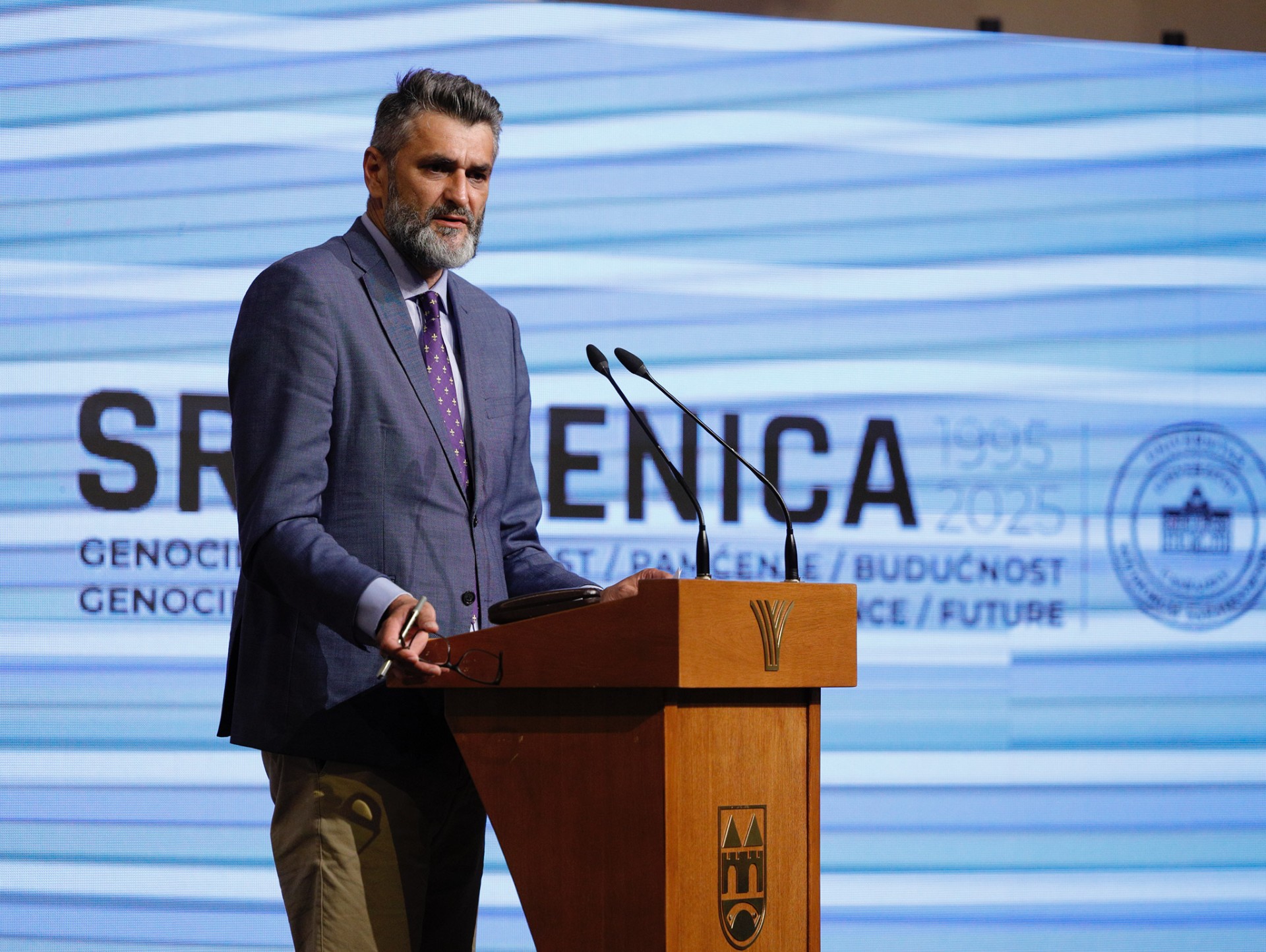
The Director of the Srebrenica Memorial Center, Emir Suljagic, warned that a coordinated campaign directed against Bosniaks and Bosnia and Herzegovina is developing within international political and media circles. According to his statements, these narratives are increasingly being shaped specifically within Western political centres.
He pointed out that this campaign is based on two narratives which he considers historically unfounded and dangerous.
"Bosniaks as a people and their country as such are the subject of a campaign that is not being conducted here, but in the West. It is being conducted here as well, of course, but it is mainly conducted in the West, in Western capitals against us," Suljagic said.
Two narratives and "historical forgery"
According to his words, the first narrative represents a serious distortion of historical facts, especially regarding the Holocaust in Bosnia.
"The first narrative distorts and falsifies historical facts to such an extent that we can speak of a form of Holocaust distortion. We are being told, sometimes subtly and sometimes very openly, that Bosniaks were the people who organized and carried out the Holocaust in Bosnia and Herzegovina. This is a first-rate historical forgery," he emphasized.
Suljagic stressed that the Holocaust in the territory of Bosnia and Herzegovina was carried out by the Independent State of Croatia (NDH), specifically the Ustasha regime led by Ante Pavelic.
"The Holocaust on the territory of Bosnia and Herzegovina was carried out by the so-called Independent State of Croatia and the Ustasha state, under the leadership of the Ustasha movement and Ante Pavelic. That regime killed tens of thousands of Serbs, Jews, Roma, and thousands of Bosniaks who opposed the genocidal policy of the Ustasha movement," he said.
He added that the attempt to shift responsibility for these crimes onto another community is political manipulation.
"To take those crimes away from their perpetrators and attribute them to another community is unprecedented political manipulation. Distorting the Holocaust is never an innocent act. It is an attempt to blur the lines of responsibility and instrumentalize memory," he emphasized.
Suljagic also recalled that Bosniaks in World War II were under occupation and without their own state.
"At that moment, we did not have a state. In occupied Yugoslavia, everyone else had some collaborator and some quisling form of a state. Except us," he said.
According to him, swapping the roles of victim and perpetrator throughout history always carries serious consequences.
"This exchange of places between victim and perpetrator is not new, but it is always dangerous," he warned.
The "Clash of Civilizations" narrative
Speaking about the second narrative, Suljagic stated that there is an attempt to portray Bosnia as a space of an alleged clash of civilizations, with claims that Islam is foreign to the European continent.
In this context, he referred to a statement by American lobbyist Michael Flynn, which, according to media reports, was made in Banja Luka.
"Yesterday, an American lobbyist, according to media reports, stated that Islam is not a religion. He stated this in Banja Luka, where 30 years ago all the mosques were destroyed because people believed that Islam was not a religion," Suljagic said.
He added that such messages are reminiscent of rhetoric from the war period.
"Those are words that echo what Momcilo Krajisnik said in 1993, that we are an artificial nation and, I quote, 'a sect, grouping, or group of Turkish provenance,'" he said.
Suljagic believes there is a clear connection between these two narratives.
"The connection between these two narratives is not accidental. Because both aim to portray us as historical and contemporary foreigners, historical foreigners in our own country, contemporary foreigners in the world we live in," he said.
Warning of the consequences of such rhetoric
The Director of the Srebrenica Memorial Center warned that rhetoric denying the identity of a people can have serious consequences.
"As a Bosniak, a Bosniak Muslim, I know that genocide begins with definitions. It begins with claims that a people is not a true people, that its religion is not a true religion, that its history is not its history," he said.
He added that such rhetoric can lead to a process of dehumanization.
"Because when you present someone as a permanent danger and a permanent foreign body, then physical removal becomes a legitimate political solution," he warned.
A call to oppose the narratives
Suljagic stated that historical facts about the Holocaust have clearly named perpetrators and that Bosnia is not a site for a clash of civilizations.
"Bosnia and Herzegovina is not any kind of battlefield for a clash of civilizations. It is a European society with a plural history in which Islam, Christianity, and Judaism have coexisted for centuries," he said.
He emphasized that Bosniaks are a people with their own language, culture, and history deeply rooted in Bosnia and Herzegovina.
"We are not any kind of artificial creation or sect; we are a people with our own language, culture, and history, rooted deeply in this country," he stated.
Finally, he warned that the fight for the truth is not over.
"Kao Bošnjak, musliman znam da genocid počinje definicijama, počinje tvrdnjama da neki narod nije istinski narod, da njegova vjera nije istinska vjera, da njegova historija nije zaista njegova historija… Počinje lobistima, frazama i pažljivim konstrukcijama. Kad nekoga… pic.twitter.com/DwTriPPnkA
— Ćamil Duraković (@Camil_Durakovic) March 4, 2026
"The adoption of the resolution on Srebrenica was an extraordinary historical step. But do not relax. No fight is over. Do not let us remain silent while targets are placed on our children's backs. No one has the right to be silent about that," Suljagic concluded.
Kakvo je tvoje mišljenje o ovome?
Učestvuj u diskusiji ili pročitaj komentare


Kakvo je tvoje mišljenje o ovome?
Učestvuj u diskusiji ili pročitaj komentare