

 Srbija
 Hrvatska
 Slovenija


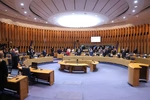
Bosnia and Herzegovina remains one of Europe's most forested nations, with over 63% of its territory covered by woodlands. However, this vital natural resource is facing unprecedented threats from climate extremes. During a public lecture at the Academy of Sciences and Arts of Bosnia and Herzegovina (ANUBiH) in Sarajevo, Prof. Dr. Besim Balic warned that droughts, heatwaves, and forest fires are causing visible degradation, with spruce trees being particularly vulnerable.
The event, titled "Forests as a Multifunctional Natural Resource under Climate Change," was organized by the ANUBiH Department of Natural and Mathematical Sciences in collaboration with the Faculty of Forestry at the University of Sarajevo. Academician Vladimir Beus, who moderated the session, emphasized that forests are essential climate regulators, absorbing carbon dioxide and releasing oxygen to stabilize temperatures and air quality.
Experts highlighted that intensifying climate shifts are undermining the stability, productivity, and health of forest ecosystems. Beyond environmental damage, these changes threaten the economic and social functions of the timber sector. Prof. Dr. Balic argued that the industry must transition from traditional methods to "adaptive forest management" to build resilience against pests and fires.
A significant hurdle identified during the lecture is the lack of a unified legal framework in the Federation of Bosnia and Herzegovina entity. The current system is fragmented across cantons, which complicates long-term planning and effective protection. This structural weakness hinders the ability to manage forests as a cohesive economic and ecological asset.
Marking International Day of Forests on March 21, under the theme "Forests and Economy," the lecture concluded that sustainable management is the only way to preserve biodiversity and regulate water flows. National inventory data presented at the session serves as a roadmap for future policy, stressing that the survival of Bosnia’s "green heart" depends on systemic legislative reform and modern ecological standards.
Kakvo je tvoje mišljenje o ovome?
Učestvuj u diskusiji ili pročitaj komentare


Kakvo je tvoje mišljenje o ovome?
Učestvuj u diskusiji ili pročitaj komentare