Srbija
 Hrvatska
 Slovenija

Darijana Filipovic displays Herceg-Bosna flag at official meeting with EU Ambassador on Bosnia’s Statehood Day


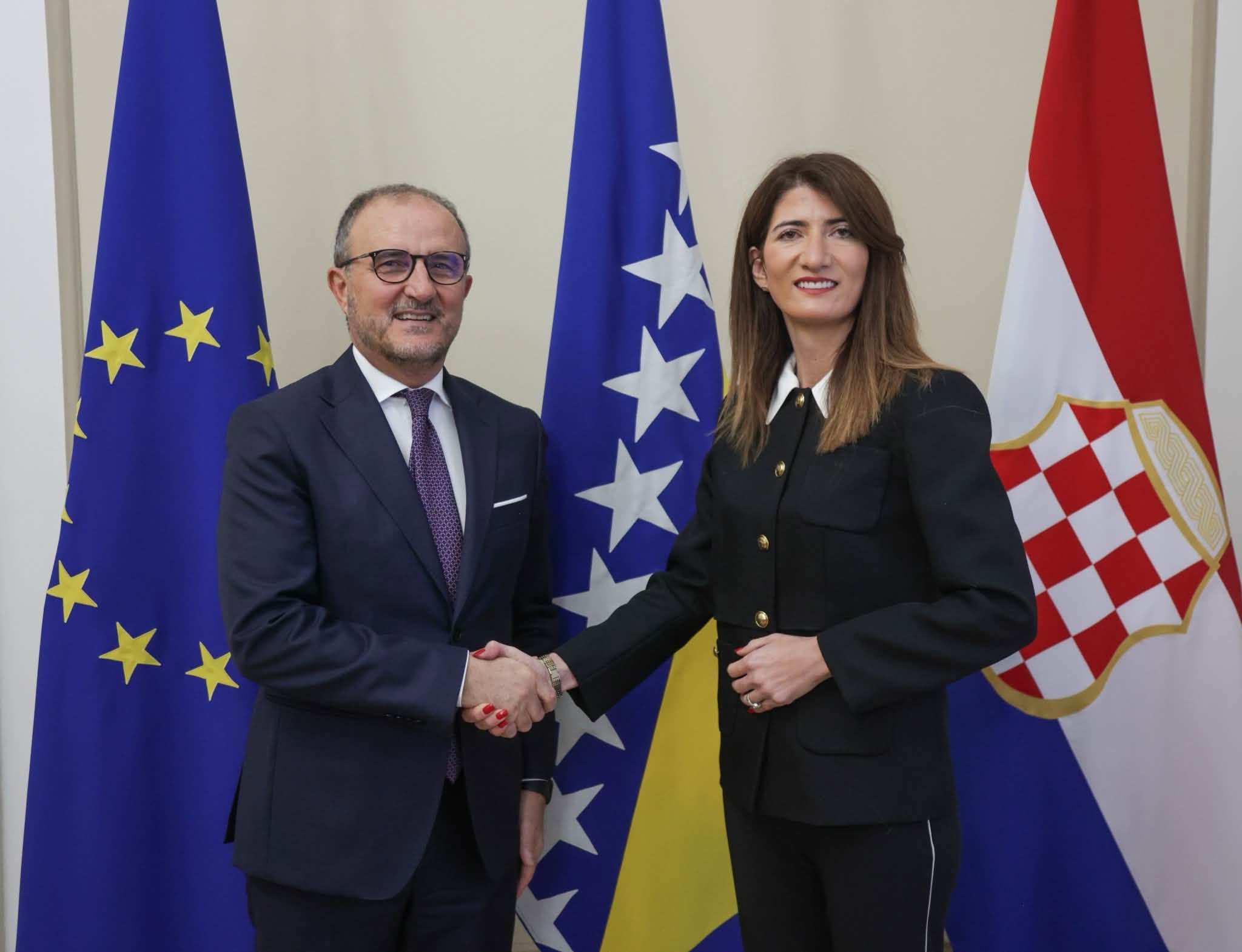
As Bosnia and Herzegovina marks the 83rd anniversary of the restoration of its statehood, Darijana Filipovic, the newly appointed Croat member of the country’s tripartite Presidency, devoted her first official meeting after taking office to the country’s European future. However, a flag associated with the self-proclaimed Croatian Republic of Herceg-Bosna, visible in a photograph of her meeting with European Union Ambassador Luigi Soreca, has also attracted attention. It is a symbol whose historical context cannot be separated from the final judgements of the International Criminal Tribunal for the former Yugoslavia (ICTY), nor from questions about compliance with the laws currently in force in Bosnia and Herzegovina.
Nine days after taking office, on Bosnia and Herzegovina’s Statehood Day, Filipovic met Ambassador Soreca to discuss reforms, the functioning of institutions, the rule of law and the next steps towards full EU membership.
In a photograph published by Filipović on her Facebook profile, three flags can be seen behind the two officials: that of the European Union, that of Bosnia and Herzegovina, and a flag featuring a red-and-white chequered coat of arms, edged in gold and decorated with a traditional interlace pattern. The latter was used as the emblem of the self-proclaimed Croatian Republic of Herceg-Bosna and is today described by some Croat political representatives as the flag of the Croat people in Bosnia and Herzegovina.
Its display at an official meeting in Bosnia and Herzegovina’s highest executive institution raises several questions that go beyond the symbolism of the photograph.
What is the legal basis for displaying this flag at the state Presidency? How does its use fit with the declared commitment to the rule of law? And what message does such a photograph send to the victims of war crimes committed as part of the political and military project of so-called Herceg-Bosna?
What does the Law on the Flag of Bosnia and Herzegovina say?
The display of flags in state institutions is not left solely to the political preferences of their officials.
The Law on the Flag of Bosnia and Herzegovina regulates the design of the state flag, as well as how it is used and officially displayed.
Article 2 stipulates that the flag of Bosnia and Herzegovina represents the state and is displayed as its symbol.
Article 5 is particularly important. It regulates the official display of the state flag on the buildings of the Presidency of Bosnia and Herzegovina and other state institutions, as well as during official international visits and gatherings at which Bosnia and Herzegovina is represented.
The amendments to the Law adopted in 2004 specify:
“In all cases referred to in the preceding paragraph, except for point (g), other flags from Bosnia and Herzegovina shall not be displayed alongside the flag of Bosnia and Herzegovina.”
The exception referred to in the law concerns entrances to buildings belonging to the Armed Forces of Bosnia and Herzegovina.
In other words, the legislator has drawn a distinction between the state symbol and other flags used within Bosnia and Herzegovina.
The European Union flag at a meeting with its ambassador has a clear diplomatic and protocol significance. The display of the so-called Herceg-Bosna flag alongside the state flag, however, requires a different explanation, particularly given that this was an official meeting between a member of the state Presidency and a foreign diplomatic representative, rather than a party gathering, cultural event or private occasion.
When Dodik tried to challenge the Law on the Flag of Bosnia and Herzegovina
The issue of displaying other flags at the Presidency of Bosnia and Herzegovina is not new.
After Milorad Dodik took office as the Serb member of the Presidency in 2018, the display of the Republika Srpska flag inside the state Presidency became the subject of political and legal debate.
In November 2019, Dodik submitted a request to the Constitutional Court of Bosnia and Herzegovina seeking a review of the constitutionality of the 2004 amendments to the Law on the Flag.
On 15 July 2021, the Constitutional Court of Bosnia and Herzegovina, in its ruling in case U-11/19, found that the contested amendments to the Law on the Flag were consistent with Article I/6 of the Constitution of Bosnia and Herzegovina.
That ruling was not issued in response to Darijana Filipovic’s meeting, but it confirmed the constitutionality of the legal amendments governing the display of other flags alongside the state flag.
The same legal criteria should apply regardless of which constituent people a member of the Presidency was elected to represent or which flag they wish to display.
A flag whose historical context includes 111 years in prison
Understanding the symbolism of the flag seen in the photograph of Filipovic’s meeting with Soreca requires recalling the judicially established facts concerning the political and military leadership of the former so-called Herceg-Bosna.
In four days, on 29 November, it will be nine years since the final judgement was delivered in the Prlic et al. case before the International Criminal Tribunal for the former Yugoslavia.
On 29 November 2017, the ICTY Appeals Chamber upheld the prison sentences of six former political and military officials of so-called Herceg-Bosna and the Croatian Defence Council (HVO), totalling 111 years.
Jadranko Prlic was sentenced to 25 years in prison, Bruno Stojic, Slobodan Praljak and Milivoj Petkovic to 20 years each, Valentin Coric to 16 years, and Berislav Pusic to ten years.
The ICTY’s final judgement confirmed their participation in a joint criminal enterprise aimed at establishing a Croat entity in Bosnia and Herzegovina through the ethnic cleansing of the Bosniak population, with the aim of enabling the reunification of the Croat people.
The crimes established by the final judgement included murder, persecution, deportation, unlawful detention of civilians, inhumane treatment, sexual violence and other serious violations of international humanitarian law.
The judgement concerned events between 1992 and 1994 in eight municipalities and five detention facilities across Bosnia and Herzegovina.
These facts are not a matter of day-to-day politics, nor do they depend on how individual political parties interpret the wartime past today. They were established in lengthy international judicial proceedings.
At the same time, it is important to stress that the judgement established individual criminal responsibility, not the collective responsibility of Croats in Bosnia and Herzegovina. Nor does the judgement itself constitute a general ban on the use of the flag.
That is precisely why it is necessary to distinguish between the legitimate expression of Croat national identity and the use of the emblem of a specific wartime political project in state institutions.
Some Croat political representatives in Bosnia and Herzegovina regard the flag of so-called Herceg-Bosna as the flag of the Croat people, while for many victims of war crimes and their families it remains inseparably linked to wartime suffering and the policies established in the ICTY judgements.
In November 2021, also on Bosnia and Herzegovina’s Statehood Day, the display of the so-called Herceg-Bosna flag at the Croat Cultural Centre of Duke Stjepan Kosaca in Mostar led to the cancellation of a ceremony organised by schools following the Bosnian curriculum.
The fact that part of the public regards a particular emblem as a national symbol does not automatically give it the status of an official symbol of state institutions.
Bosnian Croats are one of the constituent peoples of Bosnia and Herzegovina. The state flag belongs to them just as it belongs to Bosniaks, Serbs and all other citizens of the country.
Same ambassador, same institution, different protocol
Darijana Filipovic’s meeting on Wednesday is particularly interesting when compared with a meeting between her predecessor, Zeljko Komsic, and the same European official.
On 1 September 2026, Komsic met Luigi Soreca to discuss European integration, reforms, the functioning of institutions and the rule of law.
In the photograph of Komsic’s meeting with Soreca, the flags of Bosnia and Herzegovina and the European Union can be seen, along with the state coat of arms of Bosnia and Herzegovina on the wall. The so-called Herceg-Bosna flag is absent.
Comparing the protocols followed by two holders of the same constitutional office is particularly relevant because both meetings involved the same diplomatic representative and covered almost identical subjects.
The Constitution of Bosnia and Herzegovina did not change when Darijana Filipovic replaced Zeljko Komsic. Nor did the powers of the Presidency or the legal status of the state flag change.
Members of the Presidency are elected from among the constituent peoples, but the institution in which they perform their duties is an institution of Bosnia and Herzegovina. Its constitutional responsibilities include conducting the foreign policy of the entire country.
On Bosnia and Herzegovina’s Statehood Day – a date with a particular message
The fact that the meeting took place on 25 November gives the event an additional dimension.
On this day 83 years ago, the First Session of the State Anti-Fascist Council for the National Liberation of Bosnia and Herzegovina (ZAVNOBiH) was held in Mrkonjic Grad, restoring Bosnia and Herzegovina’s statehood.
The fundamental message of ZAVNOBiH was that Bosnia and Herzegovina was not the exclusive homeland of any one people, but a shared homeland of its peoples, based on their equality.
It was at that session that the historic formulation was adopted: Bosnia and Herzegovina is neither Serb, nor Croat, nor Muslim, but both Serb and Croat and Muslim.
The idea of shared statehood is particularly significant when viewed in the context of the wartime events of the 1990s and attempts to reorganise Bosnia and Herzegovina territorially along ethnic lines.
The choice of symbols displayed inside the state Presidency on this date therefore carries a broader historical significance.
“Europe as a standard, not as an additional flag”
Particular attention should be paid to the closing message in Darijana Filipovic’s statement today:
“Europe as a standard, not as an additional flag or slogan.”
Filipovic spoke about the need to build functional institutions, overcome internal blockades and put common interests ahead of individual ones.
Those messages provide grounds for examining the relationship between what was said at the meeting and the symbolism of the photograph published afterwards.
European integration means much more than adopting the laws required to open negotiating chapters. It also involves respect for the rule of law, democratic institutions and human rights, coming to terms with the wartime past, and regional reconciliation.
Official European Union documents make this clear.
In the Council of the European Union’s conclusions from December 2024, the EU emphasised Bosnia and Herzegovina’s European perspective as a single and sovereign country. The European Union called on political actors to abandon rhetoric and actions that deepen divisions, stop glorifying convicted war criminals and actively promote reconciliation.
Bosnia and Herzegovina is entering the EU accession process as an internationally recognised, sovereign state, not as a collection of separate ethnic political entities.
The issue of state symbols is therefore not outside the European agenda. It directly concerns the institutional representation of the country and respect for its legal order.
In this context, it is particularly striking that the message about Europe as a standard, rather than an additional flag, was published alongside a photograph showing the flag of so-called Herceg-Bosna next to the state flag of Bosnia and Herzegovina and the European Union flag.
Questions the public deserves answers to
The question remains: under which legal or protocol act was the flag of so-called Herceg-Bosna displayed at an official meeting in the Presidency of Bosnia and Herzegovina?
It should also be clarified whether this was a one-off occurrence or the beginning of a new protocol practice in the office of a member of the Presidency.
The position of the EU Delegation in Bosnia and Herzegovina on the display of such an emblem during official meetings with representatives of state institutions is equally relevant.
However, the ambassador’s mere presence at the meeting does not prove that the European Union supports the display of this flag.
Nine days after the change in the composition of the state Presidency, on Bosnia and Herzegovina’s Statehood Day and just days before the anniversary of the final judgement against the leaders of so-called Herceg-Bosna, a single photograph has raised questions about the law, the institutional representation of the country, historical memory and European values.
The answers will be important for understanding the future practice of the new office, as well as for assessing the consistency of its declared commitment to European standards.
Kakvo je tvoje mišljenje o ovome?
Učestvuj u diskusiji ili pročitaj komentare


Kakvo je tvoje mišljenje o ovome?
Učestvuj u diskusiji ili pročitaj komentare