

 Srbija
 Hrvatska
 Slovenija

Defense industry's records strong growth, focus on diversification and renewable energy investments


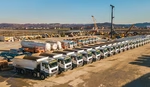
Almin Malisevic, Director of the Industry and Services Sector of the Chamber of Commerce of the Federation of BiH, told FENA that Bosnia and Herzegovina’s defense industry has recorded strong growth in revenue and employment in recent years, confirming its position as one of the key segments of the domestic economy.
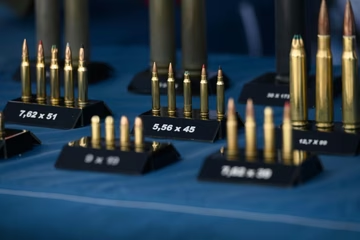
The export value in 2024 reached 560 million KM, representing a significant increase compared to the previous year.
“When we talk about 2025, it is important to note that exports to the U.S. were significantly disrupted due to the 30 percent tariffs. Although final data for the full year are not yet available, based on eleven months, we see that business and export stability has been maintained. The majority of exports consist of weapons, ammunition, and explosives. The growth trend confirms the capacity for further development and expansion into new markets,” Malisevic added.
He emphasized that, due to reduced exports to the U.S., diversification is not optional but a necessity for long-term growth and industry resilience.
“The defense industry is strengthening cooperation with European partners, where demand for BiH products is growing. At the same time, relations with customers in the Middle East and North Africa, particularly Saudi Arabia and Egypt, are developing, while the Asian market is opening new opportunities,” Malisevic said.
Diversification also involves adapting products to the specific requirements of each market – from quality standards to logistics solutions. Companies invest in international trade fairs and business missions, supported by state institutions and chambers that strengthen diplomatic and trade relations. Malisevic stressed that strategic investments in modernizing production and expanding capacity are essential for the continued growth and development of BiH’s defense industry.
“To maintain the competitiveness of BiH companies, continuous improvement of technological processes, digitalization, and automation is key, enabling greater efficiency and lower operational costs. These initiatives contribute to balanced regional development, strengthen production infrastructure, and increase the autonomy of the domestic industry relative to global demand. At the same time, they create new jobs, foster innovation, and enhance the sector’s competitiveness both domestically and internationally,” Malisevic added.
According to him, companies in the metals and manufacturing sectors are increasingly investing in solar energy and other renewable sources, taking advantage of favorable credit lines from the Development Bank of the FBiH.
“The Development Bank of the FBiH has established favorable credit lines to finance renewable energy projects, including wind, solar, hydro, geothermal, biomass, and biofuel sources, as well as other environmentally friendly renewables. Industrial companies have access to these funds, creating opportunities for investments in energy efficiency.
There are already examples of solar system installations at industrial facilities, even if not all are through bank programs. Hundreds of solar plants have been installed in FBiH, reflecting growing interest in renewables. Industrial actors see renewable energy as part of their cost reduction and decarbonization strategy. These projects help align with European standards and reduce CBAM costs. Companies increasingly recognize investment in renewables as a long-term competitive advantage,” Malisevic emphasized.
He added that the decline in production in the energy and mining sectors during 2025 negatively affected the metals industry, reducing orders and investments. In response, companies are accelerating diversification into faster-growing areas – renewable energy, equipment for the food and wood industries, electrical equipment, and solutions in automation and industrial IoT (Internet of Things).
Kakvo je tvoje mišljenje o ovome?
Učestvuj u diskusiji ili pročitaj komentare


Kakvo je tvoje mišljenje o ovome?
Učestvuj u diskusiji ili pročitaj komentare
NAJČITANIJE














Najnovije







ZDRAVLJE





LIFESTYLE




SHOWBIZ