

 Srbija
 Hrvatska
 Slovenija

Komsic at UNGA: BiH faces an "embargo on democracy", UN conventions didn't prevent genocide in Srebrenica or Gaza


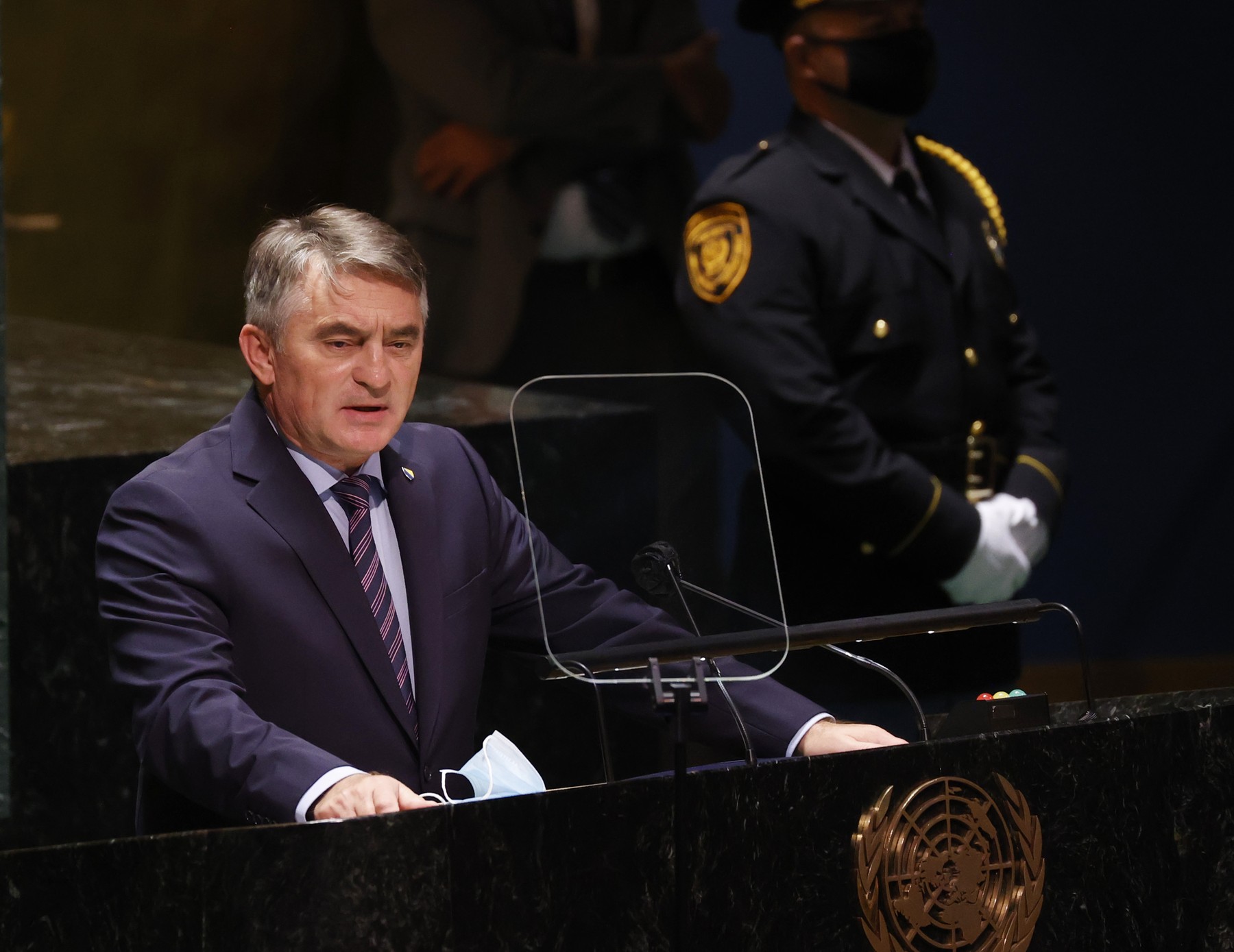
Zwljko Komaic, Chair of the Presidency of Bosnia and Herzegovina, spoke at the United Nations General Assembly in New York on the occasion of the 80th anniversary of the UN’s founding.
Addressing world leaders, Komsic reflected on the essence of the UN while congratulating the organization on its milestone.
"Allow me from this significant place, on behalf of Bosnia and Herzegovina and all its citizens, to extend congratulations to the United Nations, which is marking 80 years since its founding, and 80 years of continuous work toward its fundamental goal: ensuring and maintaining peace in the world. History will ultimately judge how successful this has been over time and the results of multiple generations participating in the UN’s bodies and organizations. At the same time, I believe it is important to clearly state our shared position today: peace in every part of the world has no alternative, and we must continue to work persistently together toward this," Komsic said.
He warned that, despite the UN’s mission, global realities often show that peace is not always in the interest of some geopolitical actors.
"The reality and what is happening today in different parts of our planet clearly shows that world peace is often not the interest of certain geopolitical actors, for whom conflict or war is a means to realize political and economic goals that largely deviate from the objectives set forth in the United Nations Charter. If we add to that the fact that armed force is used to alter state borders in ways contrary to the UN Charter, we can draw a simple conclusion: international law is not applied equally to all states. We have witnessed that in recent times, certain armed conflicts are consciously provoked, only for powerful armed forces to be used against weaker states, forcing them to the negotiation table to relinquish parts of their territory, supposedly in the name of peace, but actually in the name of force," Komsic emphasized.
He noted that while the UN Charter permits changing borders, it requires the consent of both parties without coercion. "If armed force is used to make the other party accept an imposed agreement in which it loses part of its territory, then there is no genuine will, only coercion, which contradicts multiple acts of international law," he added, referencing the pressures on Ukraine.
Komsic drew a parallel with Gaza, highlighting severe violence against civilians that exhibits multiple elements of genocide.
"(A place) where local populations are subjected to violence that clearly shows elements of genocide, as defined in the Convention on the Prevention and Punishment of the Crime of Genocide. For the record, genocide is not only physical elimination or removal of a national, ethnic, racial, or religious group, but it can also occur when such a group is subjected to living conditions designed to destroy it completely in a given territory. Today in Gaza, the Palestinian people face these elements of genocide, yet part of the global political public turns a blind eye or remains silent," Komsic said.
He condemned not only the violence but also the global silence or tacit approval. "What peace, development, or human rights can we even speak of if such violence, with elements of genocide against the Palestinian people, is allowed?" he asked.
Komsic reflected on Bosnia and Herzegovina’s own history. "Just over 30 years ago, Bosnia and Herzegovina faced aggression from neighboring countries. At that time, the UN formed the UNPROFOR peacekeeping forces. Their role was largely as observers of war crimes, ethnic cleansing, and ultimately genocide. While there were positive actions, the mission left a stain, particularly due to the inaction that allowed the genocide in Srebrenica in July 1995," he said.
He noted that the International Court of Justice in The Hague had established the guilt of several individuals for genocide and related crimes, all aimed at creating ethnically cleansed territories within Bosnia. "Over a year ago, here at the UN, we passed a Resolution on the Srebrenica genocide, which is a significant document not only for Bosnia but globally, as it aims to prevent future genocides anywhere in the world," Komsic said.
He criticized those who opposed the resolution. "Let the refusal to support the resolution serve as a 'badge of honor' for those who lobbied against it. During the 1990s, the international community imposed an arms embargo on Bosnia, preventing its defense and prolonging the conflict, costing thousands of lives."
Komsic linked the post-war political system in Bosnia to current challenges. "The Dayton Peace Agreement ended the war, but it created a sui generis political system that, 30 years later, is a problem for the normal functioning of Bosnia. It prioritizes ethnicity over basic human rights, undermining democracy to the point that it nearly ceases to exist. This is an incident political system that continuously destabilizes the country," he said.
He argued that Bosnia now faces an "embargo on democracy," echoing past embargoes on arms. "How else can we explain international actors attempting to preserve this deviant system, where a minority governs the majority, under the guise of ethnic power-sharing, undermining democracy?"
Komsic cited cases of discrimination recognized by the European Court of Human Rights that remain unimplemented, arguing that human rights and democracy have become privileges granted by larger, wealthier states, while smaller nations like Bosnia are constrained.
Komsic closed by emphasizing the universal obligation to defend peace and human rights: "Peace is not a privilege; peace is an obligation for all of us to secure at every moment, in every place. Likewise, human rights are not a privilege but a permanent civilizational duty that we must continuously fulfill."
"Consistency in these matters is essential," he concluded, "without it, we are merely a group expressing concern over wars, territorial changes, genocide, and human rights violations, without taking meaningful action."
Kakvo je tvoje mišljenje o ovome?
Učestvuj u diskusiji ili pročitaj komentare


Kakvo je tvoje mišljenje o ovome?
Učestvuj u diskusiji ili pročitaj komentare