

 Srbija
 Hrvatska
 Slovenija


Toesday marks International Holocaust Remembrance Day, a solemn global observance dedicated to the millions of victims who perished under Nazi persecution during World War II. On this date in 1945, Soviet Army units liberated Auschwitz-Birkenau, the largest Nazi concentration camp in occupied Poland, freeing 7,500 prisoners left behind by retreating forces. Historians estimate that approximately six million Jews were murdered in the Holocaust, with total fatalities including other persecuted groups reaching between nine and eleven million people.
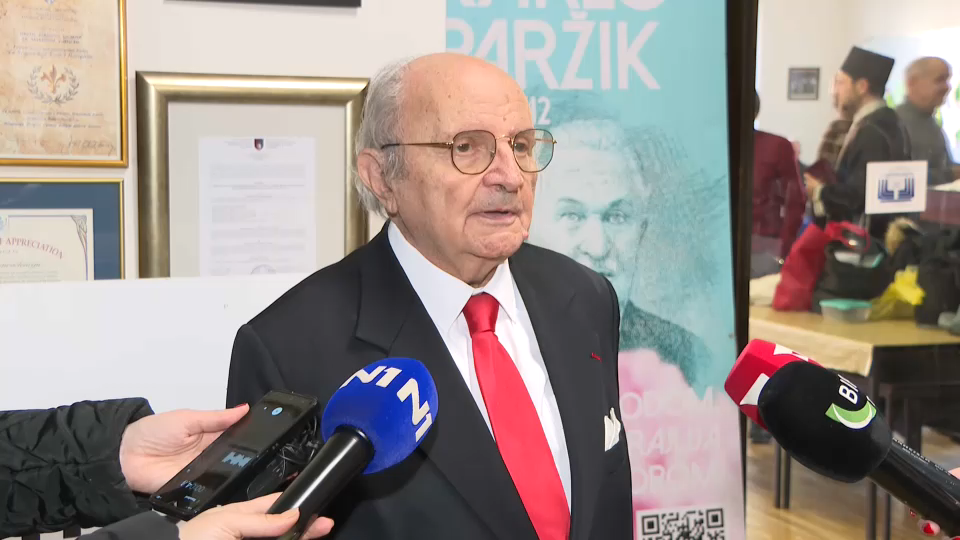
In the heart of Bosnia and Herzegovina, the Jewish Community in Sarajevo held a commemorative academy to honour those lost and to reflect on the deep historical scars left on the local population.
The cruelty of history in Sarajevo
Jakob Finci, representing the Jewish Community in BiH, emphasized the profound impact of the Holocaust on the region. He noted that while Jews have resided in Sarajevo since 1565, the events of 1941 were catastrophic. Of the 12,000 Jews living in the city at the start of the war, 9,500 were killed.
"This is a sufficient number to prove and show how cruel the Holocaust was and how it spared no one," Finci stated. However, he also highlighted the spirit of coexistence that has defined the city for nearly 500 years. He pointed to the "Righteous Among the Nations," a title bestowed upon non-Jews who risked their lives to save Jews during the war. Currently, over 50 individuals from Bosnia and Herzegovina hold this title, and investigations continue to identify more.
A legacy of courage and the Sarajevo Haggadah
A central symbol of this shared history is the Sarajevo Haggadah. Finci recalled the bravery of Dervis Korkut, who in 1941 saved the priceless manuscript from Nazi destruction. "It is still in Sarajevo today and will remain here forever, as it took its name from Sarajevo," Finci said. He stressed that the Holocaust must serve as a permanent educational lesson to ensure such tragedies, whether based on national, religious, or ethnic grounds, never recur. The community is currently working with the Ministry of Education and Culture to integrate Holocaust studies into the curriculum.
Moving out of the "Long Shadow"
Rahela Dzidic, a member of the Jewish Municipality in Sarajevo, described the city as a historical meeting point of cultures and traditions defined by tolerance. She noted that the Holocaust nearly erased centuries of Jewish contributions to trade, industry, and culture.
"The long shadow of the Holocaust has made our small community invisible," Dzidic remarked. She called for institutional support to ensure the Jewish community remains a "living community" rather than just a memory for the next 460 years.
The need for a central memorial
Igor Komezjakin spoke on the difficulty of the recovery process, noting that every Jewish individual in Sarajevo today is a direct descendant of survivors. He addressed the painful reality that local collaboration played a role in the genocide, a fact he described as essential for an honest culture of remembrance.
"Truth is most important if we want to preserve any culture of memory," Komezjakin said. He concluded by advocating for a central monument in Sarajevo dedicated to all victims of the Holocaust. "We do not have such a monument where we could go to bow to all victims, without emphasizing one over another, because every victim is equal and every pain is painful."
Kakvo je tvoje mišljenje o ovome?
Učestvuj u diskusiji ili pročitaj komentare


Kakvo je tvoje mišljenje o ovome?
Učestvuj u diskusiji ili pročitaj komentare