

 Srbija
 Hrvatska
 Slovenija


A great tragedy struck the village of Hodzici near Doboj on Saturday, when 19-year-old Mehmed Hasanamidzic lost his life. According to the Doboj Police Department, the young man was killed by an anti-personnel mine while trying to bring back goats that had strayed into a marked minefield.
“He was everything to me. He was hardworking. We struggled together just to put bread on the table. He went up to watch the goats, which often wander into minefields. He tried to bring them back. And then something exploded. They told me, ‘Your Meho is gone. He was blown apart.’ If only he had at least survived as an invalid, so I could still look at him,” said his mother, Ferida Hasanamidzic, through tears in a statement to Avaz.
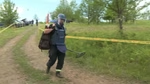
Hodzici is one of the first villages where families returned after the war in Bosnia, located directly on the entity boundary line. That line literally cuts through homes, and landmines are a part of daily life for the locals.
“We live on no man’s land, mined land. The fact that we ourselves don’t know whether we belong to the Federation of Bosnia and Herzegovina or Republika Srpska is not such a big problem. The real problem comes when someone wants to open a shop or something similar – then we get stuck in endless bureaucratic tangles,” residents said.
Since 2000, several people have been killed in Hodzici, and many injured in landmine explosions. Some areas have been cleared, but mines still remain.
Over time, locals became resistant to fear. Some even dug mines out of the ground and deactivated them themselves, fully aware they were risking their lives.
“We can’t wait for them to come and clear it for us. What else can we do, we have to do it ourselves,” Mehmed’s father, Mihret, said about ten years ago. He had then lost a leg to a mine, but claimed to have personally dug up and deactivated nearly a hundred more.
His neighbor Salih lost his wife in a mine explosion and was badly wounded himself. He was left alone with a daughter and no means to survive, convinced that “the mines won’t be cleared until they kill us all.”
One of the most horrifying sights in the village was a children’s playground surrounded by mines. Children played basketball and football on the concrete, while just a few meters away stood red warning signs with a skull and crossbones. “We’re always afraid when they go to the playground – one stray ball is enough,” parents said.
Hodzici is not an isolated case. A similar situation exists in the local community of Stanica River, between Doboj Istok and Doboj. Several hamlets lie directly on the entity boundary, and locals call it “No Man’s Land.”
Even 20 years after the war, entity civil protection services had only just begun working together on demining.
Sheep still graze there today, under constant risk.
Data from BHMAC (Bosnia and Herzegovina Mine Action Center) for 2025 shows the scope of the tragedy in the country:
More than 820 km² of land – about 1.6% of Bosnia’s territory – remains contaminated by mines.
Of the original 4,180 km², about 3,360 km² has been cleared.
An estimated 180,000 mines and unexploded ordnance remain.
1,398 communities and about 264,000 households live near mine-suspected areas.
Between 1996 and 2023, there were 1,832 mine victims: 558 killed and 1,274 injured.
Although there is a plan to clear 75 km² annually until 2027, the pace is far too slow. Bosnia remains the most mine-contaminated country in Europe, and among the top ten in the world.
Kakvo je tvoje mišljenje o ovome?
Učestvuj u diskusiji ili pročitaj komentare


Kakvo je tvoje mišljenje o ovome?
Učestvuj u diskusiji ili pročitaj komentare