


 Srbija
 Hrvatska
 Slovenija

Williamson before the Helsinki Commission: Brcko as a key U.S. mechanism for preserving Dayton and BiH’s stability


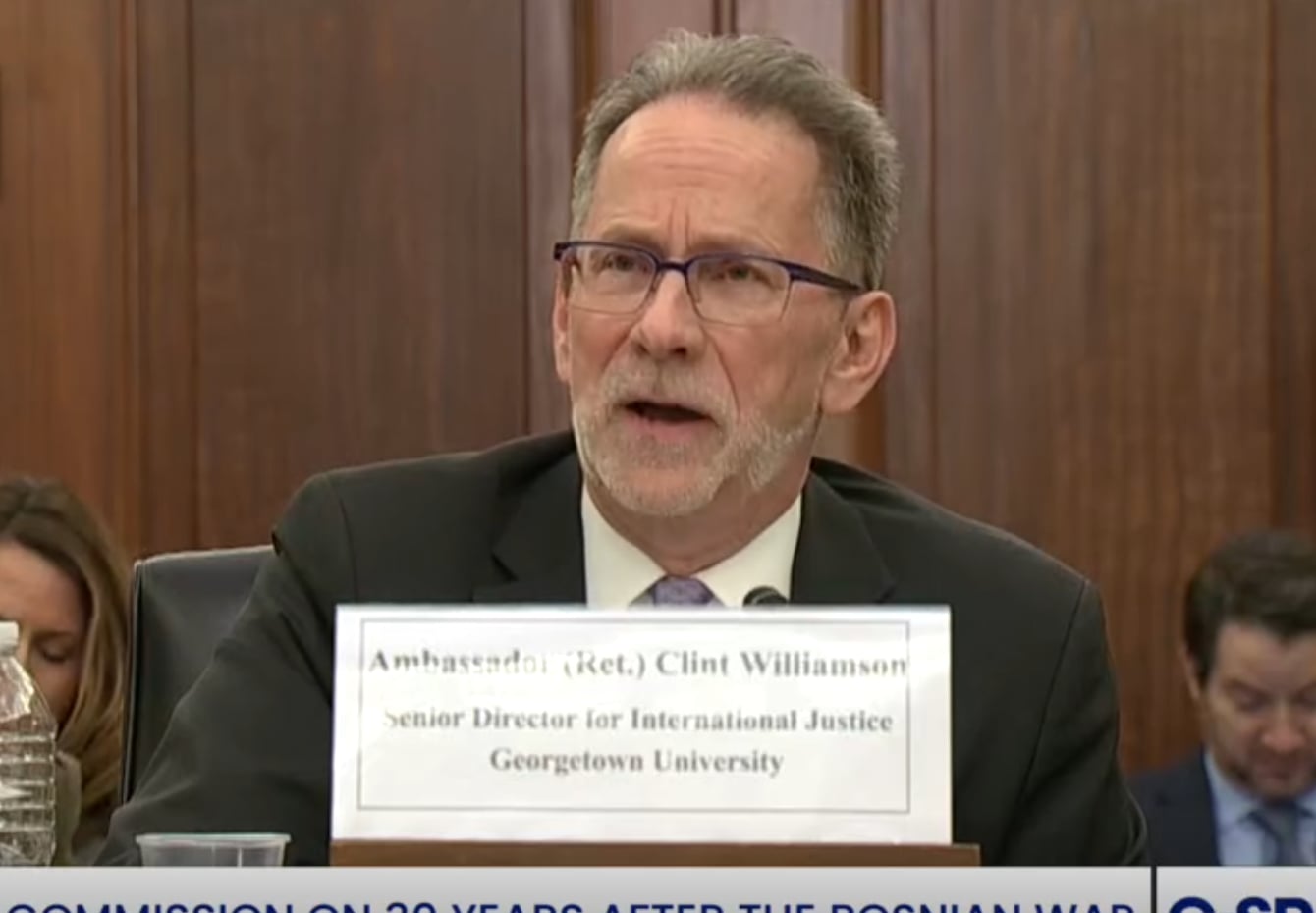
Thirty years after the end of the war in Bosnia and Herzegovina and the signing of the Dayton Peace Agreement, the Brčko District remains one of the central pillars of peace, territorial integrity, and the country’s multiethnic character. That was one of the key messages delivered by Clint Williamson, Presiding Arbitrator of the Brčko Arbitration Tribunal, during a hearing before the U.S. Helsinki Commission (the Commission on Security and Cooperation in Europe), which examined Bosnia and Herzegovina’s relationship with Europe, Russia, and the United States.
Williamson recalled that the Brčko arbitration emerged at the very end of the Dayton negotiations, at a moment when the entire peace process was at risk of collapse.
“As we mark the 30th anniversary of the Dayton Accords, I would like to focus my remarks today on this Brčko arbitration regime, which serves as an important Dayton enforcement mechanism.”
As he explained, the parties in Dayton had broadly agreed on the territorial division between Republika Srpska and the Federation of Bosnia and Herzegovina, but failed to reach agreement on Brčko’s status because of its strategic importance.
“This arbitration came about due to an impasse that arose in the late stages of the Dayton negotiations, when the parties had broadly agreed on a division of territory between Republika Srpska, the RS, and the Bosniak Croat Federation, but could not agree on a resolution of the status of Brčko due to its strategic location.”
According to Williamson, it was then–Serbian President Slobodan Milošević who proposed the solution that prevented the talks from unraveling.
“This impasse, which threatened to derail the entire process, was broken when President Milosevic suggested to Secretary Christopher that he would be willing to submit the issue for international arbitration.”
Under Annex II of the Dayton Agreement, an arbitral tribunal was established, composed of one arbitrator from Republika Srpska and one from the Federation, along with an international presiding arbitrator.
“Anticipating a likely stalemate between the two nationals, the presiding arbiter was empowered to make unilateral decisions on behalf of the tribunal, and when the final award was issued in 1999, he ended up doing just that.”
In the final decision issued in 1999, Brčko was not awarded to either entity.
“Owen ruled that a newly created Brčko District would not be awarded to either entity, but rather would be held in condominium between the two, would enjoy significant vestiges of self-government akin to those of the two entities, and it forbade the entities from any interference in the District's affairs.”
A crucial element of the ruling was the creation of a strong supervisory mechanism.
“Owen mandated the appointment of a Brčko supervisor to oversee implementation of the award. This official has always been a U.S. diplomat, now dual-hatted as the principal deputy high representative.”
Williamson stressed that this effectively made Brčko’s status a long-term American responsibility.
“Thus, maintenance of Brčko's status has very much been an American project, with the two principal guarantors, the presiding arbiter and the supervisor, both being current or former U.S. diplomats.”
He also highlighted a powerful enforcement clause built into the award, which he described as a critical deterrent—particularly for Republika Srpska.
“If either entity breached the terms of the award in a significant fashion and thereby threatened the status or security of Brčko, the tribunal reserved the right to award Brčko to the exclusive control of the nonoffending entity.”
The consequences of losing Brčko, Williamson warned, would be existential for RS.
“The loss of Brčko would cut the entity in half and sever the land corridor between the more heavily populated western half of the RS and Serbia proper, an existential threat to the entity.”
According to Williamson, this framework allowed Brčko to develop into the most successful multiethnic community in Bosnia and Herzegovina.
“This approach has mitigated interference by the entities in Brčko and has allowed it to become the most successful multiethnic community in BiH.”
He noted that in Brčko, “its three ethnic groups live in close proximity to each other, its children attend the same schools, and its political leadership is comprised of representatives from all three communities who generally work well together,” adding that it is ultimately “an American success story.”
Turning to the broader political context, Williamson warned that Bosnia and Herzegovina continues to face serious internal and external pressures.
“BiH today continues to face challenges from those intent on undermining its viability as a unified state, manifested in its most extreme form by calls for secession and active efforts to cripple state-level institutions.”
He singled out the role of external actors in exacerbating instability.
“Some of them are abetted as well by malign actors such as Russia, which seek to foster instability in the region by weakening Bosnia.”
In closing, Williamson argued that without meaningful constitutional reform or unexpectedly rapid progress toward EU membership, international engagement in Bosnia and Herzegovina will remain essential.
“From the U.S. side, this would hopefully come in the form of continued support for the Office of the High Representative and the Brčko Tribunal, which serve as firewalls against the most egregious conduct by malevolent actors.”
The message from Washington, he concluded, was unequivocal.
“A breakup of BiH, likely combined with renewed armed conflict, would have an impact far beyond the country's borders and would serve only to benefit Russia or other adversaries.”
“So it is critical that we maintain strong support for the integrity of the state and state-level institutions.”
Kakvo je tvoje mišljenje o ovome?
Učestvuj u diskusiji ili pročitaj komentare


Kakvo je tvoje mišljenje o ovome?
Učestvuj u diskusiji ili pročitaj komentare
NAJČITANIJE

















Najnovije













ZDRAVLJE





LIFESTYLE