


 Srbija
 Hrvatska
 Slovenija


Bosnia and Herzegovina’s Ambassador to the United States, Sven Alkalaj, discussed the current political climate in Washington, the stance of President Donald Trump’s administration toward Bosnia, and ongoing lobbying efforts by Republika Srpska’s leader, Milorad Dodik. Speaking to N1, Alkalaj highlighted key challenges facing Bosnia’s foreign policy amid shifting US priorities.
Alkalaj stated that the new US administration has been highly active, implementing numerous policies within weeks. He noted that unlike Trump’s first term, when over 50,000 government positions remained unfilled for months, this administration has moved quickly. The recent suspension of arms deliveries to Ukraine following the tense meeting between Trump and Ukrainian President Volodymyr Zelenskyy was described as a major turning point. Additionally, economic measures, including tariff increases on imports from Canada, Mexico, and China, have already impacted financial markets.
Regarding US policy toward Bosnia, Alkalaj acknowledged uncertainty, explaining that the State Department has yet to fully staff positions dealing with the Western Balkans. While he has maintained contact with US Secretary of State Marco Rubio, he emphasized that Bosnia is not currently a priority for the new administration.
However, he hoped key diplomatic positions would be filled in the coming months.
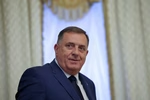
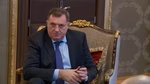
On the issue of Milorad Dodik’s lobbying efforts in Washington, Alkalaj was skeptical that the Republika Srpska leader could successfully lift US sanctions imposed against him. "Sanctions are easy to impose but very difficult to remove," he said, dismissing Dodik’s hopes as unrealistic despite his substantial lobbying efforts. However, Alkalaj acknowledged that Dodik’s influence campaign has contributed to shifting perceptions of Bosnia in Washington, which he believes the Bosnian government must take more seriously.
Alkalaj also criticized Bosnia’s lack of organized lobbying efforts, pointing out that while other regional countries, including Albania, Kosovo, Serbia, Slovenia, and Croatia, actively engage US lobbying firms, Bosnia has relied too much on sympathy from the past. "This administration is strictly business-oriented; there is no room for sentimentality," he warned, calling on Bosnia’s leadership to invest in professional lobbying.
Regarding the upcoming nomination of a US ambassador to Bosnia, Alkalaj confirmed that three candidates are under consideration. He expressed confidence that the next ambassador would be a career diplomat, which he believes is crucial to ensuring a balanced approach without excessive influence from diaspora groups with Serbian or Croatian ties.
Commenting on the latest political turmoil in Bosnia following the conviction of Milorad Dodik and the decisions of Republika Srpska’s National Assembly, Alkalaj warned of growing instability. "We are witnessing the erosion of the Dayton Agreement and the undermining of state institutions," he said, adding that his Embassy is closely monitoring developments and keeping the US State Department informed. He intends to meet with Secretary Rubio to discuss Bosnia’s concerns in more detail.
On the idea of "returning to the original Dayton Agreement," often cited by Dodik and his allies, Alkalaj dismissed it as a political slogan. "These are just phrases used by those unwilling to implement what was agreed upon and to support Bosnia’s development," he said, emphasizing that the priority should be EU integration and the adoption of necessary reforms.
When asked whether the recent conviction signals Dodik's political downfall, Alkalaj was cautious. "We don’t yet have a final verdict. Evil is not easily eradicated," he said.
However, he added that once a final ruling is in place, there will be legal grounds to demand its enforcement, which could significantly impact Dodik’s political career.
Reflecting on Bosnia’s progress since gaining independence, Alkalaj acknowledged some advancements but expressed disappointment over the country’s slow path toward NATO and EU membership. "We had momentum when we secured participation in NATO’s Membership Action Plan, but since then, we have regressed," he said.
He blamed Republika Srpska’s opposition to European integration, citing Russian and Serbian influence as key obstacles.
Alkalaj concluded by stressing the importance of Bosnia adopting the required legal reforms to advance toward EU membership, arguing that it would provide the country with much-needed political and economic strength on the international stage.
Kakvo je tvoje mišljenje o ovome?
Učestvuj u diskusiji ili pročitaj komentare


Kakvo je tvoje mišljenje o ovome?
Učestvuj u diskusiji ili pročitaj komentare
NAJČITANIJE











Najnovije





ZDRAVLJE




LIFESTYLE





SHOWBIZ