Srbija
 Hrvatska
 Slovenija

Bosnian FM urges international sanctions over Serbia's state honours at Mladic funeral


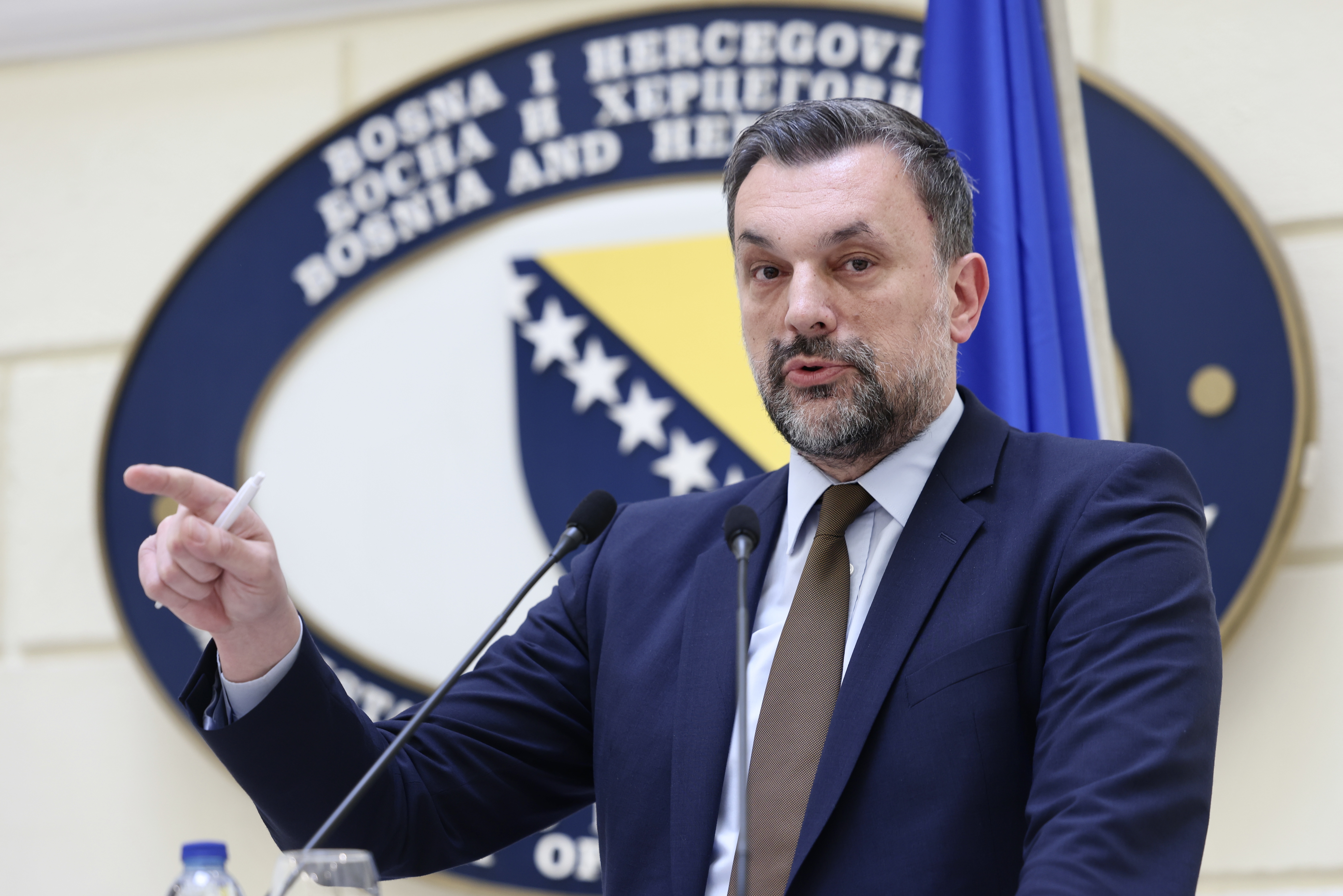
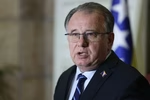
Bosnia and Herzegovina's Foreign Minister Elmedin Konakovic has called on the United States, European Union, United Kingdom and members of the Organisation of Islamic Cooperation (OIC) to impose sanctions on those responsible for the use of Serbian state and military resources during the funeral of convicted war criminal Ratko Mladic.
In a video message, Konakovic said Mladic's body was transported from The Hague on an official Serbian government aircraft, while police and military units provided security and ceremonial honours at the funeral.
Senior Serbian government officials and members of parliament attended the events, while members of the Serbian Armed Forces took part in the burial, which included an honour guard and a ceremonial gun salute, he said.
"This was not a spontaneous gathering of individuals paying tribute to a convicted war criminal. It was an institutional act of the state of Serbia," Konakovic said.
Konakovic points to Vucic's responsibility
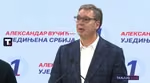
The Bosnian foreign minister said Serbian President Aleksandar Vucic bears responsibility for the military's involvement, citing Article 17 of Serbia's Law on the Armed Forces, under which the president decides on the use of the armed forces and commands them in peace and war.
Konakovic also pointed to Serbia's legislation on cooperation with the International Criminal Tribunal for the former Yugoslavia (ICTY), arguing that Serbia cannot commit itself to respecting the Tribunal's rulings while using state institutions and armed forces to honour a man convicted by that tribunal of genocide, crimes against humanity and war crimes.
"Serbia cannot, on the one hand, assume a legal obligation to respect and implement the judgments of the Hague Tribunal and, on the other, deploy state institutions and its armed forces to honour and glorify a man whom that very Tribunal convicted of genocide," he said.
Mladic was sentenced to life imprisonment for crimes committed during the 1992-1995 war in Bosnia and Herzegovina, including the Srebrenica genocide.
"Every shot was a shot at peace and stability"
Konakovic warned that the military honours transformed the funeral into what he described as a direct act of the Serbian state.
"Every shot fired in that salute was a shot at relations between Bosnia and Herzegovina and Serbia. A shot at European values. A shot at the principles of international justice established after the horrors of the 1990s. A shot at the dignity of victims and survivors of genocide and war crimes. And a shot at the peace and stability of the entire region," he said.
He argued that developments surrounding the funeral were particularly alarming for Bosnia and Herzegovina because of the country's experience during the 1990s, which culminated in the Srebrenica genocide and included crimes across the country.
Konakovic also stressed that stability in the Western Balkans is directly linked to wider European security.
He appealed in particular to the United States, citing Washington's role in the Dayton Peace Agreement and the international intervention that helped bring the Bosnian war to an end.
"During the war, we waited far too long for decisive international action against the Greater Serbia project and against the crimes associated with Milosevic, Karadzic and Mladic. This time, hesitation and prolonged waiting could create consequences far more dangerous than those we can prevent today," Konakovic said.
Call for sanctions
Konakovic also addressed OIC member states and countries that abstained from voting on the UN resolution on the Srebrenica genocide over concerns that it could impose collective responsibility on the Serbian people or create new tensions.
He stressed that Bosnia and Herzegovina had never attributed Mladic's crimes to an entire nation.
However, he accused Vucic and Serbian institutions, together with the political leadership of Bosnia's Republika Srpska entity, of doing precisely what they had accused others of doing by politically identifying themselves with Mladic.
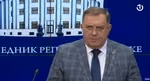
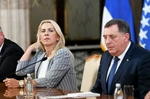
Konakovic cited the attendance of Bosnia's Presidency member Zeljka Cvijanovic, Milorad Dodik and other Republika Srpska officials at the funeral.
Concluding his message, Konakovic said international condemnations were no longer sufficient and called for concrete measures and sanctions.
"The time for words alone is over. This is the time for concrete measures," he said.
"Do it for the citizens of Bosnia and Herzegovina, who know better than anyone where the glorification of war criminals, aggressive nationalism and the silence of the international community can lead. Do it also for those in Serbia who have courageously rejected this legacy and refused to carry the burden of Ratko Mladic's crimes on their shoulders."
"History has already taught us what happens when the world sees the warning signs but chooses to wait. We cannot afford to learn that lesson twice. This time, act before it is too late," Konakovic concluded.
Mladic was buried in Serbia on September 7 in a funeral attended by numerous officials from Republika Srpska. The ceremony, which included military honours, prompted strong reactions.
The former Bosnian Serb military commander was sentenced to life imprisonment over crimes including the Srebrenica genocide, the persecution of Bosniaks and Croats across Bosnia and Herzegovina, the siege of Sarajevo and the taking of UN personnel hostage.
Kakvo je tvoje mišljenje o ovome?
Učestvuj u diskusiji ili pročitaj komentare


Kakvo je tvoje mišljenje o ovome?
Učestvuj u diskusiji ili pročitaj komentare