Srbija
 Hrvatska
 Slovenija

Ex-OHR advisor issues stark warning over Bosnia’s stability following nationalist election victory


Nationalist political parties remain the dominant force in Bosnia and Herzegovina following the recent general elections, raising questions over the potential resurgence of Serb secessionist ambitions and the risk of state fragmentation 31 years after the end of the war.
In an analysis published by Alexander Rhotert, former Chief of Cabinet and Special Advisor to High Representative Lord Paddy Ashdown, the expert noted that voters reaffirmed support for the three main ethnonationalist parties: the Bosniak Party of Democratic Action (SDA), the Croat Democratic Union of Bosnia and Herzegovina (HDZ BiH), and the Serb Alliance of Independent Social Democrats (SNSD). The HDZ BiH achieved a decisive victory by securing the election of its candidate, Darjana Filipovic, to the tripartite Presidency after two previous losses, a result met with widespread celebration in Mostar and Zagreb.
Although technical electoral reforms introduced by former High Representative Christian Schmidt effectively safeguarded the voting process against fraud, voter turnout dropped to an unprecedented low of 40 percent. The low participation reflects widespread public exhaustion, particularly among younger demographics who continue to emigrate in large numbers due to political stagnation, corruption, and cronyism impairing economic growth and administrative function.
The political outlook remains uncertain as power-sharing negotiations begin. Secessionist initiatives pursued by Milorad Dodik and his SNSD may gain momentum, particularly as the HDZ BiH has now fulfilled its primary objective regarding presidency representation.
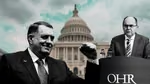
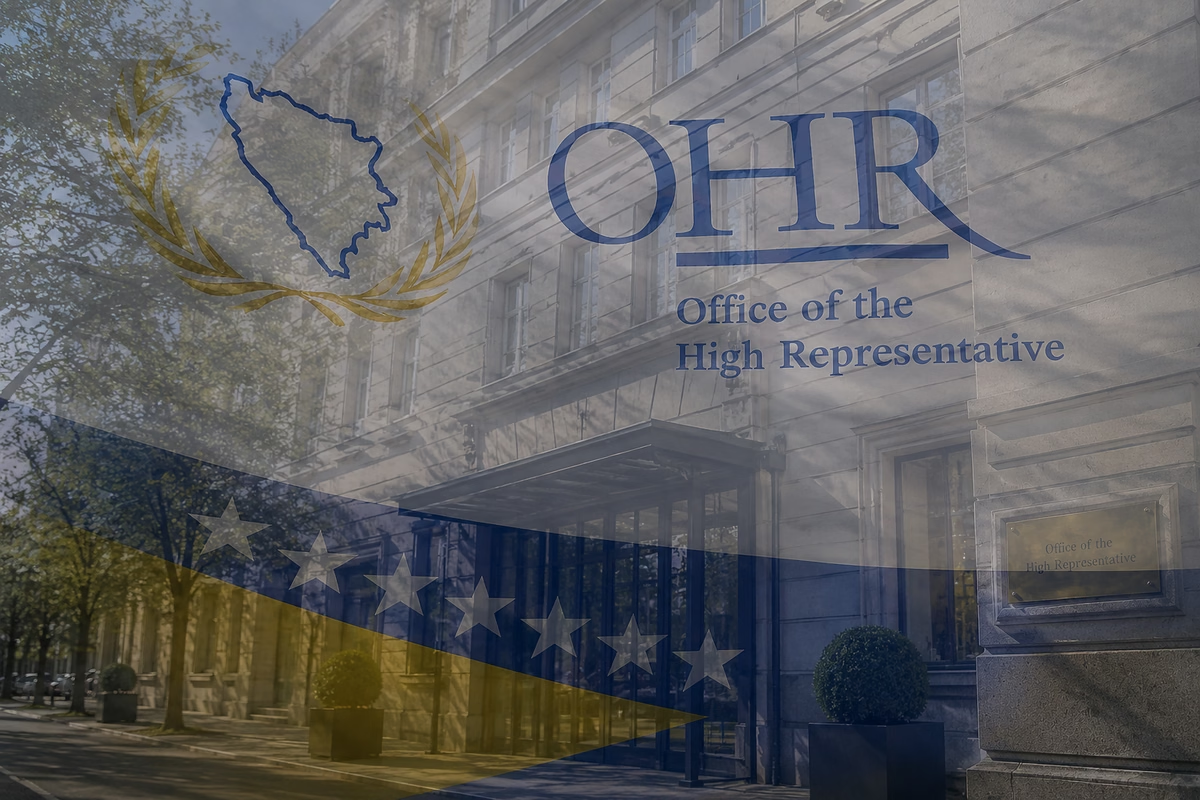
The political stability of the country faces heightened risks due to the vacancy in the Office of the High Representative (OHR) following Schmidt's departure in May. Rhotert, who also served as an Intercultural Operational Advisor (IEB) for the Bundeswehr on foreign deployments across Bosnia and Herzegovina, Kosovo, and Serbia, underscored that disagreements between the United States, the European Union, and the United Kingdom have prevented the appointment of a successor. Schmidt previously acted to counter secessionist moves regarding Republika Srpska, fulfilling the mandate to enforce the Peace Agreement and protect state integrity.
Rhotert warns that the absence of this diplomatic safeguard could trigger instability, as any unilateral secession effort would unlikely proceed peacefully and could create severe regional security crises on the EU’s borders. Should the mandate of the OHR conclude, the European Union maintains a strategic contingency through its military peacekeeping mission, EUFOR Operation Althea. Rhotert emphasizes that a significant reinforcement of the troop deployment, which currently stands at 2,000 personnel, should immediately be placed on the EU agenda to preserve security and regional stability.
Kakvo je tvoje mišljenje o ovome?
Učestvuj u diskusiji ili pročitaj komentare


Kakvo je tvoje mišljenje o ovome?
Učestvuj u diskusiji ili pročitaj komentare