

 Srbija
 Hrvatska
 Slovenija

Panel on Dayton Peace Agreement: OHR's 'original sin' was its unclear initial mandate


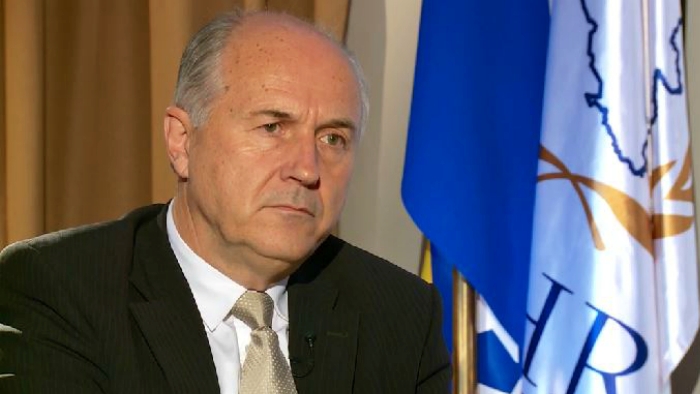
The Dayton Peace Agreement would be fully implemented today, and Bosnia and Herzegovina would be a stable country if the international community had shown the same resolve in implementing its civilian aspects as it did in enforcing the military provisions in 1996, two former diplomats have said.
Valentin Inzko, the longest-serving High Representative in BiH, holding the position for 12 years until 2021, and former German diplomat Michael Steiner, who served as the first deputy to High Representative Carl Bildt from January 1996 to July 1997, now say that the civilian and political aspects of the 1995 peace agreement lacked a clear mandate - unlike the military segment, which was led by NATO's Implementation Force (IFOR) consisting of 60,000 heavily armed troops under U.S. command.
"The generals told us clearly at the time: if anyone opposes us, we will shoot immediately. And everyone knew that. That's why there was no need to shoot," said Steiner, who returned to Sarajevo to participate in a panel marking the 30th anniversary of the Dayton Agreement at the History Fest.
As he recalled, the primary goal of the Dayton Agreement was to end the war. At the time, US President Bill Clinton, during his reelection campaign, did not want US soldiers returning home in body bags. As a result, IFOR was given a free hand to act decisively.
But when Steiner and Bildt arrived in Sarajevo in 1996, even before NATO troops, they not only lacked strong and clear powers - they did not even have an office.
"The big mistake and original sin of Dayton was treating civil and political issues as secondary," Steiner said, noting that he and Bildt were sent to BiH on an unclear mission to "monitor" the situation and "assist" in implementing the agreement. In this environment, they lacked the authority to even prevent the mass burning of homes around Sarajevo, when Radovan Karadzic and Momcilo Krajisnik effectively forced Serbs from the Sarajevo suburbs assigned to the Federation of BiH entity to leave and destroy their homes in the process.
Steiner made no secret of the frustration within the OHR at the time. The situation only changed in 1997 when the Peace Implementation Council (PIC) in Bonn granted the High Representative executive, or so-called "Bonn powers", enabling the imposition of decisions and dismissal of elected officials.
Steiner emphasised this move was necessary to correct another major mistake by the international community - allowing postwar elections as early as the autumn of 1996, instead of waiting at least three years until the situation had stabilised.
In those elections, the parties that had started and led the war won, meaning that essentially the same leaders were given a new term to govern. Steiner noted that these politicians convinced voters, traumatised and fearful after the war, that only they could protect them from "the others".
"The Bonn powers came absolutely too late," agreed Valentin Inzko, who joined the Sarajevo event via video link.
He reflected that even in Austria or Germany, a similar scenario could have occurred had elections been held right after World War II - Nazis could have won despite military defeat. Instead, in Austria's first postwar government, 80-90% of ministers and MPs were Dachau survivors. "Imagine if postwar BiH had been governed by its victims, not nationalist politicians," Inzko suggested, offering a hypothetical scenario.
Steiner, despite many disappointments, expressed pride that the OHR, even without a strong mandate, managed with OSCE support to prevent convicted war criminal Radovan Karadzic from running in the 1996 elections.
Still, he claimed that in Western capitals, he and Bildt were met with skepticism over this move, being asked whether it was truly democratic.
Later, other High Representatives like Paddy Ashdown made full use of the Bonn powers, but by then, much damage and stagnation had already set in. When Inzko took office in 2009, the international community's stance shifted drastically. He was no longer in a position to impose decisions or dismiss officials, as the prevailing belief was that domestic politicians should be allowed to resolve issues themselves. The result was 12 years of stagnation.
Inzko said he particularly regrets that the decision to remove international judges and prosecutors coincided with his arrival in BiH, even though, he said, they had done a "fantastic job" in gathering evidence on corruption tied to politics.
"That was a terrible mistake," said Inzko, adding that competent foreign legal professionals were clearly a major obstacle for local politicians.
He warned that since then, political parties have increasingly sought to place their own people into the judiciary, including the BiH Constitutional Court.
"They’re trying to turn every institution in BiH into a House of Peoples," said Inzko, referring to the abuse of numerous mechanisms designed to protect vital national interests.
Steiner and Inzko agree that it is currently impossible to dismantle the OHR without creating a dangerous imbalance in BiH.
They also had a message relevant in the context of the ongoing war in Ukraine.
Without the military shift on the ground in 1995 - NATO's intervention, the near-defeat of Bosnian Serb forces, and the weakening of Slobodan Milosevic - there would have been no chance for successful negotiations in Dayton.
"So much for the power of diplomacy," Steiner concluded.
Kakvo je tvoje mišljenje o ovome?
Učestvuj u diskusiji ili pročitaj komentare


Kakvo je tvoje mišljenje o ovome?
Učestvuj u diskusiji ili pročitaj komentare