

 Srbija
 Hrvatska
 Slovenija

Rosensaft comments as Warsaw speech prompts renewed discussion of Poland’s role in the Holocaust


Menachem Z. Rosensaft, a prominent lawyer, professor and former senior official of the World Jewish Congress, has expressed concern regarding comments made by US Ambassador to Poland Thomas Rose about Poland’s role during the Holocaust. His reaction followed a speech delivered by Ambassador Rose in Warsaw last month, in which Rose strongly rejected suggestions that Poles bore responsibility for the persecution and murder of Jews under Nazi occupation.
Rosensaft suggested that the ambassador’s statements may risk blurring the line between diplomatic reassurance and historical interpretation. Rosensaft has also been active in efforts to strengthen international awareness of the Srebrenica genocide and the imperative of remembrance. In January 2024, together with Grand Mufti Husein ef. Kavazovic, he launched and signed the Muslim–Jewish Peace and Remembrance Initiative in Srebrenica, aimed at strengthening global commitment to genocide remembrance, reconciliation and moral accountability.
The US ambassador’s speech was delivered on November 20, 2025, at an international conference on antisemitism organized by the International Association of Jewish Lawyers and Jurists (IAJLJ). Speaking before legal experts, diplomats and representatives of Jewish organizations, Rose firmly defended Poland from claims of wartime complicity.
He criticized those who blame Poles for the Holocaust, calling such accusations “a blood libel” against a nation that was itself a victim of the war. He added that these “historically false and morally scandalous” claims have long “poisoned relations between Jews and Poles.”
Rose, who is himself Jewish, also emphasized contemporary Poland’s treatment of Jews, declaring that “Poland today is the safest country in Europe for a Jew to walk the streets.”
He continued:
“For too long, this nation has been burdened with the moral stain that was never its own, the persistent belief that Poland shares guilt for the barbaric crimes committed against it.”
Calling such assertions unfounded, he added: “It’s a grotesque falsehood and the equivalent of a blood libel against the Polish people and Polish nation.”
In a response published by the Jewish Telegraphic Agency and on The Times of Israel, Rosensaft said such language represents a serious distortion of well-established historical facts.
“This is a distortion that cannot be allowed to go unchallenged or unrefuted. The reality is far more complex and far more nuanced than the simplistic and sanitized one-sided image put forward by Rose. While Poles and Poland did not perpetrate the Holocaust, those Poles who assisted the Germans in doing so must not be whitewashed out of history. I am not suggesting that Poland or the Polish people should be tarred or stigmatized by the Poles who took part in the persecution and murder of Jews during, and even after, the Holocaust. But neither should the nefarious roles of these Poles be glossed over or overlooked altogether: They are every bit as much a critically important part of the historical record as the Polish Righteous Among the Nations”, Rosensaft wrote.

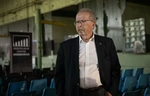
Rosensaft, whose parents were Polish Jews who survived Auschwitz, also cited the wartime recollections of his mother. He recalled her words: “Many Poles, however, were very happy about what was happening to the Jews.”
This statement, Rosensaft noted, is not a generalization about an entire nation but a reminder that such testimonies form an integral part of the collective memory of the Holocaust and must not be ignored.
Rabbi Shmuley Boteach, founder of the World Values Network, offered support for Ambassador Rose’s interpretation. He affirmed that Poland as a state did not participate in the Final Solution and described the country as Hitler’s victim, not his partner.
However, he also stressed that historical accuracy requires nuance, writing:
"What Rose got absolutely right is that the state of Poland and the Polish Nation did not choose, design or execute the Final Solution. Poland was Hitler’s first victim, not his partner. But to defend that truth credibly, we also have to acknowledge another truth: Some Poles, thousands of them, did participate in the destruction of their Jewish neighbors. Acknowledging that reality does not undermine Poland’s heroism. It strengthens it—because historical courage includes moral honesty."
Historical Context
Historians generally agree on several key facts about the Holocaust in Nazi-occupied Poland. Poland ceased to exist as a sovereign state after the German invasion in 1939, and the Polish government in exile did not collaborate with the Nazi regime. At the same time, Poland became the central location of the Nazi extermination system. The largest death camps, including Auschwitz-Birkenau, Treblinka, Sobibor and Majdanek, were built and operated by Nazi Germany on Polish territory.
Many Poles risked their lives to save Jews, and more than 7,200 have been recognized as Righteous Among the Nations. However, contemporary research also shows that some Poles took part in identifying, denouncing or killing their Jewish neighbors during the occupation. This dual reality, one of heroism on the one hand and collaboration on the other, shapes today’s debates about Poland’s wartime history.
Kakvo je tvoje mišljenje o ovome?
Učestvuj u diskusiji ili pročitaj komentare


Kakvo je tvoje mišljenje o ovome?
Učestvuj u diskusiji ili pročitaj komentare