Srbija
 Hrvatska
 Slovenija

Anniversary: 31 years since the Dayton Peace Agreement ended the war in Bosnia


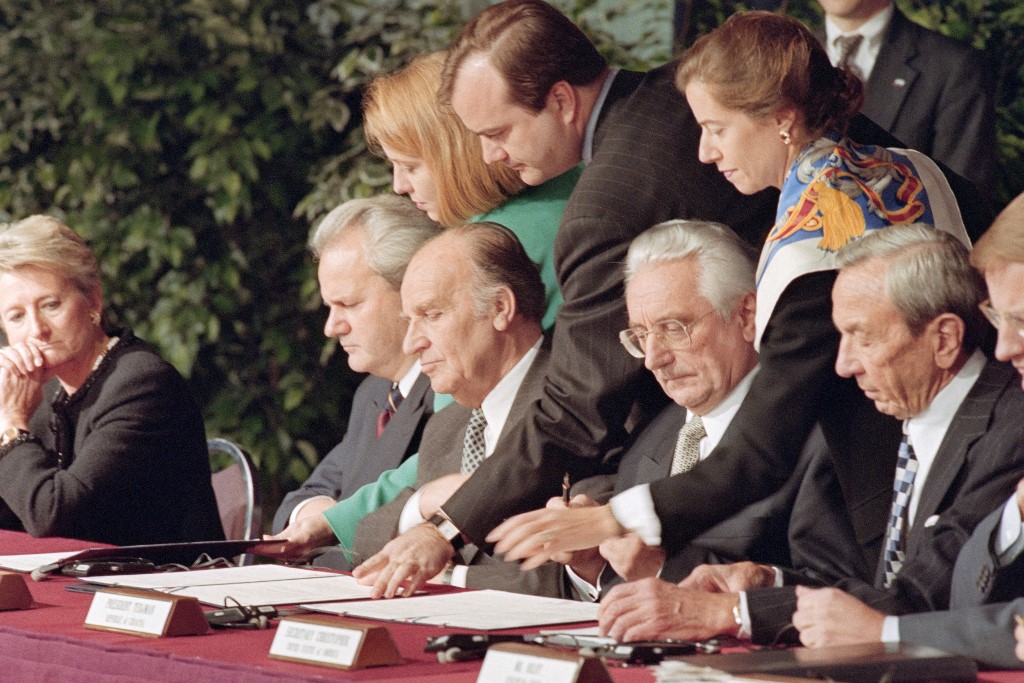
On this day, 21 November 1995, the General Framework Agreement for Peace in Bosnia and Herzegovina, along with its 12 annexes, was initialled at Wright-Patterson Air Force Base in Dayton, Ohio. The agreement brought an end to the war in Bosnia and Herzegovina, marking 31 years since its initialling today.
Following three weeks of negotiations, the Dayton Peace Agreement was initialled by the then-President of the Republic of Bosnia and Herzegovina Alija Izetbegovic, President of Serbia Slobodan Milosevic, and President of Croatia Franjo Tudjman. The initialling took place in the presence of then-US Secretary of State Warren Christopher, while key American mediators included Richard Holbrooke and General Wesley Clark.
Under the Dayton Peace Agreement, Bosnia and Herzegovina was organised as a state of three constituent peoples and others, comprising two entities: the Federation of Bosnia and Herzegovina and Republika Srpska, which are signatories to all annexes of the agreement. After being initialled in Dayton on 21 November, the accord was formally signed on 14 December 1995 at the Élysée Palace in Paris. In Republika Srpska, 21 November is observed as a public holiday and non-working day marking the establishment of the General Framework Agreement for Peace.
While the historical significance of the Dayton Agreement in halting the war remains unquestioned, 31 years later the central question is not only how the conflict was stopped, but how far society has moved beyond its political and social consequences.
For generations who survived the war, peace meant an end to killings, shelling, and destruction. For those born afterwards, peace also implies access to education, employment, freedom of movement, and living without constant invocations of new conflicts. Particular weight is lent to the anniversary by the experiences of people born in 1995, who neither participated in the negotiations, decided on the state's constitutional structure, nor chose the political system in which they grew up, yet finished school, sought work, and tried to build a future within that very system.
The wartime past remains an important part of Bosnia and Herzegovina's history and the remembrance of its victims. However, confronting the past is not the same as persistently reviving political threats of renewed war. Between the obligation not to forget crimes and the right of new generations to live without fear, Bosnia and Herzegovina has spent decades trying to find space for a normal life.
Kakvo je tvoje mišljenje o ovome?
Učestvuj u diskusiji ili pročitaj komentare


Kakvo je tvoje mišljenje o ovome?
Učestvuj u diskusiji ili pročitaj komentare