

 Srbija
 Hrvatska
 Slovenija


The appointment of Bosnia and Herzegovina's chief negotiator for EU accession talks has become the latest point of contention among political parties, turning a technical issue into a political dispute that underscores the country's deep political divisions.
The post has been vacant since March 2024, when the European Council conditionally approved the opening of accession talks with BiH, pending adoption of laws on courts and the High Judicial and Prosecutorial Council. Neither law has been passed, and even if they had, talks could not start without a negotiator or a negotiation team.
Council of Ministers Chair Borjana Kristo said this week she had prepared a proposal to appoint a chief negotiator with two deputies, and urged coalition partners to back it. Her announcement sparked new political friction.
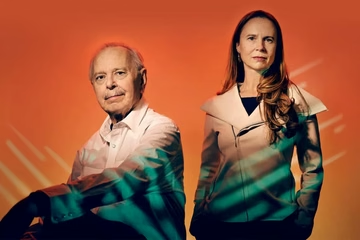
Coalition parties had earlier agreed the post should go to a candidate from the Serb entity of Republika Srpska, with media speculating that Ana Trisic Babic, a foreign policy adviser to Serb leader Milorad Dodik and former deputy foreign minister, was being considered. Dodik's chair of the House of Peoples, Nikola Spiric, called her "the best person for the job" but did not confirm her candidacy.
Foreign Minister Elmedin Konakovic dismissed Dodik's circle as "a Russian submarine destroying BiH's European path", adding: "A chief negotiator who consults with (Sergei) Lavrov and (Vladimir) Putin is not an option."
Predrag Kozul of the Croat HDZ BiH party criticised media speculation as an obstruction that only delays the start of EU entry talks.
The three Bosniak-civic parties said they had not been consulted and proposed that Parliament, rather than the Council of Ministers, appoint the negotiator. Their motion failed in the House of Representatives, after which Zeljko Komsic's opposition Democratic Front demanded the Presidency make the appointment, citing its constitutional authority over foreign policy, a view shared only by the DF and the Party of Democratic Action.
The dispute has arisen partly because no law defines how the chief negotiator should be chosen. Konakovic argued the appointment should rest with the Council of Ministers to ensure cooperation among all sides and prevent future blockages.
Kakvo je tvoje mišljenje o ovome?
Učestvuj u diskusiji ili pročitaj komentare


Kakvo je tvoje mišljenje o ovome?
Učestvuj u diskusiji ili pročitaj komentare