Srbija
 Hrvatska
 Slovenija

Bosnia after general election: National parties projected to win most seats


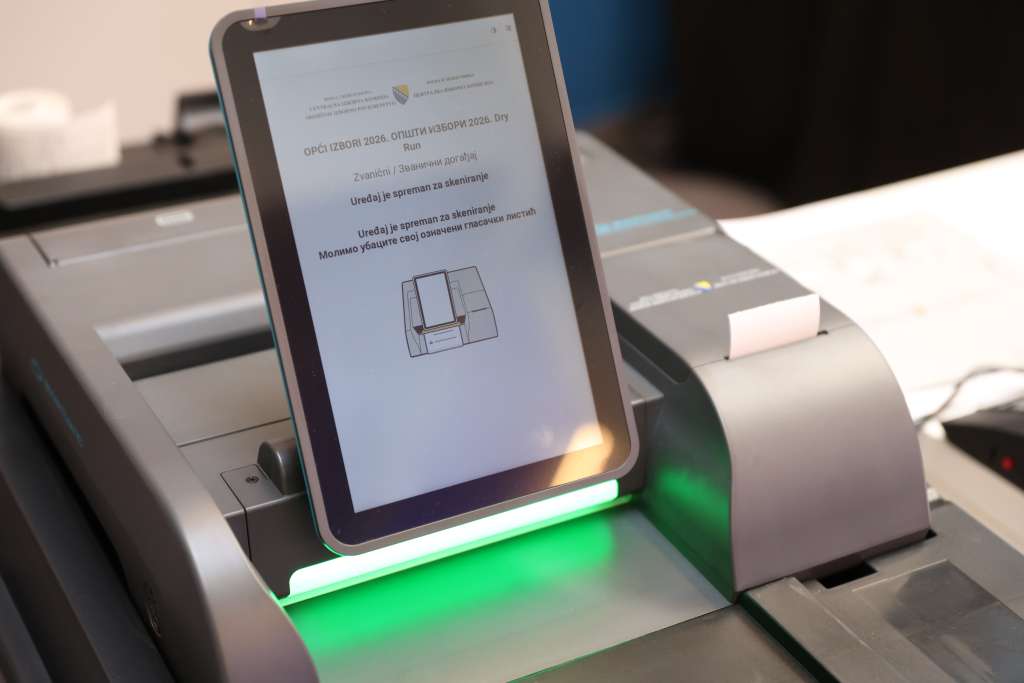
As Bosnia and Herzegovina's Central Election Commission continues to count the final results of Sunday's general election, projections indicate that a broad coalition of three national parties is likely to return to power at state level, while the parties are also set to form the backbone of governments in the two entities.
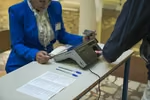
The Central Election Commission said on Tuesday that results had been established from almost 97% of polling stations, covering 1.385 million voters, of whom 95% cast valid ballots and about 60,000, or 4.4%, invalid ones.
The projections show the Party of Democratic Action (SDA) as the strongest party in the 42-seat House of Representatives of the state parliament, with nine seats, followed by Milorad Dodik's Alliance of Independent Social Democrats (SNSD) with six. The Social Democratic Party (SDP) has five seats, the Croatian Democratic Union of Bosnia and Herzegovina (HDZ BiH) four, while the Party for Bosnia and Herzegovina (SBiH), Zeljko Komsic's Democratic Front (DF) and Banja Luka Mayor Drasko Stanivukovic's Safe Srpska Movement (PSS) have two each.
The new state-level government will need a majority, with HDZ BiH and SNSD unavoidable partners and SDA needing additional support from Federation-based parties. SBiH appears the most straightforward option, but another seat would still be needed.
Theoretically, SDP could also enter the coalition-building process and try to put together a diverse Federation-based coalition, which would require at least five parties and appears less likely.
The eventual balance of power will also depend on the composition of the House of Peoples, which has yet to be elected. Any party controlling three of the five seats in each of its three ethnic caucuses would be an indispensable government partner because it would control the quorum needed for laws to take effect.
Entity parliaments
In the Federation parliament's 98-seat House of Representatives, SDA is projected to win 32 seats, SDP 16, HDZ BiH and its partners 14, and SBiH nine. Elmedin Konakovic's People and Justice (NiP) is projected to win seven and DF six, with smaller parties taking one to four seats each.
SDA and HDZ BiH, together with SBiH, would have a comfortable majority, while replacing SDA with SDP would require a more complex multi-party coalition. Much will also depend on the Federation House of Peoples, which comprises 23-member Bosniak, Croat and Serb caucuses and an 11-member Others caucus.
In Republika Srpska, Dodik faces a much easier task. His SNSD is projected to have won 34 of the parliament's 83 seats and can count on 14 seats held by its current coalition partners, giving him a stable majority.
The Central Election Commission is expected to publish the final official election results by early November, after which deadlines for forming the new authorities will begin. The first institution to be constituted will be the state Presidency, within 15 days of the final results. The new Presidency, comprising Darijana Filipovic, Denis Becirovic and SNSD's Zeljka Cvijanovic, is therefore expected to begin functioning in mid-November.
Under the established ethnic rotation system, Cvijanovic is to become the first chair of the new Presidency, to be replaced by Filipovic after eight months.
Kakvo je tvoje mišljenje o ovome?
Učestvuj u diskusiji ili pročitaj komentare


Kakvo je tvoje mišljenje o ovome?
Učestvuj u diskusiji ili pročitaj komentare