Srbija
 Hrvatska
 Slovenija

Bosnia general elections: Preliminary results signal shift in political power dynamics


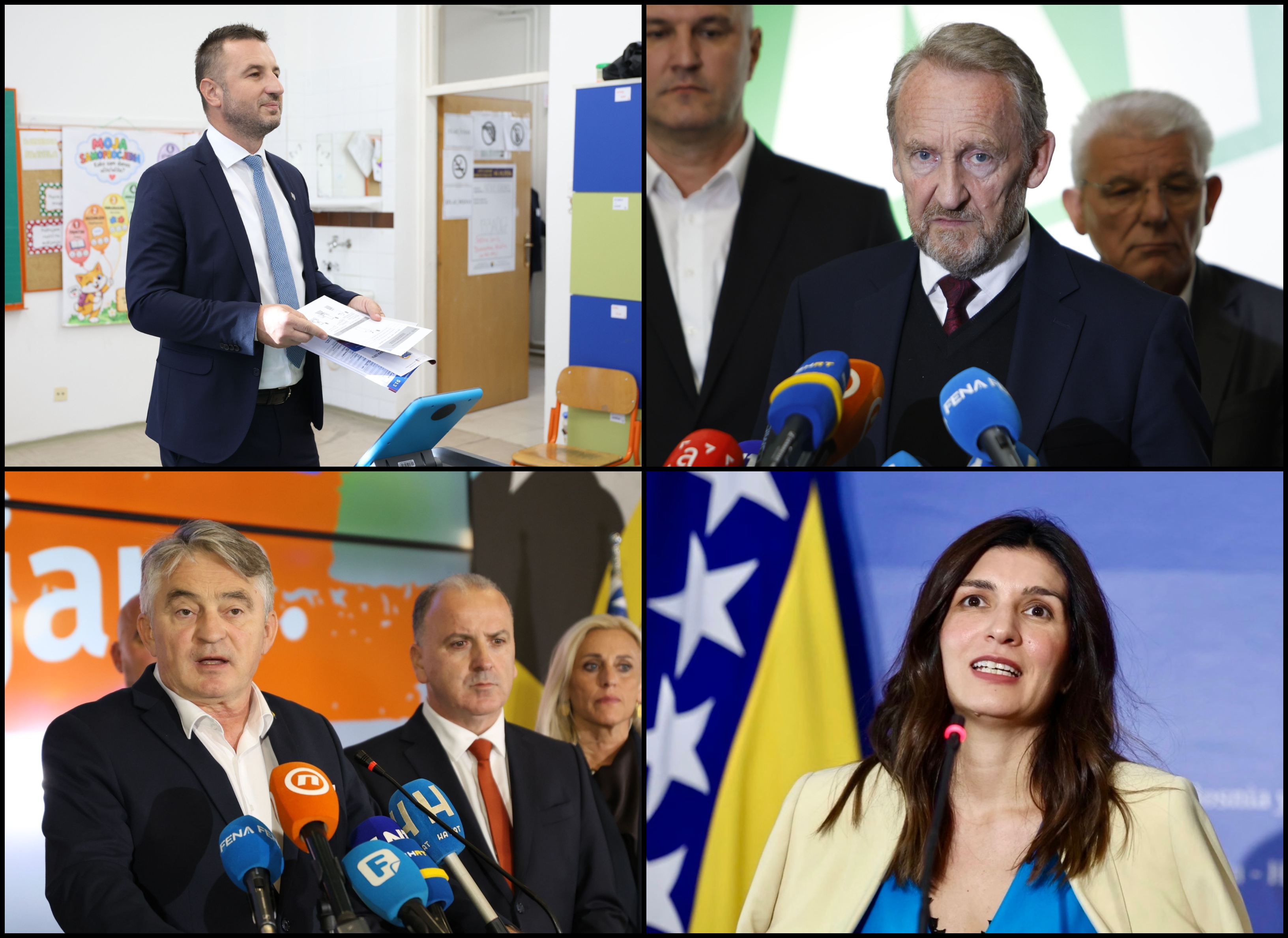
The day following the general elections in Bosnia and Herzegovina, the contours of a new distribution of political power across the country are becoming increasingly clear. Although the Central Election Commission of Bosnia and Herzegovina (CIK) continues to publish preliminary results and the final allocation of parliamentary mandates remains forthcoming, data processed so far indicates significant shifts compared to the previous election cycle.
According to preliminary findings, the Party for Bosnia and Herzegovina (SBiH) has achieved a notable breakthrough, whilst the Party of Democratic Action (SDA) has strengthened its overall standing. Conversely, the Democratic Front (DF) and Our Party (Nasa stranka) are among the political entities recording weaker performances. In Republika Srpska, the Alliance of Independent Social Democrats (SNSD) has retained its leading position.
Initial preliminary data released by the CIK on election night covered approximately 80 percent of processed polling stations. Counting has since advanced considerably, meaning vote totals and seat projections remain subject to change, particularly once all vote categories are fully integrated.
Breakthrough for Party for Bosnia and Herzegovina
One of the standout outcomes is the performance of the Party for Bosnia and Herzegovina and its president, Semir Efendic. Running for the Bosniak member of the Presidency of Bosnia and Herzegovina, Efendic secured a substantial number of votes, positioning him third behind Denis Becirovic and Bakir Izetbegovic.
Simultaneously, SBiH has recorded growth across other levels of government. Efendic stated to N1 that preliminary CIK data indicated approximately 66,000 votes for the state parliament, highlighting exceptional results in the Sarajevo Canton. He noted that the party expects to achieve parliamentary status in most cantons, securing over 30,000 votes and eight seats in Sarajevo Canton, alongside an estimated three mandates in the state parliament. If confirmed, three representatives in the House of Representatives of the Parliamentary Assembly of Bosnia and Herzegovina would mark a major advance over the 2022 mandate, in which SBiH held no seats in this chamber.
SDA strengthens presence despite personal setback for Izetbegovic
The Party of Democratic Action has also shown gains. SDA President Bakir Izetbegovic remarked following the vote that his party improved its performance by approximately 25 percent across various government tiers compared to the previous cycle. However, Izetbegovic acknowledged that his personal score in the race for the Bosniak Presidency seat lagged behind the party’s overall result, stating that the party proved more successful than his individual candidacy. Preliminary returns further confirm strong SDA positions in key cantonal assembly contests.
HDZ BiH maintains dominance as Filipovic leads race
The Croat Democratic Union of Bosnia and Herzegovina (HDZ BiH) continues to demonstrate robust support. Candidate Darijana Filipovic, currently serving as Vice President of HDZ BiH and a representative in the national House of Representatives, currently leads the race for the Croat member of the Presidency of Bosnia and Herzegovina. The party also maintains strong standings across cantonal levels.
Electoral losses for DF and Nasa Stranka
Preliminary figures indicate a noticeable decline for the Democratic Front (DF). Losing state-level representation would mark a major shift from 2022, when the coalition list held three seats in the national House of Representatives through Zlatan Begic, Vlatko Glavas, and Milan Dunovic. Meanwhile, outgoing Presidency member Zeljko Komsic concludes his tenure, having served four full terms across the periods 2006–2014 and 2018–2026.
Nasa stranka is similarly projecting a reduced presence. Currently holding two national seats held by Sabina Cudic and Predrag Kojovic, preliminary projections suggest the party may be reduced to a single mandate. Party President Sabina Cudic publicly acknowledged that performance fell short of expectations and accepted responsibility for the outcome.
SNSD retains lead in Republika Srpska
In Republika Srpska, SNSD maintains its status as the dominant political force. Candidate Zeljka Cvijanovic currently leads the vote count for the Serb member of the Presidency, with the party showing solid results across legislative levels. The final distribution of seats within the National Assembly of Republika Srpska and the state parliament will clarify the ultimate balance between SNSD and opposition parties once counting concludes.
Kakvo je tvoje mišljenje o ovome?
Učestvuj u diskusiji ili pročitaj komentare


Kakvo je tvoje mišljenje o ovome?
Učestvuj u diskusiji ili pročitaj komentare