Srbija
 Hrvatska
 Slovenija

Carl Bildt warns of growing risks to stability in Bosnia and the Balkans


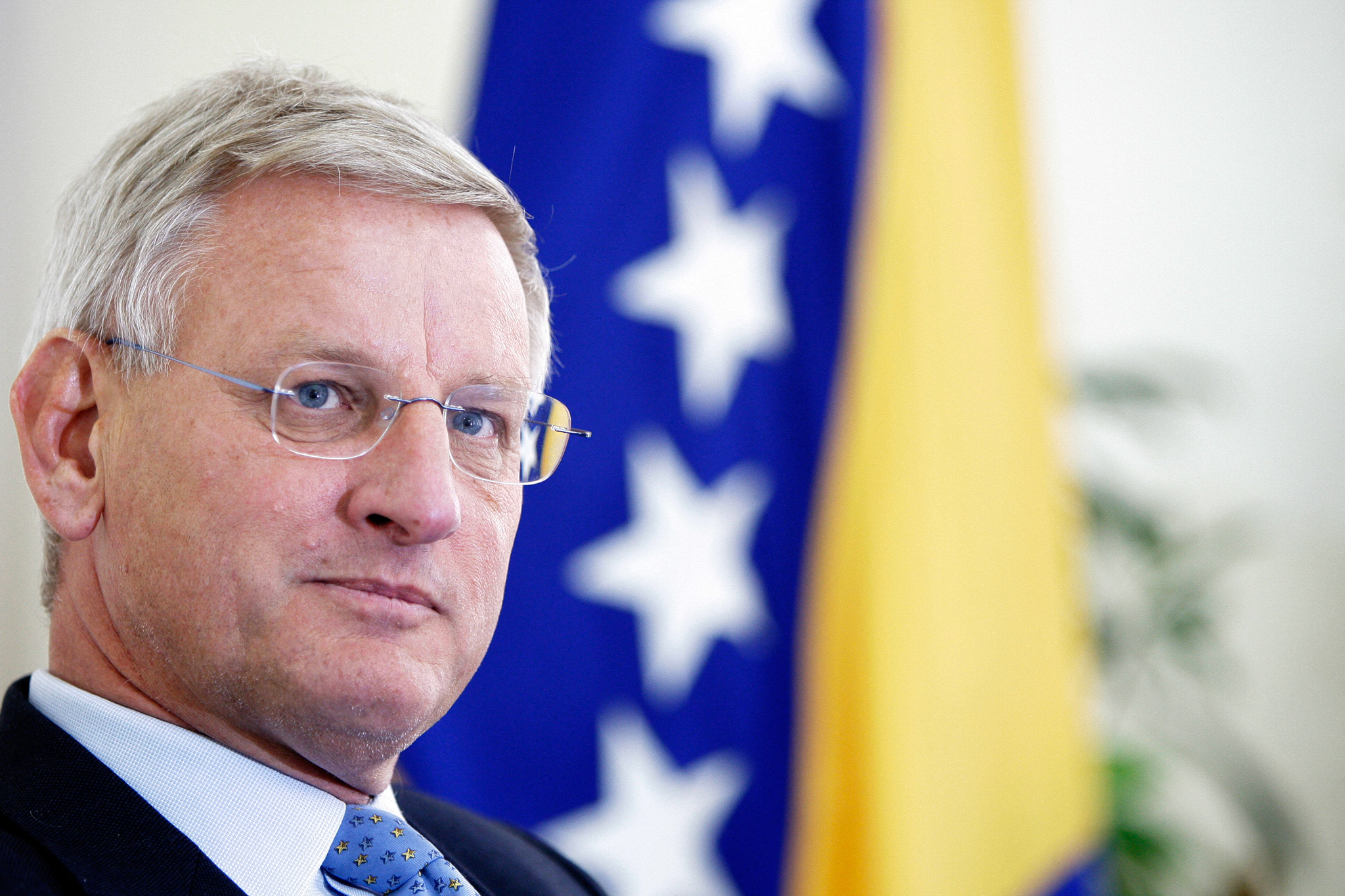
Former High Representative to Bosnia and Herzegovina Carl Bildt has warned that a combination of rising nationalist tensions, political uncertainty and weakening international engagement could push Bosnia and the wider Western Balkans towards greater instability.
In a commentary titled “Alarm Bells in the Balkans”, published by Project Syndicate, Bildt argued that several developments across Bosnia, Serbia and Kosovo may become particularly dangerous if they begin to reinforce one another.
Bildt, a former Swedish prime minister and foreign minister who served as the first High Representative to Bosnia and Herzegovina following the Dayton Peace Agreement, pointed to the recent funeral in Belgrade of convicted war criminal Ratko Mladic as one sign of renewed tensions.
He argued that the event had reopened wartime traumas and contributed to deteriorating relations between Bosnia and Serbia.
Warning over Bosnia's elections
Bildt devoted particular attention to Bosnia and Herzegovina and its October elections.
He raised the possibility that, depending on the election results, hardline Bosnian Serb and Bosnian Croat political forces could seek changes to the country's governance arrangements.
Such moves, he argued, could provoke a strong response among Bosniaks and increase the risk of what he described as a “downward spiral” capable of seriously destabilising the country.
Bildt also argued that the international environment surrounding Bosnia has changed.
While Washington and European governments were previously broadly aligned in their approach to Bosnia's post-war political order, he said the administration of US President Donald Trump had shifted its focus towards economic interests and away from active involvement in the country's political disputes.
He cited US support for a proposed gas pipeline connecting Bosnia with Croatia as an example. While acknowledging that diversifying Bosnia's gas supplies away from Russia would make strategic sense, Bildt questioned the business interests surrounding the project and companies linked to it.
Wider regional concerns
Bildt placed developments in Bosnia within a broader picture of political uncertainty across the Western Balkans.
In Serbia, he pointed to mass student protests and the emergence of an opposition movement ahead of elections, warning that a disputed outcome could fuel further instability.
He also highlighted continuing tensions in Kosovo, including the stalled dialogue with Serbia, disputes surrounding the divided city of Mitrovica and political fallout from the recent conviction of former Kosovo president Hashim Thaci by the Kosovo Specialist Chambers.
Bildt stressed that none of these developments would necessarily be destabilising on its own. Taken together, however, he said they could produce a “critical mass” of nationalist sentiment across the region.
EU integration losing its influence
Bildt also questioned whether two of the main instruments used by the international community to promote long-term stability in the Balkans – European integration and international justice – have produced the results once expected of them.
With the exception of Montenegro and potentially Albania, he argued, EU integration has largely stalled and has lost much of its ability to encourage political change.
He was similarly critical of the length of international war crimes proceedings in The Hague, arguing that cases prolonged over decades have done little to promote reconciliation and may in some circumstances have had the opposite effect.
Despite his warnings, Bildt stopped short of predicting another major conflict in the Balkans.
“This doesn’t mean we are heading toward a new round of Balkan wars,” he wrote.
However, he cautioned that even limited clashes could place the region on a more dangerous trajectory, particularly at a time when Washington is less engaged in Balkan political affairs and the European Union is preoccupied with Russia's war and broader security challenges.
Bildt concluded by urging European political leaders to take the signs of regional instability seriously.
Kakvo je tvoje mišljenje o ovome?
Učestvuj u diskusiji ili pročitaj komentare


Kakvo je tvoje mišljenje o ovome?
Učestvuj u diskusiji ili pročitaj komentare