

 Srbija
 Hrvatska
 Slovenija

Fmr US war crimes ambassador in Potocari: Justice was served, but denial persists


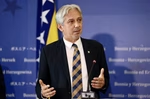
Speaking from the Srebrenica Memorial Centre in Potocari, former US Ambassador-at-Large for War Crimes Issues Stephen J. Rapp reflected on the long road to justice following the 1995 genocide, and the ongoing challenge of denial.
“We went after Ratko Mladic, who led the genocide. We brought him to justice, and he was convicted. Karadzic was also convicted, and Milosevic stood trial, though he did not live to see the verdict,” Rapp told N1.
He emphasised that it was the judicial processes that revealed the truth and secured convictions of the highest-ranking political and military leaders involved. However, he acknowledged that despite these achievements, genocide denial remains a major obstacle.
“There were several important verdicts at the Court of Bosnia and Herzegovina. We’ve seen justice, but we’ve also seen denial. Just yesterday, an important conference was held here at the Memorial Centre,” he said.
Rapp recalled visiting Potocari ten years ago with former US President Bill Clinton, highlighting the role the United States played during and after the war.
“The US intervened and supported action against the aggressors. We participated in the 2001 donor conference in Belgrade after Milosevic was extradited to The Hague. It’s true that, in some situations, the US was slow to act. We didn’t always get it right at first, but we would eventually do the right thing.”
Appointed by President Barack Obama, Rapp was instrumental in numerous justice initiatives, including supporting the establishment of the War Crimes Chamber within the Court of Bosnia and Herzegovina.
“Justice takes time. It’s a process. The U.S. continues to issue licenses and facilitate cooperation with courts, including support for the International Court of Justice.”
Rapp also addressed the controversial decision by former President Donald Trump to sanction the International Criminal Court over proceedings involving Israeli Prime Minister Benjamin Netanyahu.
“A court or its judges cannot be sanctioned. But the US often grapples with competing priorities, constantly balancing politics with the principles of international law,” Rapp concluded.
In Potocari, a funeral prayer will be held on Friday for seven more genocide victims, whose remains were identified and will now be laid to rest with dignity. Among those buried are two young men, Avdic Senajid and Mujic Hariz, both born in 1976 and just 19 years old at the time of their murder. Their remains were discovered in mass graves that had been relocated in an attempt to hide evidence of the crime.
Also buried today were Bektic Fata (1928), the oldest victim laid to rest this year, Omerovic Hasib (1961), Alic Sejdalija (1961), Gabeljic Rifet (1964), and Mujcic Amir (1964).
Kakvo je tvoje mišljenje o ovome?
Učestvuj u diskusiji ili pročitaj komentare


Kakvo je tvoje mišljenje o ovome?
Učestvuj u diskusiji ili pročitaj komentare