Srbija
 Hrvatska
 Slovenija

How Sarajevo’s German-language newspaper Bosnische Post chronicled imperial life and made journalism history


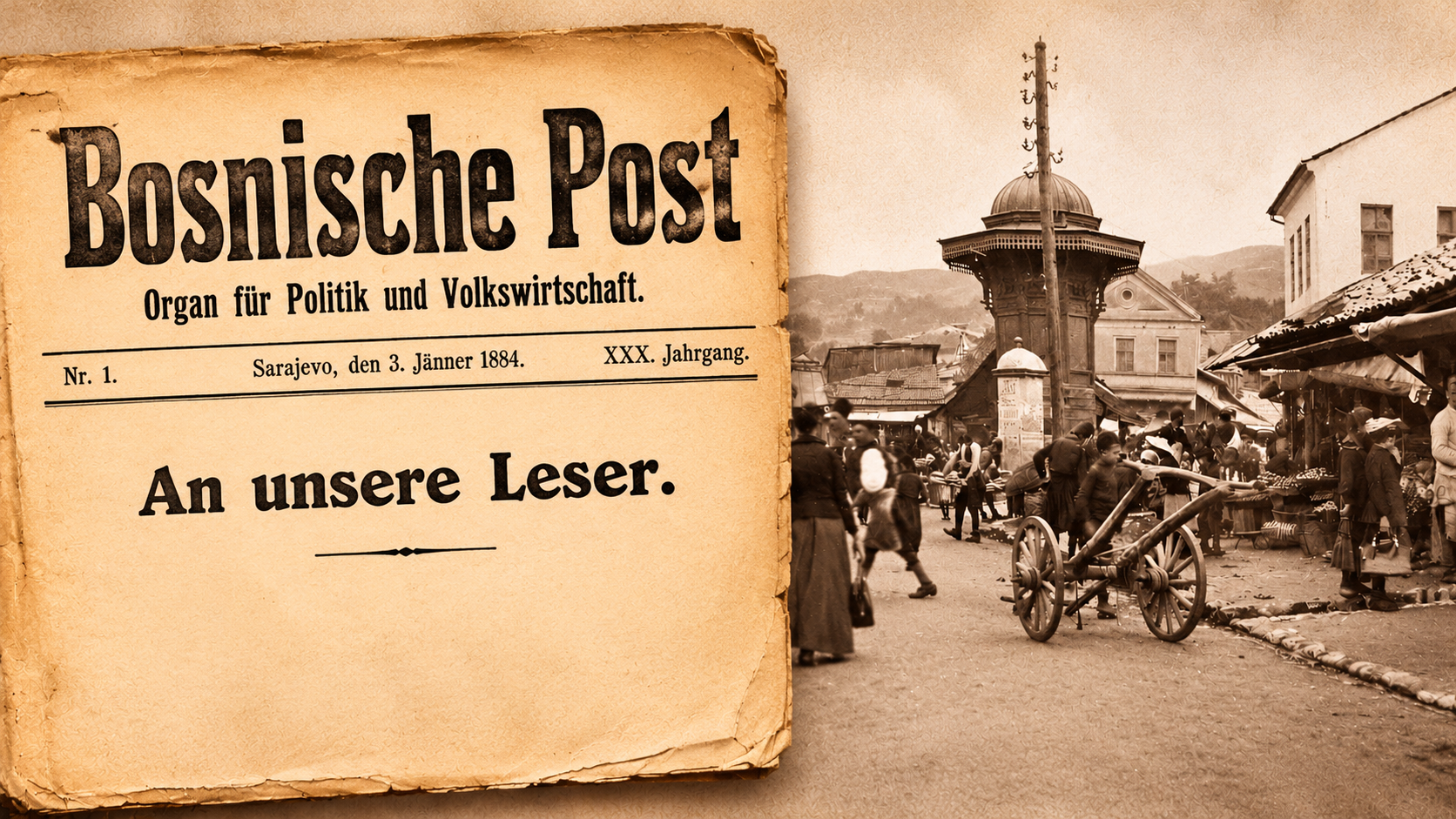
While Sarajevo underwent sweeping social and urban transformation in the late 19th century, readers on its streets could purchase a German-language newspaper named Bosnische Post (Bosnian Post), which ran for more than three decades and blended political reporting, stories from everyday Bosnian life, and advertisements for luxury goods from Vienna. Behind one of the most compelling chapters of its history stood a woman who pushed the boundaries of journalism in her era.
The first issue of Bosnische Post appeared in Sarajevo in 1884, just six years after Austria-Hungary assumed administration over Bosnia and Herzegovina. Published until 1918, the paper initially came out several times a week before becoming a daily newspaper in October 1896. Its history was examined in detail in historian Carl Bethke’s scholarly study, "The Bosnische Post: A Newspaper in Sarajevo, 1884–1903", published in 2019 by academic publisher Brill.
One of the publication’s most striking features was its advertising section. According to Bethke’s research, advertisements occupied more than half of the pages in certain editions. Merchants from Sarajevo and across the Austro-Hungarian Empire, particularly Vienna, offered readers items not easily found in local shops, ranging from luxury merchandise to intimate goods that customers preferred to order by post. The newspaper thus became a window into the monarchy's consumer culture, revealing how new trade links reshaped the habits of Sarajevo residents.
A singular place in the history of Bosnische Post belongs to Milena Mrazovic-Preindlsberger, a journalist and writer born in Vienna in 1863 to a family of Croatian origin. Arriving in Sarajevo as a young woman, she initially worked as a teacher before turning to journalism, writing about Bosnian customs, history, and daily life in an effort to bring the society she lived in closer to her readers. Following the death of Eugen von Toepffer in 1889, she inherited both the newspaper and its printing house, and by 1892 her name appeared on the masthead as editor-in-chief. When she left the paper in 1896, she remarked ironically in her farewell note on societal prejudices against women, expressing hope that the newspaper would fare better now that it was in male hands. Her work was not without controversy, however; in 1893, the newspaper Bosnjak criticised her book "Selam", arguing that it failed to authentically depict the lives of Bosnian Muslims.
Politically, Bosnische Post served a more complex role than merely chronicling urban life. Bethke documents the paper's links with the Austro-Hungarian administration, including financial backing from the authorities. While the newspaper frequently aligned with the positions of the ruling administration, it cannot simply be reduced to an official government gazette. Amid the rise of national movements, the publication promoted a monarchist, civic, and secular outlook on society while devoting substantial attention to Bosnian culture and history. Notably, its German-language format did not necessarily reflect a German national identity among its readership, which comprised settlers of diverse backgrounds who used German as a common lingua franca.
When Bosnische Post ceased publication in 1918, an era of Sarajevo press history came to a close. Today, surviving issues are preserved in libraries and archives, with portions accessible through the digital collections of the National and University Library of Bosnia and Herzegovina, offering insight into urban shifts, consumer habits, social relations, and the manner in which Sarajevo presented itself to the European public.
Kakvo je tvoje mišljenje o ovome?
Učestvuj u diskusiji ili pročitaj komentare


Kakvo je tvoje mišljenje o ovome?
Učestvuj u diskusiji ili pročitaj komentare