Srbija
 Hrvatska
 Slovenija

Judge Minka Kreho appointed as the new president of the Court of BiH


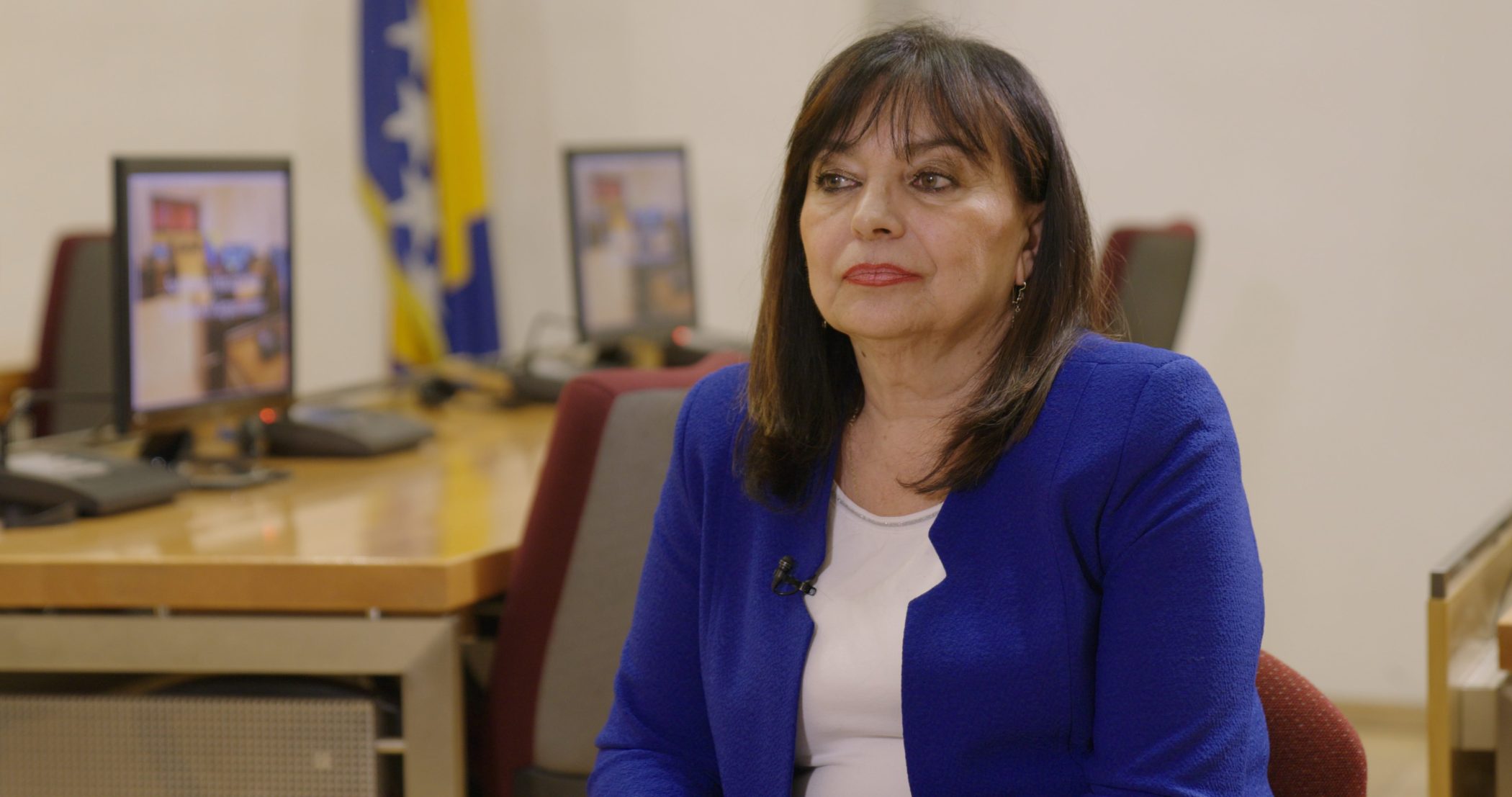
On the second day of the session of the High Judicial and Prosecutorial Council (HJPC), following the presentation of the work program by Judge Minka Kreho, who has served as acting president of the Court of Bosnia and Herzegovina since 2023, the Council appointed her president of the State Court.
During her presentation, Judge Kreho noted that the Court of BiH is the only court handling genocide and crimes against humanity cases, while less complex cases are referred to entity-level courts. She also noted that only the Court's Appellate Division handles election appeals.
Judge Kreho pointed to problems she had identified at the institution, including the fact that four judges retired this year, while eight are expected to retire next year. She noted that the Court currently has 42 judges, but staffing remains a problem despite the Council appointing four judges in September, Detektor reports.
"We know that financial checks will take quite some time, so immediately after each judge left, I reassigned their cases to existing panels so that proceedings would not be held up, and those cases are already being handled. However, next year this will be a somewhat more difficult problem when eight judges retire and we have to figure out how to organize the work with fewer judges," Kreho said.
As another problem, Kreho cited the system for overseeing temporarily and permanently seized items, recalling that an employee of the Seized Items Department was detained and sentenced this year, adding that this was not the first such case.
"We have now tightened controls in the Seized Items Department. We are even in talks with the Central Bank about placing seized money in a special vault where it would not be put into circulation," she said.
Kreho emphasized that the main problem for the Court was the absence of an agency responsible for managing temporarily seized assets, as well as the failure of the Office of the Attorney General to act in cases involving the forced collection of court costs and proceeds of crime. She explained that a decision had previously been adopted under which the judge who issued a final judgment would initiate enforcement proceedings.
"In this way, over the past two years, we have managed to channel more than eight million Bosnian marks (approx. €4 million) into the state budget, into the treasury, because the Office of the Attorney General does not want to do this," she said.
According to Judge Kreho, the Court's strengths include a high level of efficiency and quality in its work, as well as the high level of expertise and specialization among its judges and staff.
She also said that the Court's Witness Support Department had previously worked exclusively on war crimes cases, providing psychological support to witnesses in those proceedings, but that its work had now been expanded to include organized crime, corruption, and financial crime cases.
Kreho said that over the past three years she had introduced open days for foreign and domestic law students, as well as more transparent reporting on each trial and the publication of verdicts.
"We have introduced a system whereby, at the same time a verdict is read out, a statement about the verdict is also released to all media outlets, in order to limit, in a way, differing interpretations of what the judge read out when announcing the verdict," she said.
The Court of BiH, she emphasized, places great importance on training, which it also initiates itself.
"My goal is to improve efficiency and the quality of proceedings in organized crime and corruption cases," Kreho said, adding that money laundering and terrorist financing cases were also being monitored more closely.
With the appointment of new judges, Kreho plans to transfer one panel from the War Crimes Department to the Organized Crime Department, given that the number of war crimes cases has decreased while the number of cases in the latter category is increasing.
The HJPC President Sanin Bogunic said the Council had noticed a certain imbalance between judges in Departments I and II in terms of holding hearings and asked whether the Court would be prepared to make certain adjustments.
Kreho said she had requested records of judges' caseloads and confirmed that their workloads were equal. She explained that over the past six or seven months, 17 war crimes cases had been concluded, seven of them with verdicts, while the accused had died in the remaining 10 cases.
"That alone shows you how much time has passed. Defendants are falling ill, and witnesses are falling ill," she said.
She further highlighted the complexity of war crimes cases, in which a panel is sometimes unable to continue proceedings because the case cannot be separated, meaning it must wait for the accused to recover before the trial can resume.
The other Council members had no questions for Kreho.
Following a vote held behind closed doors, Judge Kreho was appointed president of the Court of BiH.
Kreho was appointed a judge of the State Court in January 2007. Before that, she served as a misdemeanor judge in Sarajevo's Centar Municipality. In 1995, she was appointed a judge of the Municipal Court, where she worked until 2003, when she was appointed to the Sarajevo Cantonal Court. She remained there until her appointment to the Court of BiH.
Following the arrest of then-State Court President Ranko Debevec in mid-December 2023, she was appointed acting president of the Court of BiH.
Kakvo je tvoje mišljenje o ovome?
Učestvuj u diskusiji ili pročitaj komentare


Kakvo je tvoje mišljenje o ovome?
Učestvuj u diskusiji ili pročitaj komentare