Srbija
 Hrvatska
 Slovenija

Analyst warns of US policy shift and silence on Mladic glorification


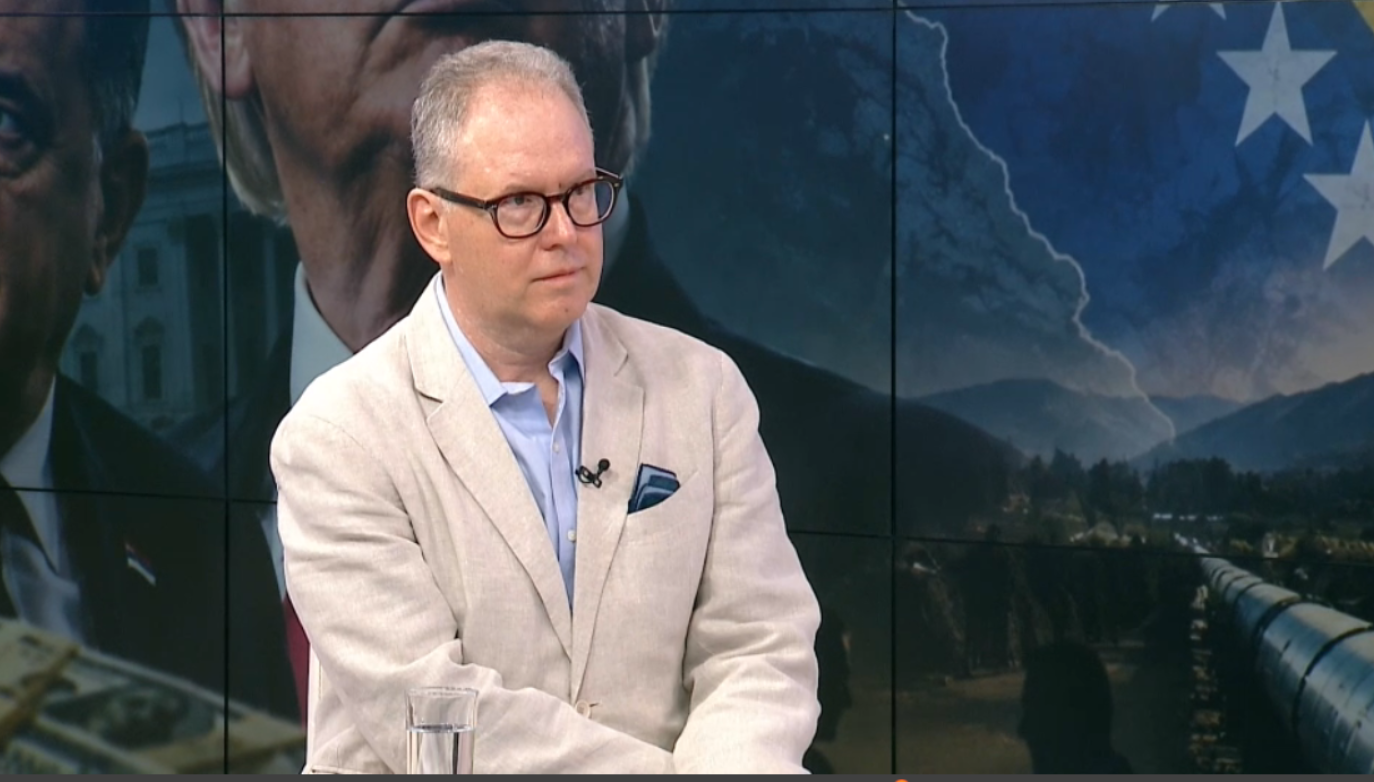
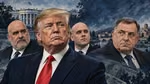
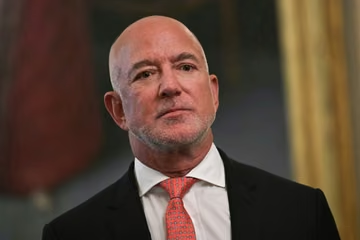
American analyst Kurt Bassuener has assessed in an interview with N1 that an apparent divergence exists between parts of the US Congress and President Donald Trump's administration regarding their approach to Milorad Dodik and the question of sanctions. He expressed particular concern over the absence of a clear reaction from the US administration to the glorification of convicted war criminal Ratko Mladic following his death.
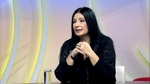
Bassuener, an analyst and co-founder of the Democratization Policy Council (DPC), discussed shifts in US policy toward Bosnia and Herzegovina, sanctions on Dodik, state property, the future of the Office of the High Representative, and reactions to Mladic's glorification.
Addressing the debate in the US Congress, Bassuener noted that several lawmakers pointed out grounds for reinstating sanctions against Dodik. "Several members of Congress stated that Dodik has already violated the principles that triggered those sanctions and that grounds exist to reintroduce them. However, this administration says that the sanctions were lifted because he withdrew anti-Dayton laws last year, but since then, since October, Dodik has, if not maintained, then gone even further in his rhetoric," Bassuener stated.
He evaluated the administration's rationale for lifting sanctions as unconvincing, noting a visible gap between parts of Congress and the Trump administration. "It is clear to me that this current administration does not want to and will not reintroduce sanctions against Dodik," he said.
Asked what Dodik would have to do for Washington to reconsider sanctions, Bassuener responded: "I think Dodik currently feels untouchable, meaning that he will go unpunished. So I really don't know what should happen, or what anti-Dayton move he must make for sanctions to be reconsidered."
He cited hypothetical examples such as deploying police to the inter-entity boundary line or declaring independence, questioning whether such moves would reopen discussions on sanctions. He emphasised that he is unaware of any clearly defined red lines within the US administration for their reintroduction.
Turning to state property, Bassuener believes Dodik has focused intensely on the issue for years. "It has been clear for years that Milorad Dodik is focused on state property, that he has also gained Vucic's support and that his eyes are constantly fixed on state property because he wants to dispose of and eventually sell state property," he said. He added that other domestic and foreign actors also see interests in lowering state property to the entity level or lower, describing it as a cause for concern.
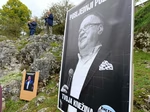
A distinct part of the conversation focused on the glorification of convicted war criminal Ratko Mladic following his death and during his funeral in Belgrade, which officials from the Republika Srpska entity attended. Bassuener expressed concern that no reaction to the glorification emerged from the State Department or the White House. "The official response or the government's response to the glorification of Mladic came from the legislative side, even before this hearing, but not from the State Department, not from the White House, from no other side except the legislative side," he remarked.
Recalling past US policy toward Mladic and Radovan Karadzic, including historical financial rewards for information leading to their capture, Bassuener offered a broader critique of current US policy, claiming ideological similarities between the Trump administration, Balkan nationalists, and the European far-right. "What worries me most regarding US policy is the fact that the Trump administration and Balkan nationalists, as well as European nationalists, such as the AfD in Germany, share the same ideological direction," he stated.
Reiterating his primary concern regarding the lack of public condemnation from the US administration, Bassuener said: "We talked about a lot of things that worry me, but this is something that truly worries me the most."
Going a step further, he offered a speculation that a different reason might underlie the administration's silence: "So they didn't issue anything, any statement condemning the glorification of Mladic, perhaps because they secretly glorify that person themselves, but silence speaks louder than words in this case." This assessment and speculation was presented without proof during the interview. Bassuener concluded by viewing the handling of these issues as an indicator of the direction of current US policy toward Bosnia and Herzegovina and the Western Balkans.
Kakvo je tvoje mišljenje o ovome?
Učestvuj u diskusiji ili pročitaj komentare


Kakvo je tvoje mišljenje o ovome?
Učestvuj u diskusiji ili pročitaj komentare