Srbija
 Hrvatska
 Slovenija

Berset urges Sarajevo to lead on reform as Council of Europe unveils 2026-2029 Action Plan


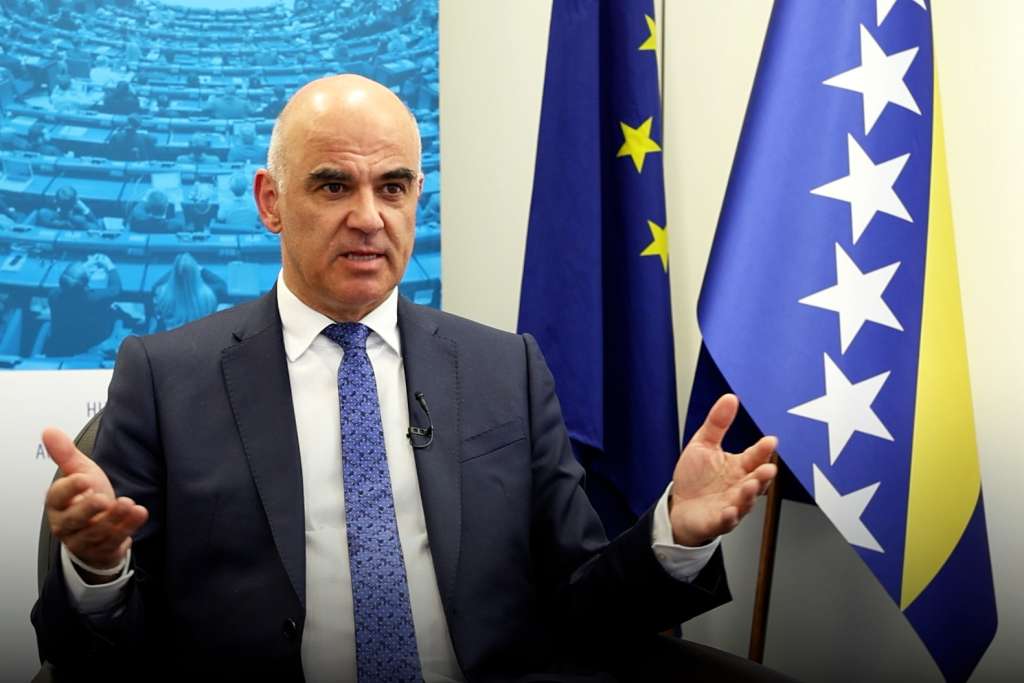
The Secretary General of the Council of Europe, Alain Berset, has reaffirmed that Bosnia and Herzegovina remains a sovereign nation, asserting that the impetus for progress must originate from within its own institutions. During a visit to the country, Berset underscored the critical necessity of domestic reform, specifically regarding electoral legislation and the implementation of outstanding European Court of Human Rights (ECHR) rulings.
Addressing the Council of Europe’s newly minted Action Plan for Bosnia and Herzegovina (2026–2029), Berset clarified that the organisation's mandate is supportive rather than prescriptive. He noted that the Council’s role is to assist the state in refining its legal framework and tackling systemic issues prevalent across the continent, such as judicial independence and the fight against corruption. The Council maintains a substantial presence in Sarajevo, with over 30 staff dedicated to aligning the nation with European values through the implementation of the Action Plan.
Berset characterised Europe as a fragmented yet diverse continent of 46 states, suggesting that long-standing institutions are essential for navigating such complexity. Regarding regional stability, he acknowledged that while the Dayton Agreement remains a fundamental cornerstone for peace, its rigid structure often complicates the pursuit of parliamentary majorities required for legislative evolution. He specifically cited the Sejdic-Finci case as a primary example where reform is overdue.
The Secretary General expressed a degree of optimism following discussions with local officials. Despite deep-seated political divisions, he remarked on the constructive nature of the direct dialogue observed in Sarajevo, describing the ability to engage openly as a prerequisite for any positive outcome.
However, Berset struck a firmer tone regarding the execution of ECHR judgments. He argued that membership in the Council of Europe carries a binding commitment to uphold its convention and rulings. With the Sejdic-Finci judgment now 16 years old, he warned that failure to act would see Bosnia and Herzegovina conduct another set of elections this autumn under a discriminatory framework. While acknowledging that complex societies require time to reach consensus, he insisted that visible progress is essential to demonstrate political will.
Furthermore, the Secretary General identified media pluralism as a non-negotiable pillar of functional democracy. He highlighted the need for independent outlets and diverse viewpoints to counter the growing threats of disinformation and malign foreign influence.
Concluding his interview with FENA, Berset outlined a regional strategy for the Western Balkans. He proposed a comprehensive approach that moves beyond bilateral divisions, aiming instead to foster regional summits focused on shared challenges. By identifying common ground across the region's diverse landscape, Berset hopes to achieve greater coherence in the rule of law and democratic standards during his mandate.
Kakvo je tvoje mišljenje o ovome?
Učestvuj u diskusiji ili pročitaj komentare


Kakvo je tvoje mišljenje o ovome?
Učestvuj u diskusiji ili pročitaj komentare