Srbija
 Hrvatska
 Slovenija

Bosnia Ambassador at UN says citizens want peace and cooperation


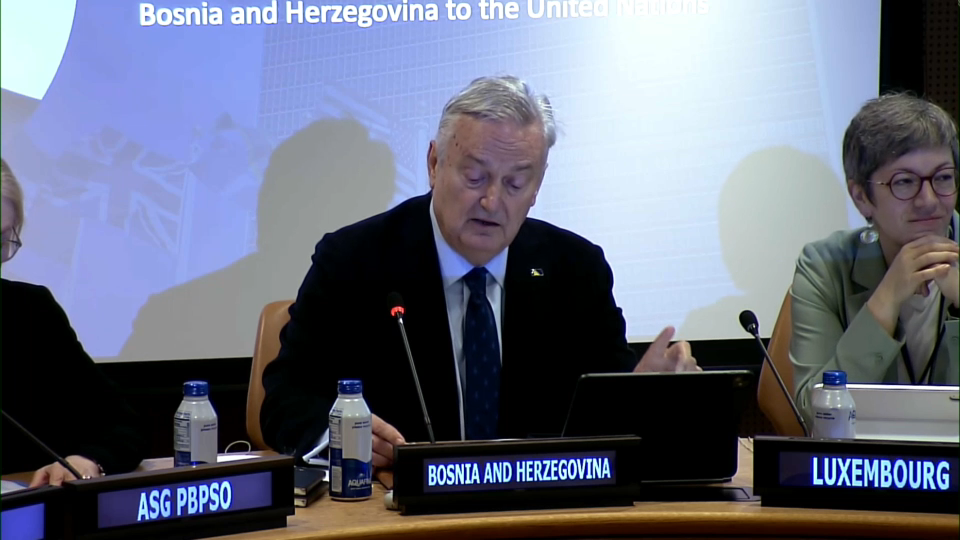
Ambassador Zlatko Lagumdzija, permanent representative of Bosnia and Herzegovina to the United Nations, addressed a roundtable dedicated to institutional strengthening and political progress, stating that ordinary citizens are far more invested in peace and cooperation than certain political leaders who attempt to steer them toward conflict and division. Pointing to extensive empirical research, he emphasized that cross-community collaboration across ethnic and political lines is significantly more prevalent than official political discourse suggests, yet structural barriers continue to prevent grassroots cooperation from translating into meaningful institutional change.
Reflecting on the realities of Bosnia and Herzegovina more than three decades after the signing of the Dayton Peace Agreement, Lagumdzija stressed that preserving peace requires far more than the mere absence of conflict. Post-conflict societies are frequently viewed through the prism of permanent divisions while collaborative initiatives connecting citizens are overlooked.
"Our experience shows that peace is not built solely by political agreements and institutional processes, but also by the daily actions of citizens, communities, civil society, and the private sector," Lagumdzija stated. He noted that findings from recent studies confirm that everyday collaboration across ethnic lines occurs regularly in professional, academic, and economic spheres, proving that society remains inherently interconnected despite political fragmentation.
However, a major challenge persists: grassroots cooperation remains largely informal and localized, rarely transforming into continuous institutional reform or sustained policy shifts. This disconnect between cooperative civic behavior and divisive political rhetoric creates an institutional gap that hinders long-term stability. Emphasizing that peace remains the foundational prerequisite for all human rights and sustainable development, Lagumdzija urged institutions to become more accountable, transparent, and responsive to the actual needs of the population.
Highlighting the role of youth and civil society, including initiatives like the student-led peace declarations, he pointed out that diverse identities should be treated as an asset rather than a burden. Sustainable peace and reconciliation require confronting the legacy of the past, respecting the dignity of victims, and ensuring meaningful public participation in governance.
Concluding his address, Lagumdzija reaffirmed that citizens are overwhelmingly committed to building bridges of cooperation rather than erecting walls of segregation, urging leaders to bridge the gap between public aspirations and institutional reality to secure a prosperous European future for the country.
Kakvo je tvoje mišljenje o ovome?
Učestvuj u diskusiji ili pročitaj komentare


Kakvo je tvoje mišljenje o ovome?
Učestvuj u diskusiji ili pročitaj komentare