Srbija
 Hrvatska
 Slovenija

Palmer: Russia exploits divisions in the Western Balkans to hinder European integration


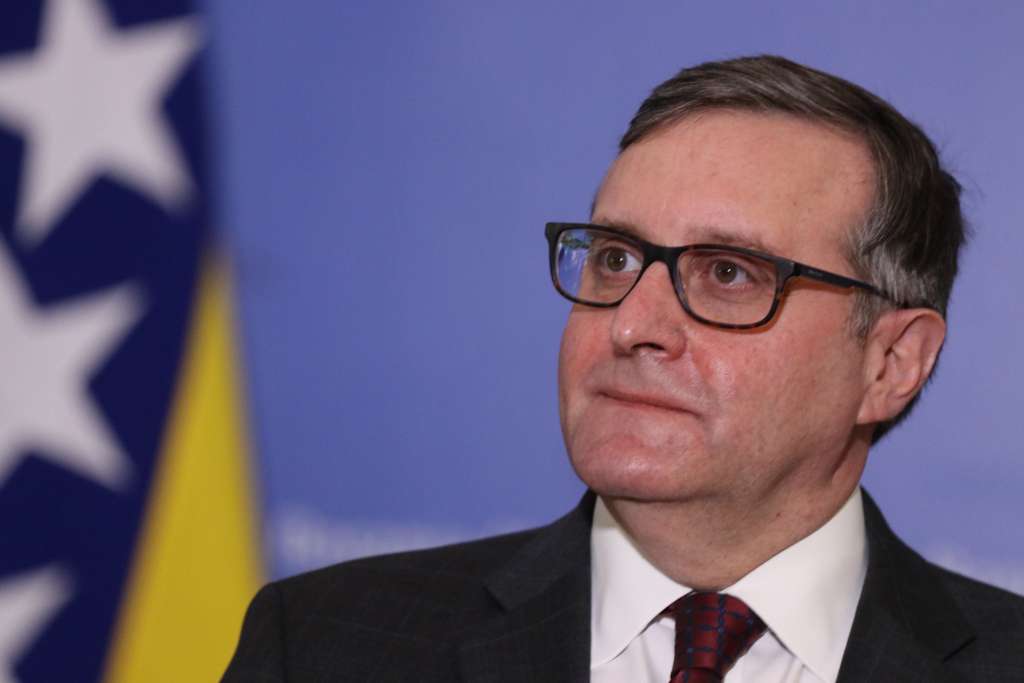
The unfinished integration of the Western Balkans into European and Euro-Atlantic structures leaves room for Russia to exploit by deepening existing political and social divisions, Matthew Palmer, former U.S. Secretary of State's Special Representative for the Western Balkans, said in an interview with FENA. Palmer warned that the region is particularly vulnerable to external influence precisely because of its internal divisions.
Palmer will return to Bosnia and Herzegovina in early September as a participant in the fourth Sarajevo Security Conference, which will gather international officials, diplomats, military representatives, experts and researchers from September 4 to 6 to discuss security challenges in Europe and the Western Balkans.
This year's conference is being held under the theme ''Securing Europe in a Divided World'', with Palmer scheduled to take part in a discussion on the future of the European security architecture.
After nearly 34 years in the U.S. diplomatic service, Palmer left the State Department this year and joined U.S. company Shield AI, where he focuses on strategic engagement in Europe and Africa. The company develops autonomous systems and artificial intelligence-based software for military and security applications, including systems capable of operating in environments without reliable GPS or communications links.
Palmer has extensive experience in the Western Balkans. From 2018 to 2021, he served at the State Department as Deputy Assistant Secretary of State for European and Eurasian Affairs, responsible for the Western Balkans. In 2019, he was also appointed the Secretary of State’s Special Representative for the Western Balkans, tasked with strengthening U.S. engagement in support of peace, stability and the region’s integration into Western institutions. He was directly involved in talks on electoral reform in Bosnia and Herzegovina.
Speaking to FENA about the consequences of Russia’s invasion of Ukraine for the continent’s long-term security, Palmer said Europe had, perhaps belatedly, recognized that it was facing an existential security challenge.
"Europe is taking responsibility for its own security. Collectively, it is increasing the resources it makes available to ensure its own security and is taking the threat that Russia in particular poses to European integrity and European security seriously," Palmer said.
In his view, changes in the security environment only further underscore the need for the Western Balkans to be more firmly connected to European and Euro-Atlantic institutions.
"If we are talking specifically about the Western Balkans, I would argue that changes in the European security environment only further underscore the importance of integrating the Western Balkans into European and Euro-Atlantic institutions," he said.
He considers cooperation among the countries of the region itself equally important, saying they should work together to strengthen both regional and broader European security.
Addressing US calls for European allies to assume a greater share of responsibility for their own defense, Palmer said strengthening European security capabilities does not necessarily mean weakening the transatlantic partnership.
He recalled that the essence of NATO is collective security, while the European Union also provides its members with a form of shared security, both economic and, in his view, physical security.
This gives Western Balkan countries an additional incentive to strengthen their ties with the EU and NATO, although he noted that this commitment is not new and that most countries in the region have long recognized the importance of European integration.
Palmer expects a stronger and more capable Europe to also have a greater say in determining its own security policy.
"As Europe becomes more capable and takes greater responsibility for its defense and security, that will necessarily affect the ability of the United States to lead Europe on security issues. As Europe becomes more capable, it will also develop a stronger voice and a greater ability to determine the way forward in the European security environment," he said.
He acknowledged that such a development could frustrate some Americans, but said he believes it will ultimately be good for both Europe and the transatlantic partnership.
He particularly warned of the security problem posed by the unfinished integration of the Western Balkans, a region geographically surrounded by EU and NATO members, while several countries are still not part of one or both organizations.
Asked whether this situation creates an opening that Russia and other external actors can exploit, Palmer gave an unequivocal answer.
"One hundred percent. We have seen Russia’s interest in identifying the cracks, divisions, gaps and weak points in European structures, and then driving wedges into those gaps and trying to widen them," Palmer told FENA.
According to Palmer, Russia does this openly at the political level, but also covertly at the societal level, while remaining highly active in the online space.
The goal, he believes, is to turn existing political differences and problems within major European structures into weaknesses.
"The Balkans are particularly vulnerable because they are divided internally in so many ways, divided against themselves. The Russians have been skillful and aggressive in exploiting those differences and trying to make it more difficult, if not impossible, for the countries of the region to integrate into European structures," he warned.
Speaking specifically about Bosnia and Herzegovina, Palmer declined to comment on current political developments, given that he is no longer directly involved in US policy toward BiH. However, he pointed to problems that, in his view, the country has faced for three decades.
To make BiH more resilient to hybrid threats, disinformation, cyberattacks and external political influence, he believes it is necessary to develop a stronger sense of shared belonging to the state.
"That means having a sense that you are a citizen of Bosnia and Herzegovina and wanting Bosnia and Herzegovina as a state to move forward on the path toward integration into European structures," Palmer said.
He also singled out the development of a strong and resilient economy as an extremely important element of security resilience, one that would enable young people, regardless of their ethnic background, to see their future in their own country.
"It is necessary to develop an economy that will encourage the young people of Bosnia and Herzegovina, regardless of their ethnic identity, to stay in Bosnia and Herzegovina, build their lives here, raise their families here and see a positive and constructive future for themselves as citizens of BiH," he said.
Palmer believes that one of the key challenges remains reaching consensus on the country’s political future and building a shared identity that is not based exclusively on ethnicity.
"It is necessary to develop a sense of shared identity that is something other than ethnic identity, that is a national identity, as well as a clear understanding that all citizens of Bosnia and Herzegovina, regardless of their ethnicity, are in the same boat and that they will either rise together or sink together," Palmer said.
As for threats that Europe may underestimate over the next five to 10 years, Palmer believes the greatest dangers do not necessarily have to come from conflicts between states.
He said he was more concerned about what is happening within states themselves.
For that reason, he identified combating corruption, strengthening the rule of law and preserving the democratic legitimacy of institutions as key security priorities.
"It is important that governments make progress in combating corruption and strengthening the rule of law, ensure democratic legitimacy and establish mechanisms through which public views and opinions are reflected in political institutions," Palmer said.
He said politically stable countries, strong democracies and healthy economies represent Europe’s most important protection against external security challenges.
"If European countries are politically strong, if their democracies are strong and if their economies are strong, I am quite confident that Europe collectively, and Europe in partnership with the United States, can respond to all challenges," he said.
But Palmer warned that the greatest weakness emerges when internal divisions begin to undermine that resilience.
"A continent divided against itself is a continent vulnerable to external threats," Palmer concluded in his interview with FENA.
Kakvo je tvoje mišljenje o ovome?
Učestvuj u diskusiji ili pročitaj komentare


Kakvo je tvoje mišljenje o ovome?
Učestvuj u diskusiji ili pročitaj komentare