Srbija
 Hrvatska
 Slovenija

Soreca: BiH risks paying a high price for ‘sour grapes’ politics


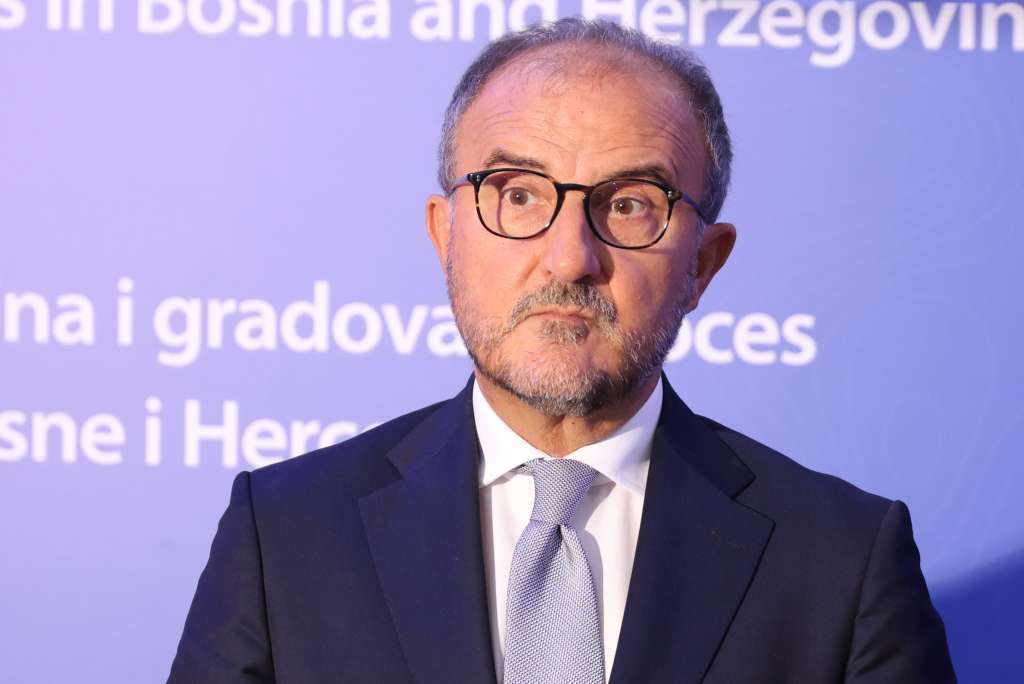
Bosnia and Herzegovina risks losing hundreds of millions of euros in EU support because of institutional inaction, EU Ambassador Luigi Soreca warned, arguing that dismissing the Growth Plan funds as insignificant or “merely loans” is misleading and deeply damaging for citizens. In an op-ed, Soreca said BiH authorities still have the power to unlock major EU funding, but that time is running out.
Soreca’s op-ed, titled “The Cost of Sour Grapes,” follows:
In Aesop’s famous fable, a fox tries unsuccessfully to reach a high bunch of grapes before walking away in a huff, muttering that they were probably sour anyway. A remarkably similar narrative seems to be emerging in Bosnia and Herzegovina. Faced with institutional inaction, some are resorting to claiming ‘sour grapes’ and implying that the risk to Bosnia and Herzegovina of losing €373.9 million from its Growth Plan allocation - on top of the €108 million already forfeited – is inconsequential.
It is stated for example that the substantial funds available under the Growth Plan are unimportant because they are "merely loans" rather than grants. This claim is highly misleading.
Of the total €976.6 million allocated to Bosnia and Herzegovina in exchange for delivering on 113 clear reform steps, €280.3 million (548.21 million KM) consists entirely of non-repayable grants.
To put this in perspective: the draft annual state budget adopted by the Council of Ministers on 21 May 2026 stands at 1.58 billion KM. The Growth Plan's grant component alone is therefore equivalent to more than one-third of Bosnia and Herzegovina’s entire annual state budget. Dismissing this important support is very hard to understand. Bosnia and Herzegovina remains at this stage the sole Western Balkan partner failing to draw a single euro from the Reform and Growth Facility of the Growth Plan.
As for the loan component, these funds are offered on exceptionally favourable terms that far outmatch what is available from any other partner. The economic growth Bosnia and Herzegovina stands to achieve through these investments is projected to vastly exceed the value of the debt itself. These loans carry a maximum maturity of 40 years, paired with a generous grace period ensuring that principal repayments do not even begin until 2034 (assuming the necessary agreements are finalised this year). Combined with highly competitive interest rates well below what is offered by the markets and other partners, the EU is making a phenomenally good financial offer. An offer that other countries in the region are taking good advantage of for the benefit of their citizens.
Amid discussions of interest rates and multi-million euro packages, it is however vital to remember that the Growth Plan is not just about financial investments. Funding is a means to an end, not the objective itself. The steps outlined in the Reform Agenda are designed to be a driver of sweeping economic transformation and to accelerate integration into the European Single Market.
Bosnia and Herzegovina possesses immense, unrealised economic potential. The Growth Plan provides the exact toolkit needed to unlock sustainable growth, prosperity, and long-term stability.
Crucially, the Growth Plan does not exist in a vacuum. It sits alongside a broader framework of European support. Growth Plan funding is separate from the €140.5 million in grants allocated to BiH under the current IPA 2025–2027 framework, which now awaits final ratification. The EU also continues to provide targeted grant support through other mechanisms — such as the €45.7 million mobilised from the EU Solidarity Fund to aid recovery from the devastating 2024 floods. Overall, since 2020, the EU has leveraged €2.4 billion in total investments for Bosnia and Herzegovina, backed by €820 million in EU and bilateral donor grants.
The clear fact rising above this mass of figures is that the EU and its Member States remain by far the largest provider of support to Bosnia and Herzegovina. This is not merely the assistance of good neighbours. It is a strategic investment in the long-term stability and prosperity of our continent, aimed at fully integrating the Western Balkans into the European Union.
Unlike the helpless fox of Aesop’s fable, Bosnia and Herzegovina’s authorities actually possess the power to reach the opportunities on offer. While the EU has consistently demonstrated flexibility in accounting for the country's complex decision-making processes, the EU also operates under strict rules and legal deadlines. Time is running out.
A key test of Bosnia and Herzegovina’s resolve to make progress towards a gradual integration in the European Single Market will be whether the country’s authorities are able to meet the conditions that allow the Central Bank to submit an application to join the Single Euro Payments Area (SEPA). Joining SEPA would dramatically reduce the costs of transferring money across borders – including to new SEPA members Albania, North Macedonia, Montenegro and Serbia - as well as the EU. The benefit for businesses as well as individuals and families is self-evident.
Another test will be whether BiH’s authorities can meet the conditions to open accession negotiations, in particular by adopting the Law on Courts and Law on HJPC in line with European standards and appointing a Chief Negotiator.
It is now high time to make progress on finalising the Loan Agreement and Facility Agreement that provide the legal basis for money to be disbursed under the Growth Plan. Following the approval of the Reform Agenda under the Growth Plan last year, Bosnia and Herzegovina is eligible for pre-financing of around €68 million. The Loan and Facility Agreements are standard administrative documents. There is no reason for delay. And no amount of ‘sour grapes’ excuses would be able to justify the unfortunate reality - inaction will be deeply costly for Bosnia and Herzegovina’s citizens.
Kakvo je tvoje mišljenje o ovome?
Učestvuj u diskusiji ili pročitaj komentare


Kakvo je tvoje mišljenje o ovome?
Učestvuj u diskusiji ili pročitaj komentare