Srbija
 Hrvatska
 Slovenija

WB: Economic growth slows as Western Balkans face critical labour shortage


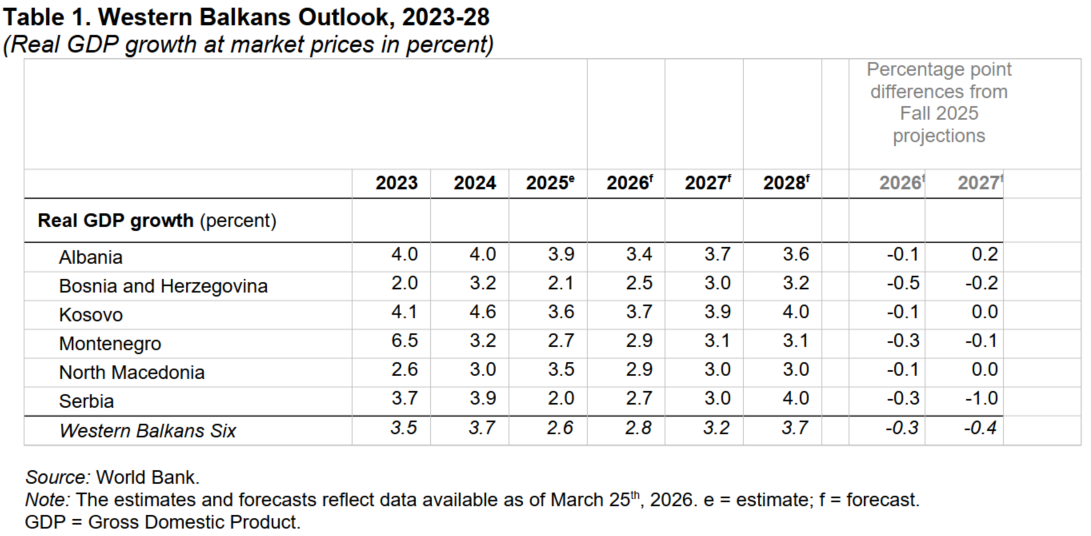
The World Bank’s latest Regular Economic Report reveals a significant downgrade in growth projections for the Western Balkans, as geopolitical tensions and demographic shifts strain the region's economy. Combined growth for Albania, Bosnia and Herzegovina, Kosovo, Montenegro, North Macedonia, and Serbia is now forecast at 2.8% for 2026, a 0.3 percentage point decrease from previous estimates, with a modest recovery to 3.2% expected in 2027.
The report identifies a striking paradox: while key sectors grapple with acute labour shortages, millions of potential workers remain on the sidelines. World Bank experts argue that the region is failing to utilise its human capital, specifically women and young people. If labour participation rates were to align with comparable European Union standards, the region would gain over 2.8 million additional workers.
Barriers to employment and the "stay-at-home" trap
Current fiscal policies are cited as a primary obstacle to workforce expansion. In many Western Balkan nations, tax and benefit regulations inadvertently penalise those seeking employment. For many individuals, reporting even a modest income leads to the immediate disqualification of poverty-targeted benefits, transforming a job offer into a financial risk rather than a reward.
Beyond fiscal reform, the World Bank emphasises the necessity of establishing affordable childcare and eldercare to support working families. There is also an urgent requirement for improved job training and modern workplaces that offer flexibility, particularly for those in the burgeoning online platform economy. These measures are critical as the region faces intense demographic pressure, with projections suggesting one in five people will be over 65 within the next decade.
Strategic imperatives for long-term progress
Global uncertainty and geopolitical tensions are holding back growth, and rising prices are hitting people’s wallets directly, stated Xiaoqing Yu, World Bank Division Director for the Western Balkans. She noted that while short-term fiscal measures provide a temporary cushion, the true key to progress lies in structural job market reform.
The economic impact of inclusion is substantial; integrating more women into the workforce alone could boost annual growth by approximately 0.35 percentage points. With the regional population ageing faster than almost anywhere else in Europe and high-skilled graduates continuing to seek prospects abroad, the report concludes that activating the untapped domestic talent pool is no longer optional, but essential for economic survival.
Kakvo je tvoje mišljenje o ovome?
Učestvuj u diskusiji ili pročitaj komentare


Kakvo je tvoje mišljenje o ovome?
Učestvuj u diskusiji ili pročitaj komentare