Srbija
 Hrvatska
 Slovenija

Covic: Croatian parliament resolution reflects Dayton principles


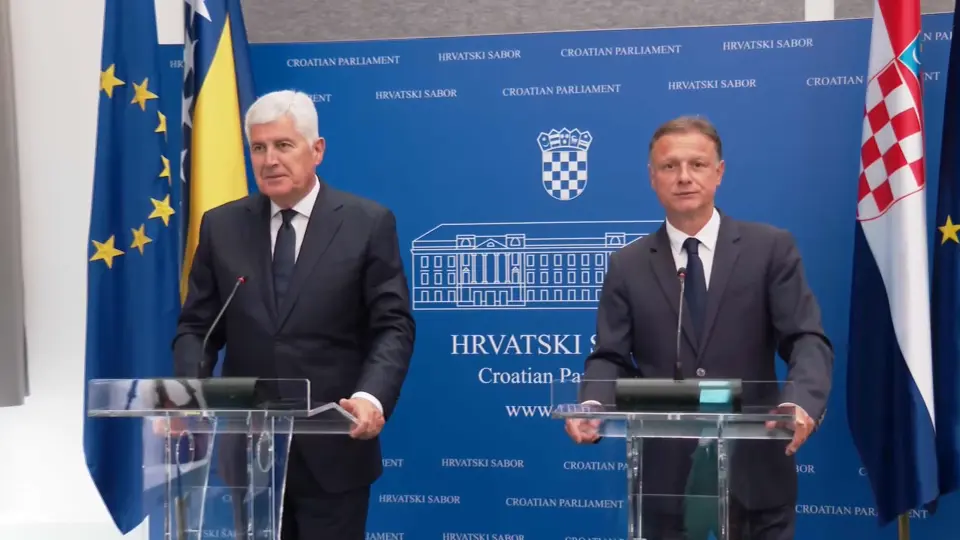
The resolution on Croats in Bosnia and Herzegovina adopted by the Croatian parliament last week reflects the spirit of the Dayton peace agreement because equality of the Croats is a constitutional category, Bosnian Croat leader Dragan Covic said during a visit to Zagreb on Tuesday.
The resolution, adopted at the proposal of the Homeland Movement, calls on the Croatian government to continue supporting the full political equality of Croats in Bosnia and Herzegovina, including electoral reform to ensure that each constituent people can elect its legitimate representatives.
The Croat and Bosniak members of Bosnia and Herzegovina's tripartite presidency are elected in the Federation of Bosnia and Herzegovina, where Bosniak voters outnumber Croats by about three and a half to one. Zeljko Komsic has four times been elected the Croat member largely on the alleged votes of Bosniak votes, but cannot seek another term in this year's election.
Covic, chairman of the House of Peoples of the Parliamentary Assembly of Bosnia and Herzegovina and leader of the HDZ BiH party, said he was confident his party's candidate, Darijana Filipovic, would be elected the Croat member of the country's tripartite presidency in the 4 October general election.
He thanked the Croatian parliament for adopting the resolution, saying it demonstrated support for Bosnia's EU path and internal stability.
Parliament Speaker Gordan Jandrokovic said the document confirmed Croatia's strong backing for Bosnia and Herzegovina's European integration.
Bosniak officials criticised the resolution, with Presidency Chair Denis Becirovic calling it interference in Bosnia and Herzegovina's internal affairs, while Foreign Minister Elmedin Konakovic argued that Croats already enjoyed more rights than provided for by law.
Asked about cooperation with former Republika Srpska (RS) entity President Milorad Dodik, Covic said he did not avoid working with him because he was the elected representative of his political constituency.
Jandrokovic said Bosnia and Herzegovina ranked third among destinations for Croatian investment, while bilateral trade exceeded €4 billion last year. He highlighted the Southern Gas Interconnection project, which will link Bosnia to Croatia's gas network and the LNG terminal on the island of Krk, reducing its dependence on Russian gas.
Jandrokovic said Croatia had secured funding to build the pipeline to the border, while Covic said operational steps would now follow after the project partner had been selected and the bilateral agreement signed.
Covic said the project also represented "a new dimension" in relations with the United States, noting that although Washington had long supported Bosnia and Herzegovina, it had not previously invested there.
The pipeline is expected to be built by Plinacro on the Croatian side and by the US private company AAFS Infrastructure and Energy in Bosnia and Herzegovina.
Jandrokovic and Covic were due to visit the Krk LNG terminal later on Tuesday.
Kakvo je tvoje mišljenje o ovome?
Učestvuj u diskusiji ili pročitaj komentare


Kakvo je tvoje mišljenje o ovome?
Učestvuj u diskusiji ili pročitaj komentare