Srbija
 Hrvatska
 Slovenija

Distance does not erase belonging: How Bosnian identity survives across generations in America



Can a community of people who may never have met one another, and among whom there are even those who have never lived in Bosnia and Herzegovina, nor ever set foot on its soil, represent one of the most striking examples of transgenerational identity in the contemporary world?
That question arises almost spontaneously after the scenes from St. Louis that we witnessed last weekend during the final warm-up match of the Bosnia and Herzegovina national team ahead of its historic participation in the World Cup, where thousands of Bosnian supporters filled the stands, transforming the American city, if only for a moment, into a sea of blue and yellow flags. At first glance, it is about sport, about a football match, about the passion of supporters. But it takes only a little longer to observe those scenes to realise that this is not merely a story about football.
Among those gathered were not only people who left Bosnia and Herzegovina during the war of the 1990s or in the years that followed. There were also their daughters and sons, and often their grandchildren - generations born and raised in the United States, educated within the American system, living everyday American lives, and often the American dream as well. Yet within one part of their personal story, there remains something that persistently draws them back towards a country they may know more through family conversations than through personal experience.

In the social sciences, such connections are often described through the concept of "imagined communities", a theory developed by Irish political scientist Benedict Anderson. The idea is simple, yet it says a great deal: nations exist not only as territories and institutions, but also as a sense of belonging shared among people who do not know one another personally, yet inhabit the same symbolic framework. This is precisely why the scenes from St. Louis transcend a sporting event. They demonstrate that identity is not static and that it does not end with crossing a border or with the passing of generations.

What makes this phenomenon even more remarkable is that this sense of belonging is passed on further, often without formal mechanisms, almost imperceptibly: through the language spoken at home, through stories repeated around the dinner table, through photographs, memories, and the quiet emotional codes that families pass down from one generation to the next. Sociologists would call this transgenerational identity, but in reality it often appears much simpler: as the feeling that “something of yours” belongs to a place you have never fully come to know.
A language that is not forgotten and a flag that evokes emotion
The Bosnian diaspora in the United States was largely formed as a consequence of forced migration during the war of the 1990s. Three decades later, it is almost inspiring to see that this connection did not fade with the first generation of emigrants. On the contrary, it has continued to live on in generations that never experienced the war, generations that often know Bosnia and Herzegovina only in fragments, yet still carry it as part of their own identity.
This is why St. Louis ceases to be merely the host city of a football match. It becomes a symbolic space in which one can see how identity can be maintained across great distances and despite the passage of time. At a moment when much is said about the growing detachment of diasporas from their countries of origin, such images suggest something more complex: that integration into a new society and attachment to one’s roots do not necessarily exclude one another.
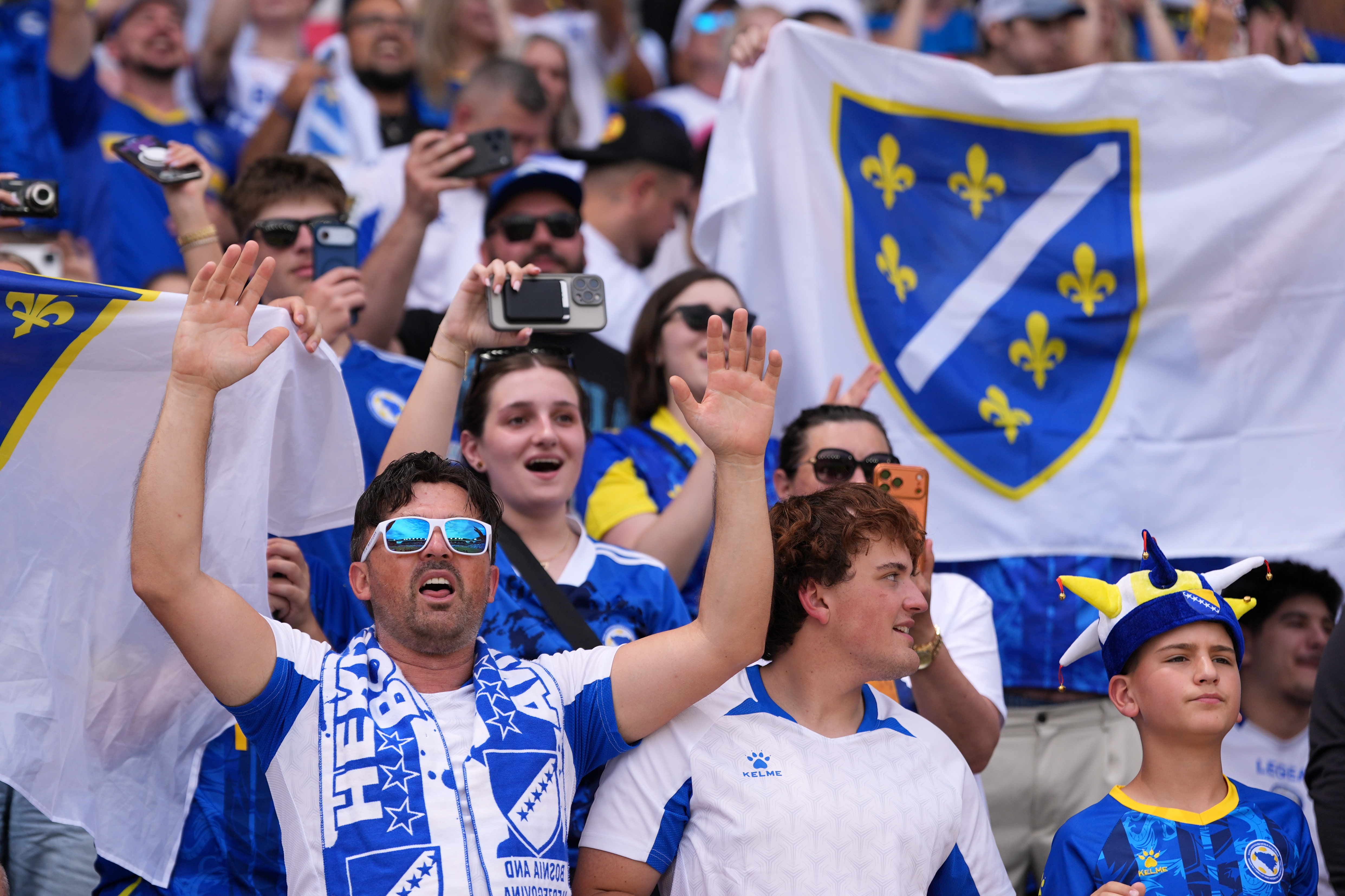
Perhaps that is precisely the greatest strength of these scenes. They were not merely a supporters’ event, nor simply a gathering of a diaspora community. They were a reminder that a homeland is not always a geographical fact. Sometimes it is a language that is not forgotten, a story that is retold, a flag that evokes emotion even among those who had nowhere to “learn” that feeling except through inheritance.
Just as the symbol of the lily endures through different historical and political eras, changing its meanings without losing its recognisability, so too can the sense of belonging survive distance and generational change. It transforms, adapts to new contexts, yet remains present.
And perhaps that is the most important impression we take away from St. Louis: that a community scattered across the world can, if only for a few hours, come together once again around something that is not merely sport, but also memory, identity, and a quiet assertion that belonging is not measured in kilometres, but in the strength of the connection a person carries within themselves.
Kakvo je tvoje mišljenje o ovome?
Učestvuj u diskusiji ili pročitaj komentare


Kakvo je tvoje mišljenje o ovome?
Učestvuj u diskusiji ili pročitaj komentare