Srbija
 Hrvatska
 Slovenija

EU citizens protest double standards on human rights


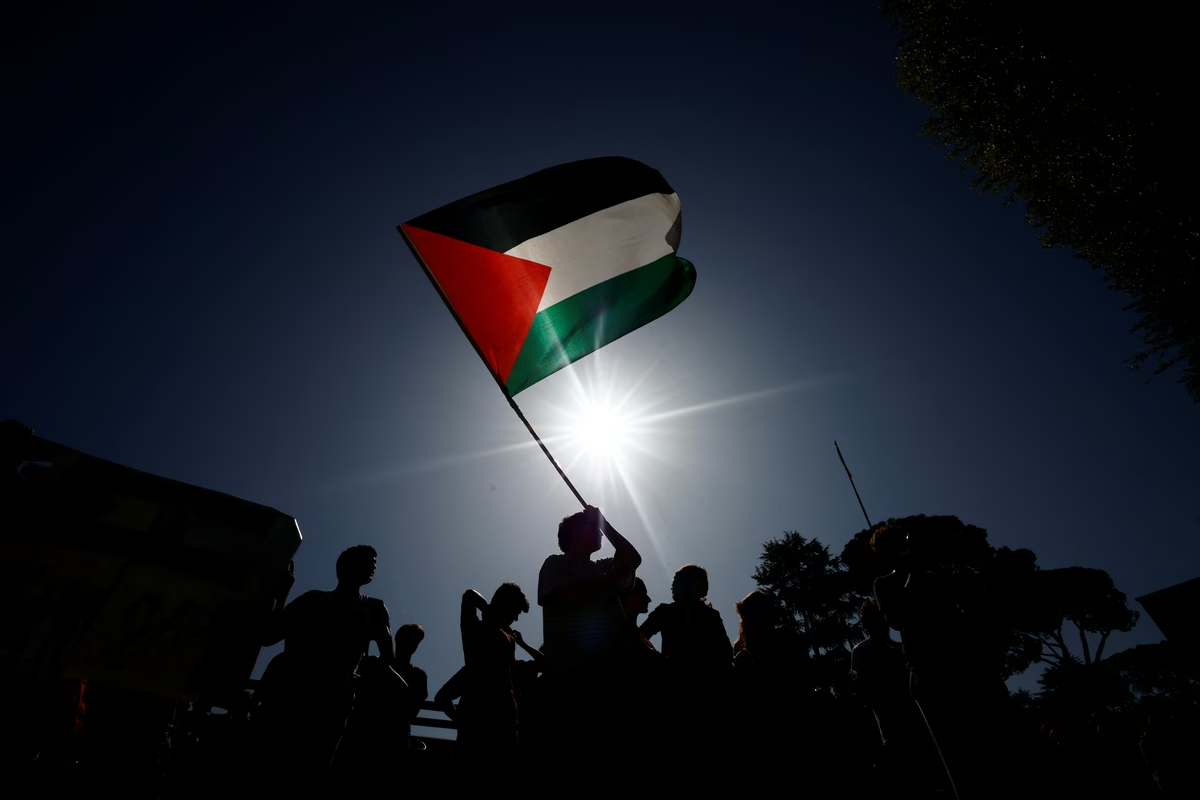
An EU citizens’ initiative calling for the suspension of the EU–Israel Association Agreement over alleged human rights violations has gathered more than one million signatures, obliging the European Commission to examine the request.
The initiative, “Justice for Palestine”, launched in January, has collected 1.1 million online signatures, including 2,140 in Croatia, according to data published on the EU website on Thursday.
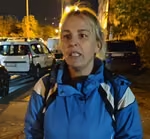
We launched the initiative in response to the ongoing, live-streamed genocide in Gaza carried out by Israel with the financial and political support of the EU, initiative representative Tamam Abusalama, a 32-year-old Belgian citizen born in the Gaza Strip, told Hina, adding that many members of her family were killed.
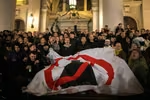
She noted that hundreds of thousands of protesters have taken to the streets of European cities over the past two years demanding “an end to EU complicity”, while EU leaders, including the European Commission president, have offered little beyond expressions of concern and condemnation, even pausing discussions on sanctions.
Under EU rules introduced in 2012 following the Lisbon Treaty, the Commission must consider any proposal backed by at least one million signatures from across all 27 member states. Of 127 initiatives launched to date, only 15 have reached that threshold.
Spain, Slovenia and Ireland called at a meeting of foreign ministers on Tuesday for the suspension of the agreement with Israel, which underpins trade relations, but were blocked by countries including Germany, Italy and Croatia.
Amid such divisions, a separate initiative titled “Stop Double Standards” was launched last month, criticising the EU for not treating military actions by Israel and the United States in the same way as those by Russia.
We are calling for legislation to ensure all countries are treated equally when they violate human rights, said Faryda Hussein, a Dutch public sector employee, presenting the initiative at the European Economic and Social Committee (EESC).
Hussein cited statements by European Commission President Ursula von der Leyen, arguing they showed inconsistent treatment of alleged war crimes. Von der Leyen had described Russian attacks on civilian infrastructure as war crimes and “acts of pure terror”, while in the case of Israel, which a UN rapporteur has accused of carrying out genocide in Gaza, she said its decision to expand military operations in Gaza should be reviewed.
The initiative also criticised the Commission president for condemning Iran in strong terms while not explicitly denouncing alleged violations of international law in attacks by Israel and the United States on Iran.
The European Commission should be legally obliged to treat third countries according to the same standards, Hussein said, adding that there must be no double standards when it comes to human rights.
The “Stop Double Standards” initiative has so far gathered 2,851 signatures online and has one year to reach the one million threshold.
We are confident we will succeed, as people across Europe are outraged, Hussein said, noting she launched the initiative with citizens from several EU countries whom she met via social media before meeting them in person in Brussels last month.
Israel has described calls to suspend the agreement as antisemitic, singling out the Spanish government and saying it would not accept criticism from a country it accuses of supporting undemocratic regimes in Turkey and Venezuela.
Erika Paulinova, coordinator of the European Citizens’ Initiative programme at the EESC, said geopolitical issues are increasingly concerning EU citizens.
In the past we received initiatives on animal protection or consumer rights, and now we have three geopolitical ones, she said, adding that global developments are clearly worrying Europeans.
European Commissioner for Interinstitutional Relations and Transparency Maros Sefcovic said last month the Commission was open to discussion.
These are turbulent times, and gathering one million signatures is a major effort, he said in an address to citizen groups presenting their initiatives in Brussels.
Kakvo je tvoje mišljenje o ovome?
Učestvuj u diskusiji ili pročitaj komentare


Kakvo je tvoje mišljenje o ovome?
Učestvuj u diskusiji ili pročitaj komentare