

 Srbija
 Hrvatska
 Slovenija


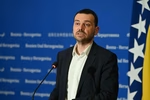
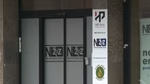
The United States has imposed sanctions on the Oil Industry of Serbia (NIS). Who is the main target of these sanctions? Could there be disruptions in the supply of energy products throughout the chain, potentially affecting Bosnia and Herzegovina, given that NIS operates offices and gas stations there? What are the potential ways to navigate this crisis? We sought answers from Goran Radosavljevic, an expert in economics and energy.
Apple Store Removes NIS Applications
What do the sanctions imposed on NIS mean, why were they introduced now, and who is their main target?
"It is evident that other companies directly or indirectly owned by the Russian Federation, which have already been subject to sanctions, are now being targeted. These sanctions specifically mean that companies based in the US and UK will be prohibited from collaborating with NIS. However, the sanctions also pose a threat to other companies with indirect ties, particularly in the EU. For instance, companies delivering crude oil to the refinery in Pancevo, such as Croatia’s JANAF, could face sanctions if they continue cooperation with NIS. The same applies to the entire financial sector. Serbia's banking market is largely composed of EU banks, with only one being domestic. The question arises: how will they react? Two days ago, Apple removed two NIS applications from the Apple Store. There is also speculation about blocking NIS accounts, which could lead to bankruptcy".
What does this mean for Gazprom in Bosnia and Herzegovina?
"The sanctions include a clause specifically addressing financial institutions, warning that they will be penalized if they cooperate with these companies. If banks were to block accounts, as we saw in Republika Srpska, it could lead to scenarios where customers at gas stations can only pay in cash, not by card. A significant consequence is that the Pancevo refinery needs to purchase crude oil from the market to function. If banks cease cooperation, all foreign currency accounts could be frozen, leaving NIS unable to pay for or acquire crude oil, resulting in the refinery shutting down.
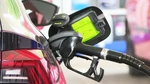
Approximately 80% of Serbia’s demand for oil derivatives is met by the Pančevo refinery. Through its subsidiaries in Bosnia and Herzegovina, NIS Petrol and Gazprom rank as the second or third largest market players. A potential outcome could be fuel shortages at gas stations, leading to price increases."
What are the possible solutions for companies operating in Bosnia and Herzegovina?
"In principle, NIS, like Sberbank, has been affected by earlier sanctions. While NIS managed to adapt, Sberbank disappeared from the market. Now that direct sanctions have been imposed on NIS, adapting will be much harder. Options for the company include a change in ownership—if the Russian side agrees—or the Serbian government purchasing ownership. Alternatively, the state could undertake a friendly or hostile nationalization of the company to prevent collapse and bankruptcy. The oil industry is crucial for agriculture, transportation, and other sectors. A disruption could lead to significant market instability, impacting the prices of goods and services. There are limited solutions available."
How would this benefit Serbia?
"If NIS alone were the focus, one might argue that Serbia has two options for Russia: allow the company to fail or sell it until the war in Ukraine concludes and negotiations over property resume. However, the issue is much broader—it involves Gazprom's gas supplies from Russia to Serbia. Serbia is entirely dependent on Russian gas. This year, Serbia faces a review of its contract with Gazprom and cannot satisfy its gas needs elsewhere. Russia could leverage this by threatening to cut gas supplies if Serbia acts unilaterally, which would be catastrophic. The potential fallout includes the collapse of a company that operates effectively in the market and meets oil derivative demands in Serbia, Bosnia and Herzegovina, and the broader region. It would not be in anyone’s interest to let such a company fail. Finding a solution is crucial."
Will prices rise?
"Any disruption or anticipation of disruption impacts prices. In the 1990s, due to sanctions, fuel was purchased on the black market, and prices fluctuated daily. Major retailers, agricultural producers, and transport companies will question whether they have sufficient supplies and may begin stockpiling, which could drive demand and increase prices. Although prices are controlled in Serbia, shortages could lead to the emergence of a parallel black market. It is critical to avoid panic, and I believe that the situation will be resolved swiftly in the interest of all parties."
Do we have energy security?
"What is vital for the region as a whole is energy security. Bosnia and Herzegovina has some advantages, such as access to the sea and the Port of Ploce, through which it can procure oil derivatives and obtain gas via other terminals. Serbia, however, relies entirely on the TurkStream pipeline for gas and has no access to maritime ports or interconnections. Steps have been taken, such as connecting southern Serbia to Bulgaria via a terminal linked to Azerbaijan. Diversifying supply sources and routes should be a priority to ensure the region's energy security. The invasion of Ukraine in 2022 prompted Europe to gradually revise its energy policies, focusing more on importing gas from global markets. This shift could eventually lead to the creation of a global gas market and increased attention to alternative energy sources, electricity, and regional markets."
Kakvo je tvoje mišljenje o ovome?
Učestvuj u diskusiji ili pročitaj komentare


Kakvo je tvoje mišljenje o ovome?
Učestvuj u diskusiji ili pročitaj komentare