Srbija
 Hrvatska
 Slovenija

Back on Europe’s security map: Bosnia and Herzegovina is no longer just a peace project


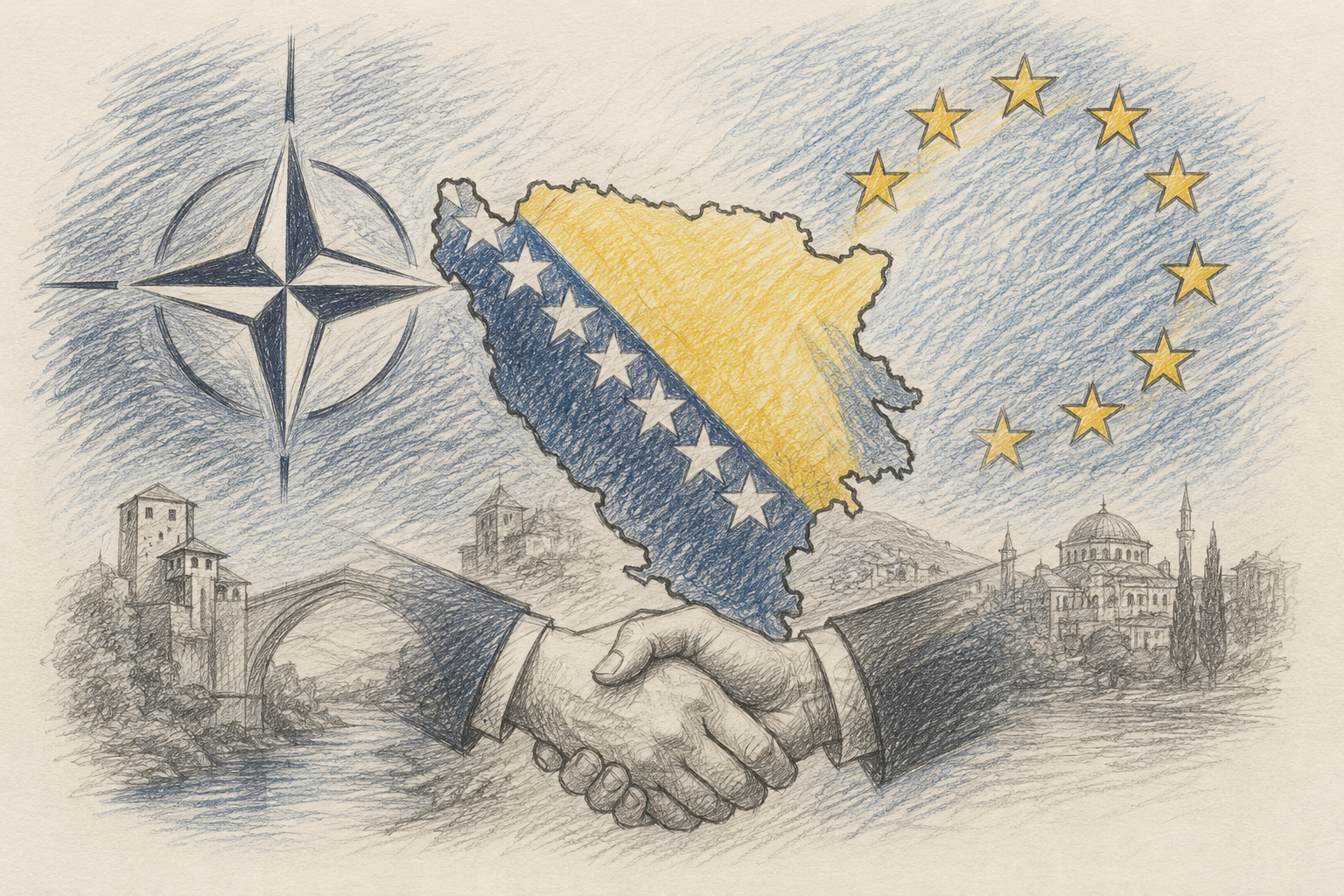
Three decades after the Dayton Peace Agreement ended the war, Bosnia and Herzegovina is again being discussed as a European security issue. The reason is not an immediate threat of conflict, but a profound change in Europe's geopolitical landscape.
Russia's full-scale invasion of Ukraine, uncertainty over the long-term US commitment to European security, questions surrounding EUFOR's future, and NATO's renewed focus on the Western Balkans have all pushed BiH back into a broader strategic conversation.
The clearest sign of that shift came from senior NATO official James Hamilton, who told N1 that the Alliance's commitment to Bosnia and Herzegovina remains firm.
"NATO's commitment to BiH is ironclad, steadfast. We will always be there for BiH and we will not allow a security vacuum to emerge in this important region of Europe," Hamilton told N1 in a recent interview.
For years, NATO officials tended to describe BiH through the language of partnership, reform and Euro-Atlantic integration. Hamilton's reference to a "security vacuum" reflects a broader shift in the language Western officials increasingly use when discussing BiH.
From peacekeeping to deterrence
The same logic runs through the debate over EUFOR Althea, the EU's military mission in BiH.
Austrian official Arnold Kammel recently warned that the annual renewal of EUFOR's mandate at the UN Security Council can no longer be taken for granted a point N1 has flagged before.
"Until now, the extension of the mandate has always succeeded, but in these unpredictable times there is no longer any guarantee," Kammel told Die Presse.
Austria, which takes command of EUFOR next year, plans to boost its troop presence in BiH. The more significant story is not the troop numbers themselves, but what they suggest about Europe's assessment of regional security.
For years EUFOR was treated as a routine feature of the post-Dayton security framework. It's back in the spotlight precisely because its future can no longer be assumed. The mandate runs through the UN Security Council, where geopolitical friction can turn what used to be a rubber-stamp extension into a genuine political fight.
That turns EUFOR into more than a military mission. It's a signal on three fronts: to domestic actors, that destabilisation has limits; to Moscow, that a security vacuum in the Balkans won't be tolerated; and to Europe itself, that stability in BiH can't keep being treated as a technicality.
NATO's message has changed
NATO's tone toward BiH is shifting too.
Hamilton didn't just talk about protection. He talked about responsibility.
"At the same time, we expect more from our partners in terms of defense spending, in terms of local ownership of your security and stability," he said.
That marks a subtle but important shift. For years, the international approach to BiH leaned on external guarantees - OHR, EUFOR, NATO's political presence, the whole Dayton scaffolding. Now the language pairs reassurance with expectation.
Hamilton gave BiH credit for what it's done on defence reform.
"There is a defense reform program which is robust and ambitious, and NATO is helping BiH authorities to implement," he said.
He also pointed to the Individually Tailored Partnership Programme, which he called "a suite of literally hundreds of areas of activity" through which NATO engages BiHa's institutions.
But he wants to see more money behind it.
"What NATO hopes for in the immediate term is an increase to defense spending," Hamilton said. "We would like to see Bosnia and Herzegovina increase defense spending so your defense forces can be more interoperable with NATO, so that your defense forces can serve the security and stability of this country and the region as a whole."
The message, in short: NATO isn't just promising to help preserve stability. It expects BiH to assume a greater share of responsibility for its own defence and security.
In many ways, BiH now finds itself in an unusual position. Technically, cooperation with NATO has continued to deepen through defence reforms, interoperability programmes and the Individually Tailored Partnership Programme. Politically, however, progress remains constrained by internal divisions. The gap between institutional cooperation and political consensus has never been wider.
The institutional paradox
On paper, the country is closely tied to NATO. It takes part in NATO partnership mechanisms, has a unified Armed Forces structure at the state level, and has spent years on defence reform and interoperability.
The UK-based New Diplomacy project has argued that NATO accession would strengthen BiH's territorial integrity, deter secessionist threats, and close one of the last strategic gaps in the Western Balkans. The same analysis pointed out that most of the region is already inside NATO - Croatia, Montenegro, Albania, North Macedonia - while BiH stays politically blocked despite its long cooperation with the Alliance.
Journalist Nafisa Latić put the contradiction well in her analysis of BiH's NATO path: the country is "institutionally prepared, yet politically frozen."
Today, BiH's principal obstacle is no longer cooperation with NATO itself, but the absence of domestic political consensus over the country's Euro-Atlantic direction.
Leadership in the country's Republika Srpska (RS) entity keeps opposing NATO membership, pushing military neutrality, and challenging state-level decision-making on foreign and security policy. So BiH ends up cooperating extensively with NATO without ever building the internal consensus needed to turn that cooperation into an actual path to membership.
The EU and OHR dilemma
The same contradiction shows up on the European path.
European Council President Antonio Costa told leaders in Sarajevo that BiH is only "a few steps" from the next concrete phase of its EU accession process - but warned the country needs to move on reforms fast, or risk losing European financial support.
"Bosnia and Herzegovina needs to decide whether it will do what is necessary to share the same future in the European Union. You are only a few steps away from the next concrete phase in opening accession negotiations," Costa said.
He also noted BiH had already lost 108 million euros, with another 373 million euros potentially at risk in the coming months. His message echoed NATO's: the door is open, but BiH's institutions have to actually walk through it. Although the two organisations operate through different frameworks, both are increasingly placing responsibility for progress on BiH's own political leadership.
Haris Plakalo, Secretary General of the European Movement in BiH and Herzegovina, laid out another paradox in an interview with N1: BiH can't become a full EU member while the Office of the High Representative still exists.
"We cannot move further towards the EU and become a full member of the EU with the Office of the High Representative. That is clear and there is no debate," Plakalo said.
But he immediately added that current political circumstances still make the OHR necessary.
"The current situation absolutely requires the continued presence of the Office of the High Representative of the international community in Bosnia and Herzegovina," he said.
That tension says a lot about where BiH stands: pushed toward full sovereignty and EU membership, while its political system keeps producing the kind of crises that make international supervision feel unavoidable.
Plakalo said the real obstacle to reform isn't opposition to the EU in principle - it is that declarations rarely turn into action.
"In a declarative sense, everyone is in favour of the European Union and European integration, but in practical terms the picture is completely opposite," he said, adding that BiH is going through "a new political saga, blockades and blackmail" over nearly every major reform tied to its EU path.
A European security question
Put all of this together and a broader shift comes into focus.
BiH isn't discussed only in the language of Dayton, peace implementation and post-war reconstruction anymore. Increasingly, it's discussed in the language of deterrence, defence spending, resilience, interoperability, prevention.
None of this means that the country is on the brink of conflict - no Western official has said that. But it does mean its political dysfunction is no longer viewed as a purely domestic or regional problem.
If EUFOR's mandate becomes uncertain, that is a European security question. If NATO is warning against a "security vacuum," that is a transatlantic security question. If BiH fails to reform and loses EU funds, that's a question about whether Europe can stabilise its own neighbourhood.
BiH remains an unfinished political project. But the framework through which Western capitals increasingly view it has changed.
Thirty years after Dayton, BiH is discussed not only as a post-conflict state, but as part of Europe's wider security architecture.
Whether that shift eventually translates into new policy is impossible to predict. But it already marks a notable change in how BiH is discussed in Brussels and at NATO headquarters.
Kakvo je tvoje mišljenje o ovome?
Učestvuj u diskusiji ili pročitaj komentare


Kakvo je tvoje mišljenje o ovome?
Učestvuj u diskusiji ili pročitaj komentare