Srbija
 Hrvatska
 Slovenija

Political philosophy
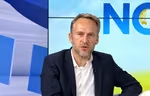
Chiara Bottici to N1: Democracy needs new utopias before authoritarianism fills the void


As liberal democracies face growing polarization, geopolitical fragmentation, the resurgence of authoritarian politics and a deep crisis of public trust, fundamental questions are being raised about the future of the political order that emerged after the Cold War. Is the liberal international order merely undergoing a period of turbulence, or are we witnessing the end of an entire political era?
In an interview with N1's Nikola Vucic, Italian philosopher and political theorist Chiara Bottici argues that today's crisis extends far beyond institutions. She says democracy has lost its ability to generate compelling political myths, while political imagination has increasingly been ceded to the authoritarian right. Bottici also discusses Donald Trump, the rise of political myth-making in the digital age, the decline of the Democratic Party's connection with the working class and why democracies urgently need new utopian visions capable of mobilizing solidarity rather than fear.
Bottici is Professor of Philosophy at Serra Hunter Distinguished Professor at the Autonomous University in Barcelona, where she has also directed programs in Gender Studies. She is widely recognized for her work on critical theory, political philosophy, feminism and the concept of political myth.
N1: In recent years, we have witnessed a profound crisis of the liberal international order that shaped the world after the Cold War. Wars, geopolitical fragmentation, the rise of China, and the declining influence of the West have all called its stability into question. Do you see this as a temporary crisis of a political model, or as the end of a historical epoch and the political imagination that sustained it?
Chiara Bottici: I see the current crisis as the result of the worldwide resurgence of right-wing populism and authoritarianism. It is no coincidence that extreme concentrations of wealth and neo-authoritarian politics have advanced together. Although the West may appear to be in decline, U.S. imperial power remains remarkably resilient, albeit in new forms that have surprised many observers. One important difference from earlier forms of imperialism is that authoritarian leaders such as Donald Trump no longer feel compelled to conceal their ambitions. As Trump himself remarked during a press briefing with New York City Mayor-elect Zohran Mamdani, yes, we can call him "a fascist." In a sense, it is easier this way: the emperor has no clothes to hide behind.
Why democracies are losing the working class
N1: At the same time, liberal democracies are facing growing public distrust, polarization, and weakening institutions. Is the problem rooted in democratic institutions themselves, or in their diminishing ability to offer a compelling vision of a shared future?
Chiara Bottici: In my view, the root of the problem lies in the extreme concentration of wealth, which enables a small number of economic and technological elites to exercise disproportionate influence over democracies that increasingly serve their interests rather than those of the broader population. In the United States, where I lived for the past sixteen years, another important factor has been the Democratic Party's growing inability to represent the working class or to articulate a political vision capable of inspiring it. Historically, many Democratic representatives came from working-class backgrounds and were therefore better equipped to understand and channel the aspirations and grievances of their constituencies. Today, many belong instead to an upper-middle-class professional elite that is often disconnected from the everyday realities of its electoral base. This has left many working-class citizens feeling politically abandoned. In the absence of meaningful political representation, many have turned to social media, where frustration and disillusionment are easily transformed into political identities. This is precisely how the alt-right pipeline operates: it recruits people who feel excluded from traditional political institutions and offers them narratives that give shape to their resentment.
N1: In your work, you argue that political myths are not necessarily falsehoods, but ways through which communities create meaning and collective identity. Can the current crisis of liberal democracy be understood as a crisis of its founding myths, progress, rationality and universal values, which no longer possess the same mobilizing power they once did?
Chiara Bottici: The current crisis is certainly also a crisis of the founding myths you mention. More worrying, however, is our collective inability to produce compelling new ones. Political myths and symbolism have largely been abandoned to right-wing movements, which, with the support of social media, have become remarkably effective at constructing powerful myths grounded in fear, exclusion and violence. The problem is not that myths have disappeared, but that democratic politics has ceased to generate myths capable of inspiring solidarity, equality and collective hope.
N1: Donald Trump is often described as a political figure who succeeded in constructing an alternative narrative of reality that, for millions of people, appeared more convincing than traditional institutional sources of authority. Is Trump the cause of the crisis of liberal democracy, or rather a symptom of a deeper crisis in the political imagination of the West?
Chiara Bottici: Trumpism is both a symptom of the current crisis and one of its causes. The absence of a convincing democratic alternative, together with the growth of the alt-right pipeline and the proliferation of xenophobic narratives, has much deeper historical roots than Trump himself. At the same time, there is little doubt that Trump has dramatically accelerated these dynamics. The contrast between his first and second presidencies illustrates this clearly. During his first term, his authoritarian and neo-fascist rhetoric still encountered resistance from key pillars of American democracy, including the judiciary, federalism and the constitutional separation of powers. During his second term, much of that resistance has weakened. Trump enjoys the support of a conservative Supreme Court, relies extensively on executive orders to bypass Congress, where his party also holds a majority, and has increasingly used ICE to enforce his political agenda, including conducting deportation operations in cities that have declared themselves sanctuary jurisdictions, such as New York City. In all these cases, we can see how he has contributed destroying democracy and I am sure this will be of inspiration to other authoritarian leaders worldwide.
Why political myths still matter
N1: If political myths shape the way people understand the world, how do you explain the willingness of many individuals today to embrace narratives that seem to conflict with empirical evidence? Are people ultimately searching for truth, or for meaning, belonging and identity?
Chiara Bottici: Political myths function as self-fulfilling prophecies. They do not seek merely to describe reality; they actively participate in creating it. Consider the founding myth of MAGA, "Make America Great Again!" It rests on the assumption that America was once "great" and has declined because of Democrats, immigrants, feminists, transgender people and other groups portrayed as responsible for national decay. Once these groups become the targets of state policies, as we have seen through mass deportations and the persecution of migrants, including many with legal status, the myth performs itself. America is presented as becoming "great again" precisely through the exclusion and removal of those who had first been constructed as its enemies, regardless of whether they ever had any empirically verified role in the country's supposed decline. Political myths therefore derive their force less from empirical truth than from their capacity to organize collective action and produce the very reality they claim merely to describe.
N1: We are often told that we live in an age of "post-truth." Do you believe we are witnessing the erosion of the very idea of truth, or merely a transformation in the mechanisms through which societies determine what is credible and worthy of trust?
Chiara Bottici: We live in a society of the spectacle, one in which images shape public life to an unprecedented degree. Consider how many images mediate political life today compared with even two centuries ago: the increase is exponential. Yet it is not only the quantity of images that has changed, but also their nature. Digital images are no longer fixed representations; they are dynamic processes that can be endlessly modified, circulated and recombined. This transformation has profoundly altered our relationship both to images and to the political world they mediate. Put somewhat provocatively, we might even say that images no longer simply mediate politics; they increasingly perform politics in our place.
N1: If political imagination is central to shaping social and political life, what kind of new imaginary could respond to today's crises, from geopolitical conflict and climate change to growing inequality and democratic decline, without sliding into authoritarian or exclusionary political myths?
Chiara Bottici: We urgently need new political imaginaries. We need new utopias, new visions of a society that is more egalitarian and in which everyone's basic needs, including food, shelter, healthcare, education and rest, are guaranteed. But we must also fundamentally rethink our relationship with the Earth, because there is no Planet B. At the same time, we need new ways of relating across difference, not through the false promise of an abstract universalism, but through the recognition of our shared humanity amid differences of race, gender, class, nationality and political affiliation. The challenge is to develop political myths capable of mobilizing solidarity rather than exclusion, and hope rather than fear. The task is daunting, but we cannot avoid it. And there are already many of us who are working in that direction.
Kakvo je tvoje mišljenje o ovome?
Učestvuj u diskusiji ili pročitaj komentare


Kakvo je tvoje mišljenje o ovome?
Učestvuj u diskusiji ili pročitaj komentare