Srbija
 Hrvatska
 Slovenija

Karlica acquittal exposes shortcomings of transferring war crimes cases to Serbia


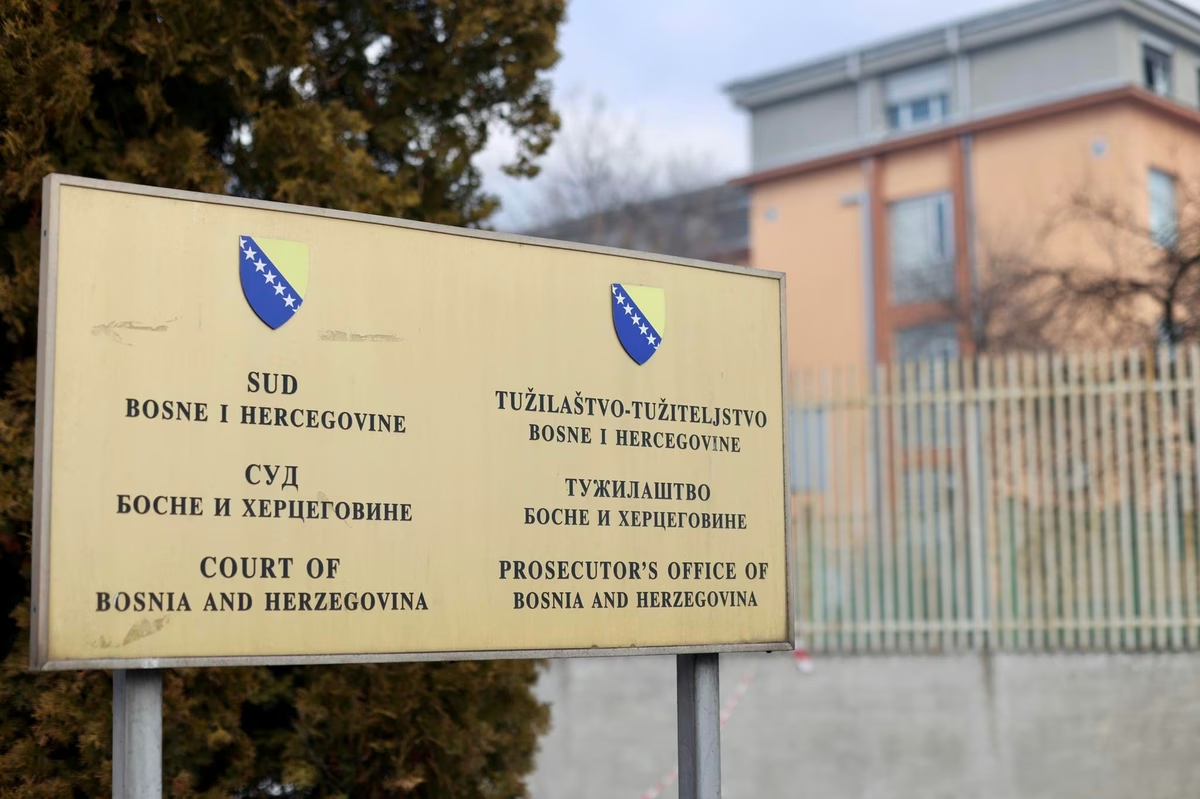
Although the Court of Bosnia and Herzegovina has sentenced several people to more than 180 years in prison for war crimes in Alici and Ekici, near Bosanski Novi, the Higher Court in Belgrade this week acquitted two people of crimes related to the same events. The verdicts have prompted victims’ families and experts to warn that transferring cases to Serbia does not guarantee effective prosecution, undermines trust in the judiciary and raises questions about regional cooperation.
Bekir Alic survived the June 22, 1992, attack on the villages of Alici and Ekici, in which 24 people were killed, including members of his family. He told Detektor that he had left the village by chance and gone to another settlement. By the time he returned, the attack and killings had already taken place.
"On June 22, 1992, my father, brother, maternal uncle, his two sons and my nephew were killed. They were all neighbors and relatives, some close, some more distant. These were people you were born alongside, lived with your whole life and were connected to. Unfortunately, the killers were also our neighbors, people we went to elementary and high school with, worked with and stood alongside at the same bus stop," Alic said. He has testified several times in cases concerning crimes in the two villages.
The Court of BiH sentenced ten people to a total of 162 years in prison for crimes committed in Bosanski Novi. Ranko Balaban, Ratko Goronja, Nikola Reljic, Mirko Odzic, and Ranko and Dragan Baltic each received 18 years. Rajko Karlica, Milenko Brcin and Milenko Babic were each sentenced to 15 years, while Miroslav Kapetanovic received nine years. In a separate case, the state court sentenced Stojan Kenjalo, Zoran Kenjalo and Dragan Balaban to a total of 19 years after accepting their guilty pleas for the killings, forced displacement and torture of Bosniaks in Bosanski Novi.
In January 2022, Serbia took over the cases against Zeljko Novakovic and Milenko Karlica. Both were subsequently acquitted of involvement in the attack and killings on June 22, 1992. Novakovic had been indicted in June 2019 for participating in the killings, torture and persecution of Bosniak civilians from Ekici and Alici, while Karlica was indicted in early 2016.
The Prosecutor's Office of BiH may transfer cases to Serbian judicial authorities under a 2013 protocol on cooperation in prosecuting war crimes, intended to prevent suspects with dual citizenship from evading prosecution.
Marijana Cestic Jelovac, a legal analyst with the Humanitarian Law Center, told Detektor that transferring cases to Serbia is an important mechanism for prosecuting Serbian citizens suspected of war crimes when proceedings in Bosnia and Herzegovina are not possible. However, the Karlica case shows that transferring a case alone does not guarantee effective prosecution.
She said the indictment brought by Serbia's War Crimes Prosecutor's Office did not cover the same factual and legal framework as the indictment transferred from BiH. The Serbian prosecutor's office has refused to bring charges of crimes against humanity, resulting in a different legal classification. She also criticized the prosecution for failing to propose new evidence during the retrial, which concluded after a single hearing, and the court for failing to assess the evidence in the broader context of the attack and the forced displacement of Bosniak civilians.
According to Cestic Jelovac, the court relied on revised testimony by Stojan and Zoran Kenjalo, who had identified Karlica as the organizer of the attack during proceedings before the Court of BiH. They later claimed they had implicated him to obtain lighter sentences. She noted that the indictment against Karlica had been issued before the indictments against the Kenjalos.
Alic described the proceedings in Belgrade as meaningless and distressing for victims and witnesses. He said the prosecution appeared to be acting like the defense, while defense lawyers put witnesses in difficult positions.
"I am disappointed with these proceedings in Belgrade. It is difficult. I would not say that a person gets used to it over time, but through these proceedings you come to understand that some people are simply doing their jobs. I understand that judges and prosecutors cannot identify with every victim. They are professionals, and I can understand that. But when it seems that everything is slipping through their hands, it all becomes meaningless," Alic said.
Murat Tahirovic, president of the Association of Victims and Witnesses of Genocide, said the prosecution of war crimes had become increasingly meaningless in Bosnia and Herzegovina, let alone in Serbia and Croatia. He cited a case involving eight police officers from Kravica that began in 2015 and remains unresolved, saying proceedings are repeatedly delayed.
"Every case transferred there will fail to reach the necessary outcome. If there is a conviction, it will be minimal, or there will be an acquittal. We no longer have the time or the means to fix the situation," Tahirovic said.
Cestic Jelovac argued that cooperation between prosecutors' offices should extend beyond transferring completed cases when suspects are unavailable. Joint investigations and teams involving prosecutors from BiH and Serbia could improve the efficiency of proceedings in both countries and help rebuild victims' trust. She also pointed to insufficient communication with witnesses and cases in which victims' families were not informed that proceedings had begun in Serbia.
She stressed that individual criminal responsibility must be established in every case, regardless of whether the charges concern command responsibility or direct participation. However, differing outcomes in cases concerning the same events can deepen survivors' sense of injustice and further undermine their confidence in the judicial system.
According to Detektor's database of judicially established facts, 24 Bosniak civilians from the hamlets of Alici and Ekici, in the Maslovare area, were killed by members of Serbian armed forces at the local cemetery on June 22, 1992. Some bodies were exhumed after the war, while others have never been found. The mass grave had been disturbed, and most of the remains were thrown into a river.
Residents were forced from their homes and taken to a house, where men were separated from women and children and taken to the cemetery. Women and children were transported by tractor to the Urije settlement, and their gold and money were confiscated.
"We must fight for the truth and for justice. It is our duty to those who were killed and to our children, who need to know what happened and who did what. Not so they can take revenge, but so they can know," Alic said.
Kakvo je tvoje mišljenje o ovome?
Učestvuj u diskusiji ili pročitaj komentare


Kakvo je tvoje mišljenje o ovome?
Učestvuj u diskusiji ili pročitaj komentare