Srbija
 Hrvatska
 Slovenija

Natasa Kandic on Ratko Mladic's death: Trial record remains, but propaganda has shaped a generation


The death of Ratko Mladic does not close the chapter on the conflicts of the 1990s, as his trial leaves behind thousands of adjudicated facts and tens of thousands of evidence items that future generations will study, according to Natasa Kandic, founder of the Humanitarian Law Center and a longtime human rights activist. Speaking to N1, Kandic emphasized the enduring weight of the legal record while warning of how Serbian media and political propaganda have distorted public perception among younger populations.
Reflecting on the extensive judicial proceedings spanning 530 days, Kandic stated, "It seems to me that we will never close the chapter relating to the period from the nineties." She added, "We need to read all that, what happened and what stands in 2.000 adjudicated facts, in tens of thousands of evidence items reviewed during the trial of Ratko Mladic. That is something that generations will read, study, and interpret."
Kandic also defended the Residual Mechanism's decision to reject requests for Mladic to spend his final months receiving medical treatment in Serbia, noting that he spent years evading justice before being provided with proper medical care in detention. "He hid, he ran away from justice," she said, stressing the importance of fulfilling the court-mandated sentence.


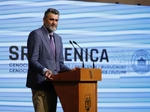

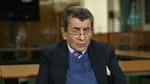

Kandic sharply criticized media reporting in Serbia following Mladic's passing. "Most media address him as a general, 'the general has passed away,' and then begin with information about his biography which, as presented, acts like the biography of a famous military commander," she noted. She warned that state-controlled programming would likely promote narratives depicting Mladic as a savior rather than addressing his war crimes, such as the sniper and artillery terror directed against civilians in Sarajevo. "That was sniper terror over civilians in Sarajevo and those are things that cannot be covered up, everything cannot be put aside now with his death," she declared.
Addressing the broader societal impact, Kandic argued that long-term political messaging has severely hindered facing the past. "We are currently witnesses that propaganda over the past 13-14 years has acted terribly on young generations, that it is instilled in their minds, and that the propaganda has succeeded, so that they now think that Ratko Mladic is truly a fighter, that he is a hero who managed to stop some genocide against the Serbian people," she stated.
She noted that overcoming this ideological shift requires a fundamental change in political leadership and educational institutions. "Institutions have completely failed," Kandic concluded, warning that political elites continue to exploit nationalism to maintain power, leaving society at risk of distancing itself even further from historical truth.
Kakvo je tvoje mišljenje o ovome?
Učestvuj u diskusiji ili pročitaj komentare


Kakvo je tvoje mišljenje o ovome?
Učestvuj u diskusiji ili pročitaj komentare