Srbija
 Hrvatska
 Slovenija

Schmidt: Situation in Bosnia is specific, country needs more of EU's understanding


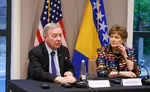
International community's peace envoy in Bosnia and Herzegovina Christian Schmidt assessed that Bosnia's European path requires greater engagement of domestic politicians, but also more understanding of the European Union.
"We must explain that the situation in BiH is specific and cannot be compared, for example, with the integration of Lithuania. Therefore, I am a supporter of the ideas of Alexander Schallenberg and Antonio Tajani, and we should say: let's move forward, let's start the integration process. At the Thessaloniki Conference in 2003, the European Union promised the integration of the Western Balkans. However, 23 years later, we see that little has been achieved," Schmidt told Vecernji list daily.
He also said that the European Union itself has an interest in integrating BiH and the Western Balkans, for security, economic and historical reasons, but he is convinced that not all actors in BiH are fully committed to this idea.
State property issue
Commenting on the months-long deadlock in the work of the House of Peoples, the High Representative warned that politicians "are not paid to do nothing" and called for urgent decisions. He particularly referred to the issue of state property, which is holding back billions-worth of investments.
"I cannot change the Dayton Constitution, but there is a solution. BiH is the only state of the former Yugoslavia that has not resolved the issue of property succession at the state level. It is necessary to pass a state law that would distribute property between entities, cantons and municipalities," said the High Representative, who is in charge of overseeing the implementation of the Dayton Peace Accords, a peace treaty that ended the 1992-95 war and established the constitutional system of BiH.
He stressed that he would rather leave the solution to local politicians, acknowledging that the current ban on the disposal of state property is economically damaging to the country.
"I would like there to be more political pressure on local political representatives. If someone reads my decision on the ban on the disposal of state property in detail, they will see that there is a way out, or rather a solution. There would be a commission that would decide whether there is a public interest, in what way, and the like. All that is needed for that is a decision by the Council of Ministers. I believe that this is truly necessary and I am ready to support that process," said Schmidt.
Bonn Powers and the Election Law
When asked about his own intervention to resolve the Election Law, which is an issue of particular importance for the Croat people in BiH, Schmidt expressed his reservations about that idea.
"We must recognize that there is a discrepancy between constitutional rules, the Election Law and the expectations of some political leaders. European rules, the Copenhagen criteria, require respect for judgments, including the Sejdić-Finci judgment (the issue of minorities running for the Presidency), which will also affect the election law. The solutions discussed in Neum three years ago were not bad. I believe that respect for all constituent peoples in the Federation (one of Bosnia's two entities where power is shared by the Bosniaks and the Croats) should be enabled, without separating the electorate. This is a complex issue and requires broad support. I would like to not have to get into the situation of using the Bonn powers for this issue," said Schmidt, who has a special authority prescribed by the Dayton agreement to impose laws and remove officials.
According to him, the role of the Bonn powers will decrease more and more as the process of European integration progresses:
"I believe that people in this wonderful country can and know that they should make their own decisions, and not have someone else do it for them. The role of the high representative, in my opinion, is to somehow hold a mirror to society so that it can see its own reflection. In such a case, Bonn powers would no longer be needed."
According to him, what Bosnia and Herzegovina as a state lacks is greater control of citizens over politicians, that is, that citizens determine how politicians will behave.
Accordingly, it is extremely important to ensure and strengthen the integrity of the election process, said Schmidt, adding that the parties will do everything to make these efforts a reality.
Kakvo je tvoje mišljenje o ovome?
Učestvuj u diskusiji ili pročitaj komentare


Kakvo je tvoje mišljenje o ovome?
Učestvuj u diskusiji ili pročitaj komentare