Srbija
 Hrvatska
 Slovenija

Srebrenica Memorial Center hosts conference on genocide education to counter political manipulation and denial


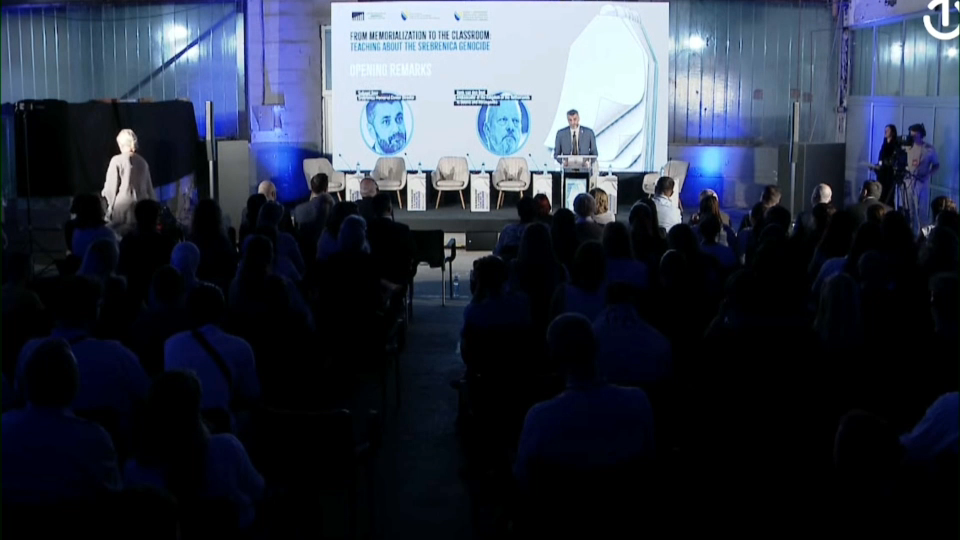
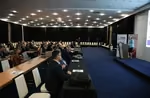
The Srebrenica Memorial Center has organized a dedicated conference focused on teaching about the Srebrenica genocide. The international gathering aims to facilitate the exchange of experiences and strengthen educational programs addressing one of the darkest chapters of European history since the Second World War.
Opening the conference, the Director of the Srebrenica Memorial Center, Emir Suljagic, thanked all participants for attending, emphasizing that the institution never takes visits to Potocari for granted.
"We know that a certain effort is needed to come here. We know that a certain effort is required to stay here. We know that this takes time and resources, but that is also part of our struggle to ensure that people always have a reason to come here," Suljagic stated.
Reflecting on the deeper significance of the location, Suljagic explained that remembrance at the site is tied to real human experiences rather than theoretical concepts.
"Here in Potocari, memory is not an abstract concept. It has a name, it has a face, it has a family, it has a grave," he noted, reminding attendees that the Memorial Center exists because internationally and judicially established truths proved genocide was committed there. "But it does not exist solely to preserve the memory of the dead. It also exists for the living."
The director warned that memorialization is insufficient if it remains confined within museum walls or limited to a single annual commemoration.
"Memory becomes a social value only when it becomes knowledge, and knowledge becomes history when it enters the classroom," Suljagic noted. "We are not just talking about how to remember the Srebrenica genocide. We are talking about how to teach it. Those two things are not the same."
According to him, teaching about genocide requires explaining how a society can gradually normalize exclusion, discrimination, and hatred.
"To teach means to explain to young people how a society can gradually become accustomed to exclusion, discrimination, and hatred, how propaganda can replace facts, how institutions can become instruments of persecution, how words can prepare the ground for crimes, and how genocide never happens suddenly," Suljagic explained. He added that it represents "the end of a long process in which too many people decide to remain silent or to complicit."
Consequently, he emphasized that genocide education extends beyond the history of Bosnia and Herzegovina, calling it "an education about the responsibility of every democratic society to recognize the signs while there is still an opportunity to act."
Addressing contemporary challenges, the Director raised concerns over the exploitation of historical data.
"We live in a time in which historical facts are no longer the subject of scientific debate, but of political manipulation. A time in which genocide denial is presented as a legitimate opinion, and the glorification of war criminals as patriotism," he warned. "This is not just an attack on the dignity of the victims. It is an attack on the very idea of education, because education rests on the simple assumption that facts exist and that truth is not a matter of political choice."
Looking forward, Suljagic noted that the Memorial Center views its mission as an active educational authority.
"Our obligation is to be an educational institution, to develop curricula, create new sources of knowledge, cooperate with teachers and universities, and build an international network of people who understand that knowledge and the distribution of that knowledge is the only possible way to work toward a peaceful future in this country," he said.
He stressed that while current generations cannot change July 1995, they hold the power to decide what today's children will learn.
"Every generation decides what kind of legacy it will leave to the one that comes after it. We cannot change July 1995. But we can decide whether the children sitting in school desks today will grow up in a world where they will learn about it from facts or from lies. That is the choice we are making today," Suljagic noted, observing that societies choosing to live apart from facts face an unsustainable future.
Concluding his address, Suljagic thanked the participants, highlighting that shared human values, rather than financial or political incentives, brought them to Potocari.
"None of you came here today for money or because of money. None of you were, quote-unquote, lobbied. You received invitations, checked if you had time, and decided to come," he stated, adding that the attendees are united by a conviction that facts must remain the baseline of any debate. "We gather people here based on values. Here are people who believe in and hold their own humanity as a fundamental value."
He expressed his final gratitude to the attendees for choosing to educate themselves and bring the experience of Potočari back to their own communities.
"Thank you for deciding to come here and to educate yourselves, to share with us a little bit of how we felt or could have felt here in July 1995, and for letting that inspire you when you return home, so that you do not tolerate injustice where it is within your capabilities and where you can," Suljagic concluded.
Kakvo je tvoje mišljenje o ovome?
Učestvuj u diskusiji ili pročitaj komentare


Kakvo je tvoje mišljenje o ovome?
Učestvuj u diskusiji ili pročitaj komentare