Srbija
 Hrvatska
 Slovenija

Costa urges BiH to speed up EU reforms as Presidency Members clash over NATO and OHR


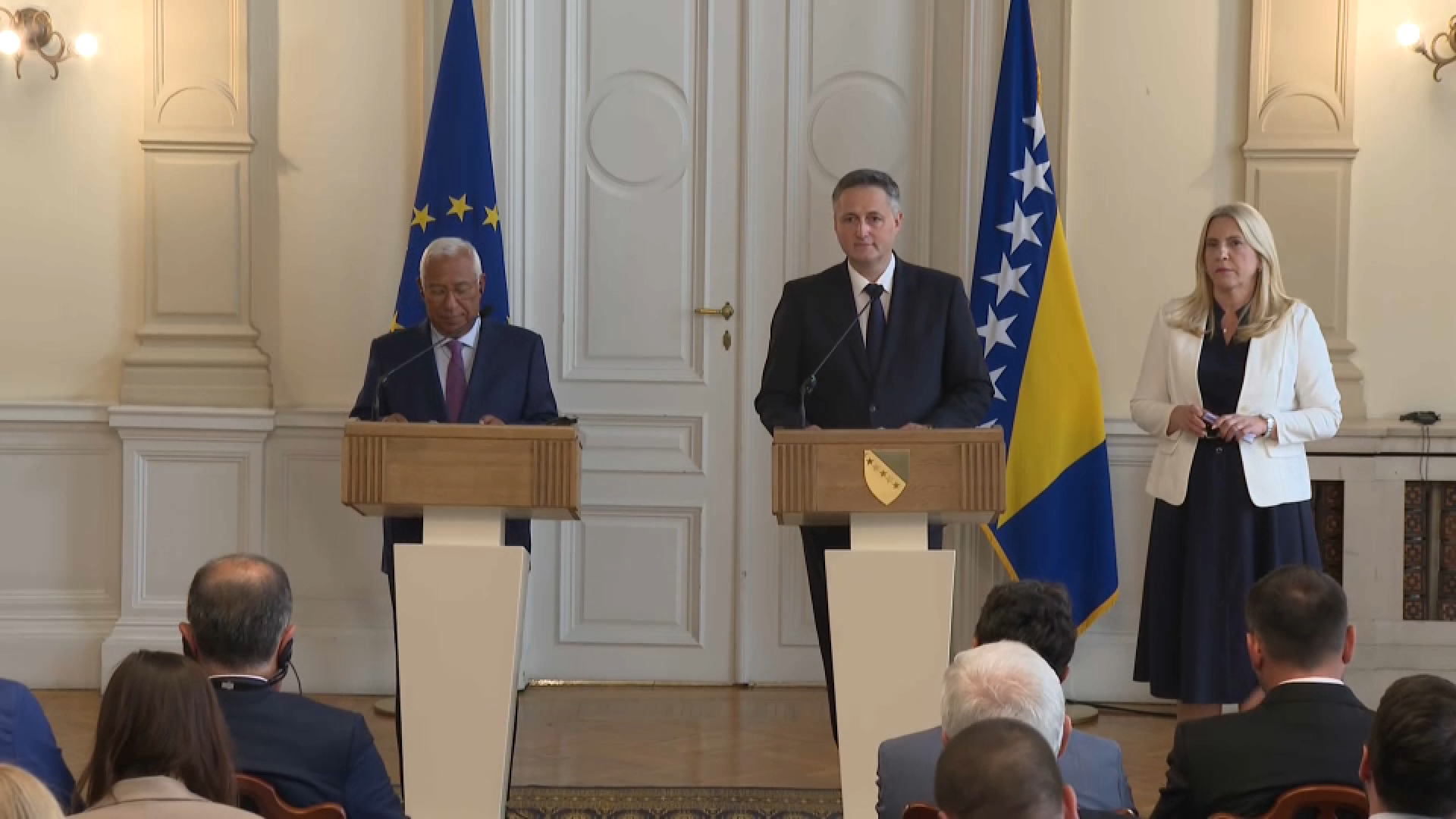
The President of the European Council, António Costa, used a visit to Sarajevo on Monday to urge Bosnia and Herzegovina’s leaders to accelerate reforms needed for EU accession, while members of the country’s tripartite presidency publicly highlighted deep divisions over NATO membership and the future of the international High Representative.
Speaking after a meeting with Bosnia’s Presidency, Costa said the country was only “a few steps away” from reaching the next stage of its EU accession process, but warned that delays in implementing reforms could come at a significant financial cost. “Bosnia and Herzegovina must decide whether it will do what is necessary to share the same future in the European Union,” Costa said, calling on authorities to complete remaining judicial reforms, appoint a chief negotiator and begin implementing the Reform Agenda required under the EU’s Growth Plan. He warned that Bosnia had already lost €108 million in potential EU funding and that a further €373 million could be at risk in the coming months if reforms are not implemented.
The visit also exposed longstanding political disagreements within Bosnia’s leadership.
Chairman of the Presidency Denis Bećirović described membership in both the European Union and NATO as Bosnia’s strategic foreign policy objectives.
“We reiterated once again that membership in the European Union and NATO are strategically defined foreign policy goals of Bosnia and Herzegovina,” Becirovic said.
He also praised the role of the EU-led peacekeeping mission EUFOR Althea and argued that the mandate of the Office of the High Representative (OHR) should remain intact.
According to Becirovic, weakening the OHR could threaten peace and stability in Bosnia and the wider region.
However, Presidency member Zeljka Cvijanovic challenged that position, stressing that NATO membership was not discussed during the meeting with Costa.
“We did not talk about any NATO path today. We talked about what needs to be done regarding Bosnia and Herzegovina’s European path,” Cvijanovic said.
She also reiterated the position of BiH's Republika Srpska entity that the OHR should be closed, arguing that three decades after the war, Bosnia should no longer be governed by decisions imposed by international officials.
Costa avoided taking sides in the domestic dispute but stressed that Bosnia’s future lies in the European Union.
He said the next High Representative should embody the country’s commitment to EU integration and highlighted continued EU support through security assistance, investment programmes and gradual integration into the bloc’s single market.
The press conference ended with another exchange between Becirovic and Cvijanovic over the constitutional role of Presidency members.
Becirovic argued that once elected, members of the Presidency represent the state of Bosnia and Herzegovina rather than the entities from which they are elected. Cvijanovic responded that Bosnia and Herzegovina cannot function without its entities and that the Serb member of the Presidency is constitutionally obliged to protect the interests of Republika Srpska.
Costa’s visit to Sarajevo marks the first stop on his Western Balkans tour, which aims to reaffirm the European Union’s commitment to enlargement amid growing concerns over political stagnation and reform delays in the region.
Kakvo je tvoje mišljenje o ovome?
Učestvuj u diskusiji ili pročitaj komentare


Kakvo je tvoje mišljenje o ovome?
Učestvuj u diskusiji ili pročitaj komentare