Srbija
 Hrvatska
 Slovenija

Dutch Ambassador declares Srebrenica genocide education a shared international moral responsibility


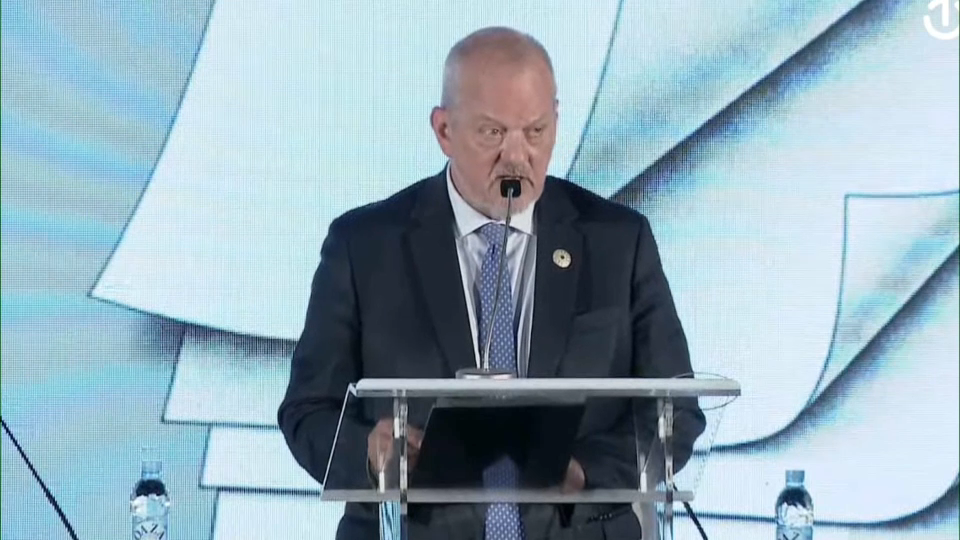
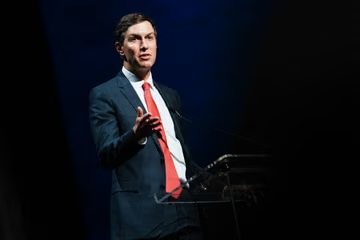
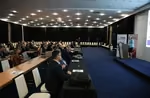
Education about the Srebrenica genocide represents a profound moral responsibility and stands as one of the most vital pathways toward preserving historical truth and preventing future atrocities, the Ambassador of the Kingdom of the Netherlands to Bosnia and Herzegovina, Henk van den Dool, declared during a major educational conference. Speaking at the Srebrenica Memorial Center during the "Teaching about the Srebrenica Genocide" conference, the ambassador stressed that safeguarding this memory remains a collective global duty.
Addressing the Mothers of Srebrenica, survivors, victims' families, and representatives of domestic and international institutions, Van den Dool emphasized that his remarks stem from a genuine desire for universal peace. "Everything I say, I am honoured and proud to say. It should be understood in the context of a sincere desire that none of us, nor any of our countries, ever comes into a position to face the violence of genocide and to participate in the process of transitional justice," the ambassador stated.
He added that assembling at the Memorial Center itself serves as a testament to a painful history that should never have occurred, noting, "But we are here because it did happen, and it is both our duty and honor to contribute to remembrance, education, and the prevention of future crimes anywhere in the world."
The Netherlands actively shares a unified vision with the Srebrenica Memorial Center, the survivors, and the families to transform this enduring warning into decisive actions. "One of the common goals we share with the Srebrenica Memorial Center, with the mothers, and with the survivors is to turn this permanent warning into meaningful deeds. One of the most significant and effective ways to do this is through education, and that is why it is an honor that the Government of the Kingdom of the Netherlands can support this important aspect of the Memorial Center’s work," Van den Dool remarked.
The ambassador made it clear that such educational efforts must transcend purely academic boundaries. "Genocide education is not an academic subject. It is a moral responsibility. Through education, we preserve historical facts, strengthen critical thinking, and empower future generations to recognize the dangers of denial and hate speech," he said.
He further emphasized that the international scope of the conference demonstrates that preserving this specific history extends far beyond local borders, stating, "Today's conference is the best illustration that preserving the memory of the Srebrenica genocide is not the obligation of one institution or one country. It is a shared international responsibility that needs to be translated into commitment and cooperation."
Highlighting practical outcomes of this partnership, Van den Dool pointed to the ongoing Srebrenica summer school, which brings together international youth and experts. "Today we have with us here students from 19 countries participating in the summer school in Srebrenica. Together, they are learning about the Srebrenica genocide firsthand, from survivors and descendants of the victims, while at the same time cooperating with lecturers from Italy, Great Britain, the Netherlands, and other countries," he explained, reinforcing that such educational partnerships build foundational trust and are "extremely important for the reconciliation process."
Paying special tribute to the courage of the survivors, Van den Dool offered his "deepest respect to the families of the survivors and victims," identifying their bravery as the absolute cornerstone of this institutional work. He explicitly extended thanks to the Mothers of Srebrenica, specifically mentioning Munira and Kada, alongside the staff of the Memorial Center. The ambassador also credited Dutch institutional partners, including the Anne Frank House, the University of Amsterdam, and Fontys University, stating that "what has been achieved so far would have been impossible some ten years ago."
Looking ahead, Van den Dool expressed hope that the dialogue would generate practical initiatives and a stronger international network to counter denial, concluding that the future curriculum will remain firmly anchored in established facts. The curriculum will utilize international court verdicts and scientific evidence, including DNA analyses from the International Commission on Missing Persons, because "in this way, we help maintain the memory of those who are no longer with us and give them a voice that the world needs to hear."
Kakvo je tvoje mišljenje o ovome?
Učestvuj u diskusiji ili pročitaj komentare


Kakvo je tvoje mišljenje o ovome?
Učestvuj u diskusiji ili pročitaj komentare