Srbija
 Hrvatska
 Slovenija

Becirovic: Closure of OHR can be discussed only after the 5+2 agenda is fulfilled


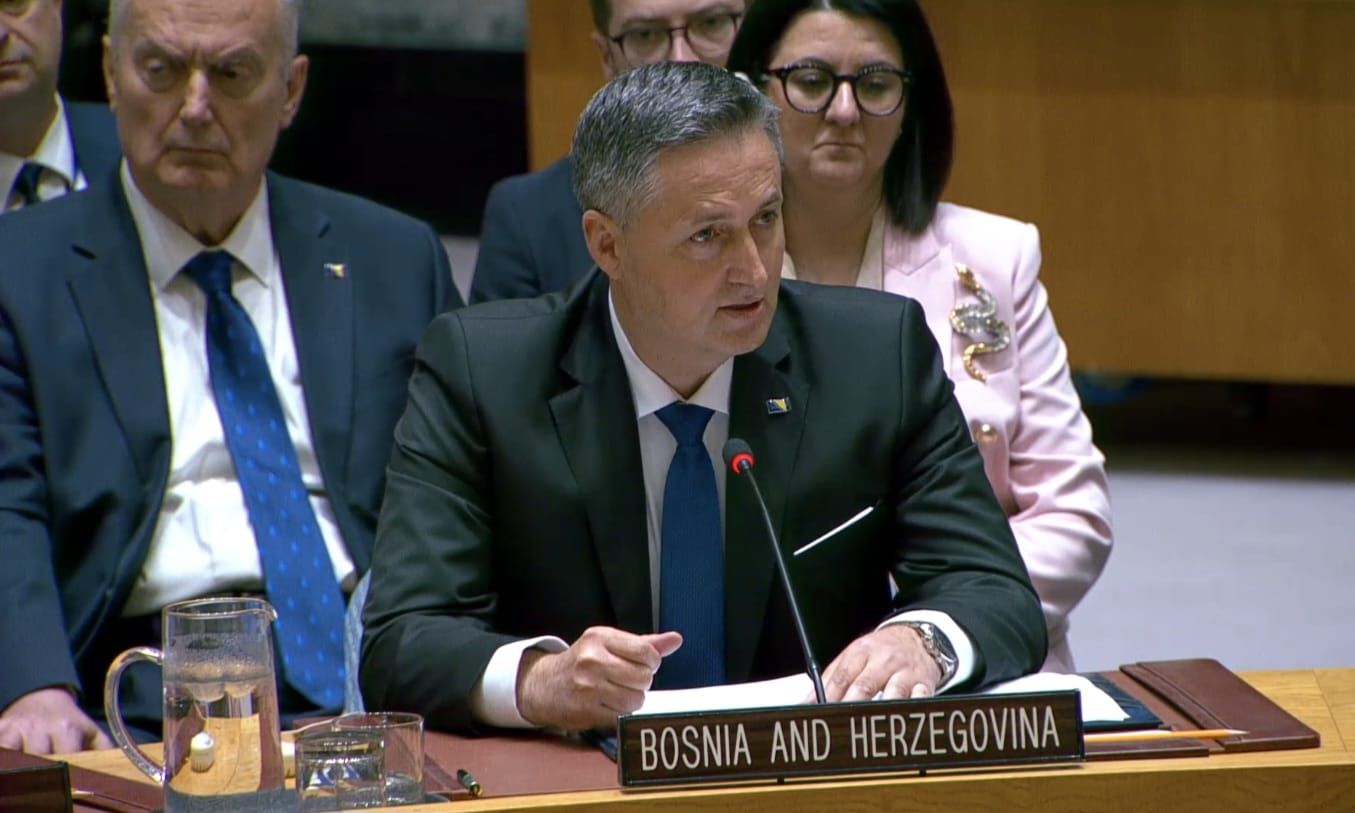
Chairperson of the Presidency of Bosnia and Herzegovina, Denis Becirovic, addressed the session of the United Nations (UN) Security Council in New York regarding the Report of High Representative in BiH Christian Schmidt on the situation in Bosnia and Herzegovina.
The address of Chairperson Becirovic follows below in its entirety:
“Mr. President,
Excellencies,
At the outset of my address, I would like to take this opportunity to greet the President of the United Nations Security Council, the distinguished ambassadors of the UN Security Council member states and other ambassadors, as well as Mr. Christian Schmidt, High Representative of the international community in Bosnia and Herzegovina.
From the High Representative’s Report, it can be observed that the political and security situation in Bosnia and Herzegovina is complex and challenging.
This document further confirms the importance of the continued attention of the international community, with the aim of protecting peace, stability, and the General Framework Agreement for Peace in Bosnia and Herzegovina (the Dayton Peace Agreement).
Ladies and gentlemen,
Despite numerous challenges, Bosnia and Herzegovina has achieved significant progress on its European and Euro-Atlantic path.
On December 15, 2022, the European Council decided to grant Bosnia and Herzegovina candidate status for EU membership.
On March 21, 2024, the European Council adopted the decision to open accession negotiations with Bosnia and Herzegovina.
We adopted and submitted six reform programs of BiH to NATO headquarters in Brussels, and preparations are underway for the adoption of this document for 2026.
Bosnia and Herzegovina has fulfilled the conditions to receive an invitation for NATO membership.
Our results would have been even better had there not been constant obstructions and blockades from the Republika Srpska entity.
In order to objectively assess the current situation in Bosnia and Herzegovina, it is necessary to point to the facts that preceded the current state of affairs.
I particularly emphasize the following:
- The Republic of Bosnia and Herzegovina, a UN member state, was the victim of brutal aggression from 1992 to 1995;
- Joint criminal enterprises were carried out against the Republic of Bosnia and Herzegovina;
- Genocide was committed against Bosniaks, the only genocide in Europe after World War II;
- Proponents of Greater State policies continue, even in the post-Dayton period, to pursue objectives that were not achieved during the armed aggression.
Ignoring these facts, established also by the judgments of UN courts, helps no one. On the contrary, neglecting them can lead to a false diagnosis of the situation and, subsequently, potentially new wrong steps.
We must not allow that.
Ladies and gentlemen,
A very difficult year, 2025, is behind us.
The anti-Dayton policy of the leadership of the Republika Srpska entity brought Bosnia and Herzegovina to the brink of armed conflict.
We avoided the worst-case scenario thanks to institutional and responsible action on the legal and foreign policy fronts.
We also learned an important lesson: any undermining of the position and competencies of the Constitutional Court of BiH, state judicial institutions, and the High Representative could have unforeseeable consequences for peace and stability in Bosnia and Herzegovina and this part of Europe.
I especially want to warn of the danger of undermining the role of the High Representative.
The High Representative exists based on Annex 10 of the Dayton Peace Agreement and is the final authority in theater regarding the interpretation of the civilian implementation of the Agreement.
The signatories and witnesses of the Dayton Peace Agreement knew even at the end of 1995 that this was an important institution for protecting this international agreement. They knew that the Agreement as a whole could not function without Annex 10.
The Dayton Peace Agreement is not a menu from which you can choose what you want and what you do not want. It is an international agreement that must be respected in its entirety.
The forthcoming appointment of a new High Representative should be carried out in a way that:
- As before, the Peace Implementation Council selects the new High Representative;
- The competencies and mandate of the High Representative are not undermined.
- The closure of the OHR can only be discussed after the 5+2 program has been fulfilled.
To conclude: the problem of Bosnia and Herzegovina is not the High Representative, but rather the anti-Dayton policy that openly advocates the destruction of the Dayton Peace Agreement and Bosnia and Herzegovina.
Ladies and gentlemen,
Let us be completely clear and direct: it is the leadership of the Republika Srpska entity, not the High Representative, that is undermining the Dayton Peace Agreement.
It is time to stop those who are destroying the Agreement, not weaken the institutions that protect it.
Neighboring states, the Republic of Serbia and the Republic of Croatia, do not have the right to interfere in the internal affairs of the state of Bosnia and Herzegovina.
They are not guarantors, but signatories to the Dayton Peace Agreement. Therefore, Serbia and Croatia undertook an additional international obligation to respect the independence, sovereignty, and territorial integrity of Bosnia and Herzegovina, as well as the judgments of UN courts.
It is extremely important that all members of the Steering Board of the Peace Implementation Council, on the occasion of the 30th anniversary of the Dayton Peace Agreement, emphasized the importance of respecting the sovereignty, territorial integrity, and constitutional order of Bosnia and Herzegovina.
On that occasion, the members of the Steering Board particularly emphasized that:
Bosnia and Herzegovina was not created in 1995, but continued its legal continuity;
Sovereignty belongs exclusively to Bosnia and Herzegovina as a single state;
The entities exist on the basis of the Constitution of BiH and do not possess their own sovereignty.
The leaders of the Republika Srpska entity continue to undermine the Dayton Peace Agreement.
They publicly advocate:
- The unilateral destruction of the Dayton Peace Agreement;
- The destruction of the state of Bosnia and Herzegovina;
- And other violations of international and domestic law.
Ladies and gentlemen,
It is scandalous that the leaders of the Republika Srpska entity signed a contract with a lobbying firm aimed at undermining the Dayton Peace Agreement.
The contract lists as its main objectives:
- Changing the foreign policy of the United States toward Bosnia and Herzegovina;
- Redefining the status of the Republika Srpska entity;
- Securing international support for secession;
- And challenging the fundamental parts of the Dayton Peace Agreement.
Such anti-Dayton policy directly threatens peace and stability throughout the region.
The dangerous policy is also reflected in the so-called report illegally submitted to the UN Security Council by the Government of the Republika Srpska entity.
In addition to falsehoods, the report contains elements of propaganda similar to what we witnessed before the genocide against Bosniaks was carried out.
Let me be clear: this is the reactivation of genocidal propaganda.
Politicians who glorify convicted war criminals are trying to turn the victim into a target for a new genocide.
This is unacceptable, shameful, and extremely dangerous.
Destructive political forces are trying to create dangerous ethnic divisions, including the creation of a so-called third entity.
Such irrational policies caused enormous evil during the 1990s and must be cut off at the root, because they could once again lead to conflicts and suffering.
A gathering was recently held in Zagreb, where maps of ethnic divisions in Bosnia and Herzegovina were once again being drawn.
Therefore, here in the UN Security Council, I want to be very clear: advocating ethnic divisions in Bosnia and Herzegovina is not politics, it is a direct threat to peace.
History teaches us that whenever maps dividing Bosnia and Herzegovina were drawn in Belgrade and Zagreb, the citizens and peoples of my country suffered
It is our shared obligation and responsibility never again to allow borders to be drawn over open wounds.
The citizens and peoples of Bosnia and Herzegovina deserve peace, stability, and economic progress.
One of the frequent political deceptions of anti-Dayton forces is the spreading of fear of unitarism in Bosnia and Herzegovina.
Speaking about the danger of unitarism and centralism in deeply decentralized Bosnia and Herzegovina is completely meaningless.
Intimidation through alleged unitarism aims to:
Therefore, here as well, at the UN Security Council session, it should be clearly stated that this is a political narrative of proponents of Greater State policies.
Ladies and gentlemen,
Today, I address you not only as Chairperson of the Presidency of BiH, but also as the voice of millions of people from Bosnia and Herzegovina who believe in the future.
Our future is not based on divisions, but on knowledge, innovation, and the dignity of every human being.
My vision of Bosnia and Herzegovina is a stable, secure, educated, and digitally developed European state – a society of shared values, sustainable development, and strong institutions.
What should be done in Bosnia and Herzegovina?
First, according to international and domestic law, as well as final and binding rulings of the Constitutional Court of BiH, state property belongs to the state of Bosnia and Herzegovina.
There must be no political bargaining over this issue.
Second, it is necessary to proceed with the implementation of the judgments of the European Court of Human Rights in Strasbourg.
In this process, it is necessary to strengthen the democratic and multiethnic state of Bosnia and Herzegovina and eliminate every form of discrimination against citizens.
Third, the Constitution of BiH clearly defines the supremacy of the state of Bosnia and Herzegovina over the entities.
In this context, the message of the members of the Steering Board of the Peace Implementation Council is also important – that the Constitution of BiH must be fully respected and that it takes precedence over entity constitutions and laws.
Fourth, I believe it is important that the UN Security Council in 2026 also adopt the Decision extending the mandate of EUFOR/Althea.
The presence of EUFOR is important for preserving peace and stability in Bosnia and Herzegovina, but also in the region.
Fifth, for the stability and security of Bosnia and Herzegovina and the region, it is important to accelerate Bosnia and Herzegovina’s path toward full NATO and EU membership.
Sixth, it is high time for the international community and the High Representative to stop anti-Dayton attempts to undermine the state institutions of Bosnia and Herzegovina.
For example, it is important to prevent attempts from the Republika Srpska entity to shut down the Public Broadcasting Service of Bosnia and Herzegovina, as an independent broadcaster at the state level.
Finally, on behalf of the citizens of Bosnia and Herzegovina, I sincerely thank the friends of our country.
We have not forgotten the assistance we received from many UN member states.
Bosnia and Herzegovina appreciates and remembers this.
Let us jointly preserve peace and stability in Bosnia and Herzegovina and the region,” said Chairperson of the Presidency of BiH Denis Bećirović in his address before the UN Security Council.
Kakvo je tvoje mišljenje o ovome?
Učestvuj u diskusiji ili pročitaj komentare


Kakvo je tvoje mišljenje o ovome?
Učestvuj u diskusiji ili pročitaj komentare