Srbija
 Hrvatska
 Slovenija

Bosnia international Esmir Bajraktarevic carries his family's Srebrenica legacy



The family history of Bosnia and Herzegovina international Esmir Bajraktarevic is deeply marked by the 1995 Srebrenica genocide.
His parents survived the fall of the UN-declared "safe area" in July 1995, while two of his maternal uncles were killed in the genocide. Years later, after rebuilding their lives abroad, they welcomed a son who has since emerged as one of Bosnia and Herzegovina's brightest young football talents.
For Esmir's aunt, Ifa Golic, his greatest achievement is not only his success on the pitch but the fact that he has never forgotten his roots.
"I am happy for Esmir. He is my whole world and I am proud of him," she told Anadolu. "He loved football from an early age. He loves people and has a great sense of humour. Sometimes I feel as if he had been born here rather than in America."
Ifa and Esmir's mother, Emina, grew up in the village of Sase near Srebrenica.
After the enclave fell in July 1995, they were among thousands of women and children evacuated from Potocari to Kladanj, while Esmir's father, Elmir, reached Bosnian government-held territory after making the perilous journey through the forests.
The couple later met in the town of Lukavac, married, and eventually settled abroad. Esmir was born in the United States in 2004, nine years after the genocide.
"When we reached free territory, my sister met Esmir's father in Lukavac. They later moved to Switzerland, started a family, and Esmir was born in America," Ifa recalled.
During the genocide, the Husic family lost two sons.
"My brothers, Mevludin and Fahrudin, also loved football. Both were killed after the fall of Srebrenica," she said.
Their names are engraved on the memorial at the Srebrenica-Potocari Memorial Centre, where many members of the family are buried.
Although he grew up far from Bosnia and Herzegovina, Bajraktarevic has maintained strong ties with his parents' homeland.
"I speak with my sister every day. They all speak Bosnian, although you can tell they grew up abroad," Ifa said.
She remembers that even as a child Esmir dreamed of following the footsteps of Bosnia captain Edin Dzeko.
"He used to say, 'I'll play like Dzeko one day.' He wasn't interested in toys or trucks, only in football. It was in his blood."
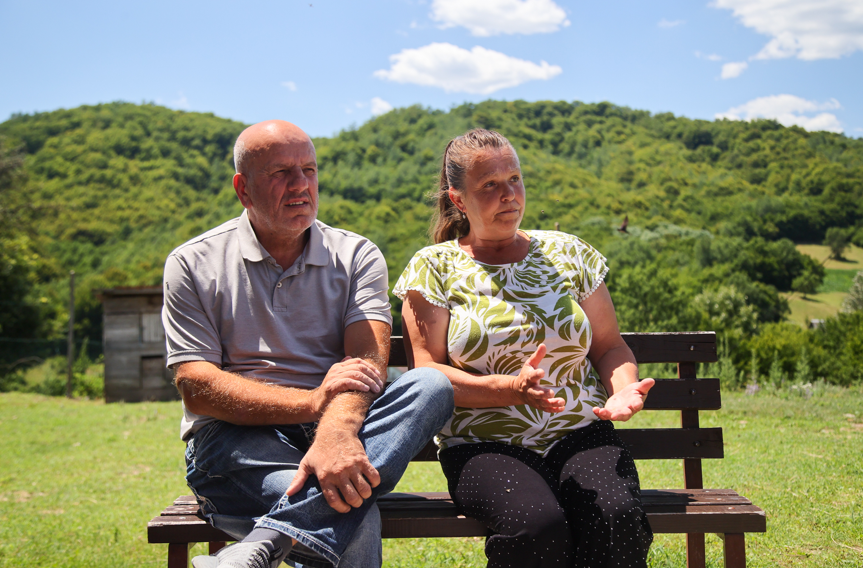
His uncle, Safet Golic, said the entire family is proud of the young footballer.
"We are all proud of Esmir, especially here in the Podrinje region. Children wear jerseys with his name on them. He is their role model," he said.
According to Golic, what matters most is that Bajraktarevic has remained connected to his heritage.
"His parents return to Bosnia and Herzegovina every year, and Esmir comes whenever he can. He is a well-raised young man. His parents passed on their love for Bosnia and Herzegovina, its traditions and its people. He knows exactly where his roots are."
More than 8,000 Bosniak men and boys were killed by Bosnian Serb forces and their collaborators after the fall of Srebrenica on 11 July 1995, in what international courts have ruled was genocide.
So far, 6,772 victims have been buried at the Srebrenica-Potocari Memorial Centre, while another 250 were buried in local cemeteries at the request of their families. More than 1,000 victims of the genocide are still missing.
Kakvo je tvoje mišljenje o ovome?
Učestvuj u diskusiji ili pročitaj komentare


Kakvo je tvoje mišljenje o ovome?
Učestvuj u diskusiji ili pročitaj komentare
NAJČITANIJE
















Najnovije









ZDRAVLJE





LIFESTYLE





SHOWBIZ



N1 KVIZ