Srbija
 Hrvatska
 Slovenija

Bosnia votes in landmark election as new voting technology faces first test


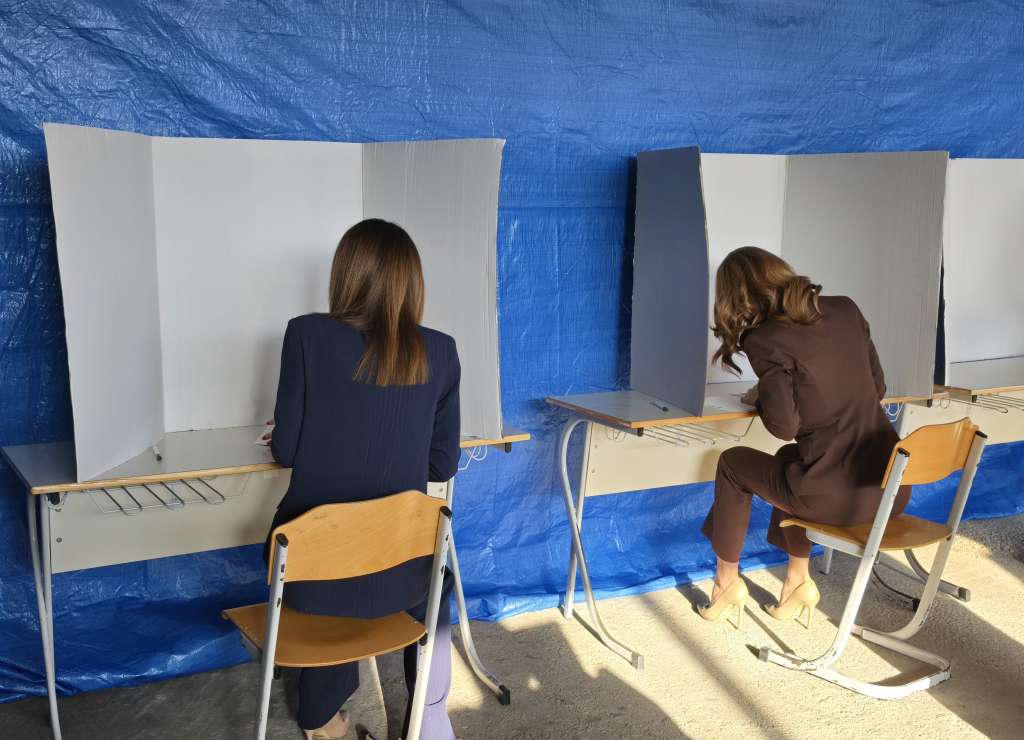
Citizens across Bosnia and Herzegovina began voting on Sunday in the country’s 2026 General Election, the first nationwide election to use biometric voter identification and ballot scanners, with initial technical difficulties causing delays at a number of polling stations.
Polling stations opened at 7 a.m. and are due to close at 7 p.m., with voters electing the three members of the Presidency of Bosnia and Herzegovina, representatives to the state and Federation parliaments, the president and vice presidents of Republika Srpska, members of the Republika Srpska National Assembly and representatives to the cantonal assemblies in the Federation of Bosnia and Herzegovina.
A total of 518 mandates are being contested by 7,028 certified candidates.
According to Bosnia and Herzegovina’s Central Election Commission (CEC), 3,414,364 voters are registered for the election.
For the first time, voters across the country are being identified using new biometric technology, while completed ballots are scanned after voting. The new system is also expected to allow election results to be transmitted considerably faster than in previous election cycles.
Technical problems delay voting in several areas
While voting began on time in many parts of the country, technical problems with the new equipment caused delays at dozens of polling stations.
In Mostar, between seven and eight polling stations experienced problems with the new technology, according to Mario Cuturic, president of the City Election Commission.
Technical operators and support teams were dispatched to the affected locations, while voting at those polling stations will be extended by the amount of time lost due to the delays.
"If the problem is resolved within half an hour, voting will be extended by half an hour," Cuturic said.
If the scanners cannot be brought into operation, reserve devices will be sent to the polling stations. Should those attempts also fail, permission from the Central Election Commission would be required to revert to the previous voting procedure without scanners.
Cuturic said he expected all polling stations to eventually open and estimated that, if the old voting method had to be used, this would likely affect no more than one or two polling stations.
Mostar has 152 regular polling stations and 101,878 registered voters, as well as 36 mobile teams for voters unable to reach polling stations due to age or limited mobility.
In Tuzla Canton, 53 polling stations were late opening at 7 a.m., according to preliminary information from the cantonal Interior Ministry. At the time of the police report, two polling stations – one in Gradacac and one in Lukavac – had still not opened.
Police said no election-day incidents had been reported in the canton.
A joint operational plan prepared by the Tuzla Canton Prosecutor’s Office and police provides for prosecutors and criminal investigators to respond to reports of possible election irregularities or illegal activities.
Delays also reported in Zenica-Doboj Canton
Technical problems also affected polling stations in Zenica-Doboj Canton.
According to the latest information provided by Lejla Ekinovic, spokesperson for the cantonal police, voting had begun at most polling stations across the canton.
Earlier technical problems had affected polling stations in Zenica, Visoko, Kakanj, Maglaj, Vares and Usora.
Ekinovic said that, according to information collected by 7:55 a.m., two polling stations in Zenica, 10 in Kakanj and one in Maglaj had still been affected. Shortly afterwards, all polling stations in Zenica and Kakanj were reported open, leaving only one polling station in Maglaj yet to begin voting.
In Zenica, around 101,200 voters are registered to vote at 138 regular polling stations. Four mobile teams have also been established.
Problems with scanners reported in Republika Srpska
Technical difficulties were also recorded in several parts of Republika Srpska.
All 27 polling stations in Bratunac opened, although several were delayed by a few minutes for technical reasons. In Laktasi, several polling stations also opened late because scanners could not initially be activated.
More significant delays were reported in Bijeljina, where 153 polling stations opened on time while voting had not begun at 30 others due to problems involving the new voting technology, according to City Election Commission president Dijana Savic Bozic. More than 111,300 people are eligible to vote in Bijeljina.
In Banja Luka, polling stations opened at 7 a.m. Voting is taking place at 259 polling stations, with 192,366 registered voters.
All polling stations opened in Visegrad, while in Gacko technical problems with biometric devices were reported at two polling stations. One of the problems was subsequently resolved.
Most polling stations in the East Sarajevo area opened on time, although scanner problems were reported at some locations.
All polling stations opened on time in Trnovo, Sokolac and Istocni Stari Grad. One of the 24 polling stations in Istocna Ilidza was delayed due to scanner problems, while there was no official information on the status of all polling stations in Pale at the time of the initial reports. According to information from voters, one polling station there had not opened on time because of problems with the new technology.
Polling also began in Prijedor, while in Nevesinje all but one polling station opened on time. The delay there was caused by a problem with a jammed door rather than the election technology.
Elsewhere, all polling stations in Konjic, Citluk and Orasje opened on time, according to information provided to the Fena news agency.
CEC chief: Initial problems quickly resolved
Central Election Commission President Jovan Kalaba said after voting in Banja Luka that the first elections in Bosnia and Herzegovina to use the new technologies were proceeding largely according to plan, despite minor problems at the start.
"These are the first elections with the new specific technologies, with identification using an identity document and fingerprint and the scanning of ballot papers. As you could see, there were some minor problems at the beginning until the system consolidated," Kalaba said.
He said voting was proceeding without major delays following the initial difficulties and expressed hope that the rest of election day would remain peaceful.
Kalaba also said preliminary results should become available shortly after polling stations close.
"Immediately after the polling stations close, we expect the first preliminary results," he said.
The ballot scanners operate offline during voting. Once polling stations close, a results slip is produced by the device and signed by members of the polling station committee. The device is then connected to the network and the data transmitted to the Central Election Commission.
Turnout data will be collected every hour, while the CEC will publish turnout figures at 9 a.m., noon and 3 p.m., in accordance with the country’s Election Law.
Final results will take longer because ballots arriving by post and from diplomatic and consular missions abroad must also be processed. Kalaba said the CEC must wait five days for postal ballots to arrive before they are scanned and manually counted.
How the new voting system works
Voters must present a valid Bosnia and Herzegovina identity document – an identity card, driving licence or passport – when they arrive at their polling station.
Their identity and eligibility to vote are then checked using the new biometric identification system.
Once the identification process is complete, voters receive their ballot papers and vote in private, as in previous elections. The completed ballots are then inserted into a scanner.
The Central Election Commission introduced the technology to improve oversight of the election process, including voter identification, turnout records, ballot scanning and the processing of results.
The equipment was tested in cities and municipalities across Bosnia and Herzegovina ahead of election day.
A total of 5,569 polling stations have been established across Bosnia and Herzegovina, including 5,121 regular polling stations and 385 mobile teams.
A further 48,078 voters are registered to vote from outside the country, including 45,457 by post and 2,621 at diplomatic and consular missions. Voting is also taking place at 20 Bosnia and Herzegovina diplomatic and consular missions in 13 countries.
The Central Election Commission has accredited 2,432 election observers, including 1,557 from citizens’ associations, 756 international observers and 119 observers representing political parties. Municipal and city election commissions have also accredited around 25,000 observers representing political entities.
The election silence, which began at 7 a.m. on Saturday, remains in force until polling stations close at 7 p.m. on Sunday. During this period, political entities are prohibited from participating in public political activities, while media reporting on campaign-related activities is also prohibited.
A ban on publishing election-related opinion poll results has been in force since 7 a.m. on Friday.
Polling stations are scheduled to close at 7 p.m., with the first preliminary results expected shortly afterwards if the new system operates as planned.
Kakvo je tvoje mišljenje o ovome?
Učestvuj u diskusiji ili pročitaj komentare


Kakvo je tvoje mišljenje o ovome?
Učestvuj u diskusiji ili pročitaj komentare