Srbija
 Hrvatska
 Slovenija

Croatia marks Srebrenica genocide anniversary as 10 more victims set for burial


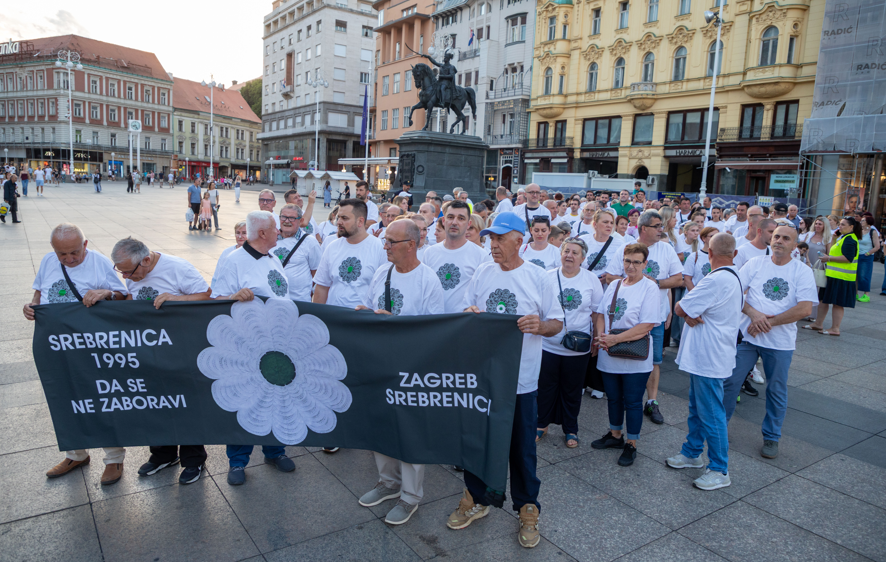
Croatia marked the 31st anniversary of the Srebrenica genocide on Friday with commemorative events in Zagreb and Rijeka, while Bosnia and Herzegovina prepared for the collective funeral in Potocari, where 10 newly identified victims will be laid to rest on July 11.
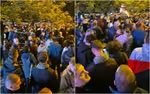
In Zagreb, hundreds of people took part in a silent March of Remembrance organized by the Council of the Bosniak National Minority of the City of Zagreb and the National Coordination of Bosniaks in the Republic of Croatia. Participants gathered at Ban Josip Jelacic Square wearing white T-shirts bearing the Srebrenica flower before walking in silence to the Zagreb Fountains.
The procession, led by Croatian Member of Parliament Armin Hodzic, symbolically retraced the death marches endured by thousands of Bosniaks following the fall of the UN-protected enclave of Srebrenica in July 1995.
At the fountains, the "Flower of Remembrance" was projected onto the water wall alongside the message, "Srebrenica 1995 – Never Forget / Zagreb to Srebrenica." The flower, a widely recognized symbol of remembrance, features white petals representing innocent victims, a green centre symbolizing hope, and 11 petals marking July 11, the day the genocide began.
The evening march concluded a day of commemorative events in the Croatian capital, which also included a memorial ceremony at the Vatroslav Lisinski Concert Hall under the patronage of the Croatian Parliament. The events were co-financed by the Croatian Government through its Office for Human Rights and the Rights of National Minorities.
In the northern Adriatic city of Rijeka, the traditional "Srebrenica Through the World 2026" remembrance march was held from Korzo to Karolina Rijecka Pier, where participants placed 31 white roses into the sea in memory of the victims.
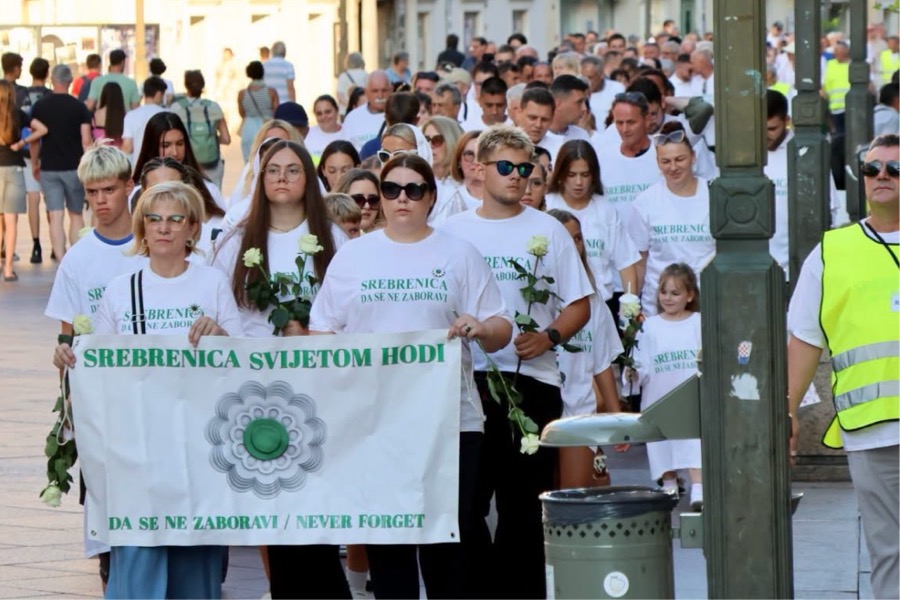
Rijeka Mayor Iva Rincic said that the greatest strength lies in the ability to forgive, while stressing that forgiveness must never come at the expense of remembering the past. She thanked organizers and all those committed to preserving the memory of the victims, highlighting the large number of young people, children and families who participated in the event.
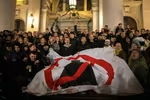
Meanwhile, preparations continue at the Srebrenica Memorial Center in Potocari, where the remains of 10 newly identified genocide victims will be buried during the annual collective funeral.
The victims, aged between 20 and 56 at the time of their deaths, were exhumed between 1997 and 2022 from several mass grave sites, including Kamenica, Jelovacka Cesma, Budak and Glogova.
The youngest victim to be buried this year is Senad (son of Zaim) Jusic, who was 20 when he disappeared in the Bratunac area in July 1995. His remains were recovered in 2022 from the Kamenicko Brdo site.
The oldest is Ramo (son of Mustafa) Dautovic, born in 1939, whose remains were exhumed in 2001 after the discovery of the Kamenica–Cancari mass grave. He will be buried alongside his brother Juso.
According to the Podrinje Identification Project, the remains of another 10 identified victims are still awaiting burial because their families have not yet given consent. In addition, the remains of 36 DNA-identified victims have yet to undergo formal family identification.
Families often delay burial because only partial remains have been recovered, choosing instead to wait in the hope that additional mass graves will be discovered and more complete remains of their loved ones will be found.
Bosnia’s Missing Persons Institute continues to search for approximately 900 victims of the Srebrenica genocide who remain unaccounted for.
Kakvo je tvoje mišljenje o ovome?
Učestvuj u diskusiji ili pročitaj komentare


Kakvo je tvoje mišljenje o ovome?
Učestvuj u diskusiji ili pročitaj komentare