Srbija
 Hrvatska
 Slovenija

Families of victims still face obstacles in marking mass graves


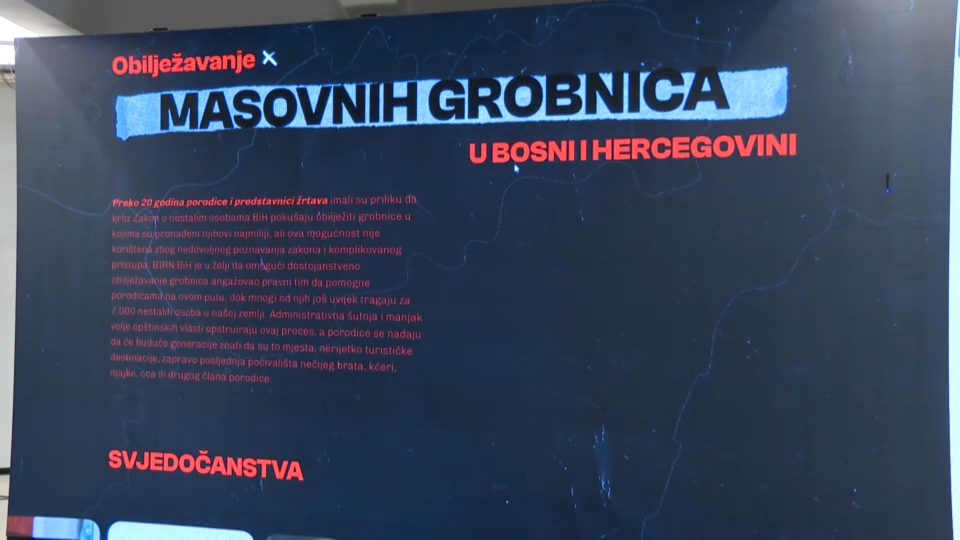
Although Bosnia and Herzegovina's Law on Missing Persons, adopted in 2004, requires mass graves to be marked, victims' families continue to face administrative obstacles and a lack of institutional support, leaving them largely responsible for preserving the memory of those killed and missing.
This was stated at the conference 'Ten Stories of Marking Mass Graves in BiH', organized by the Balkan Investigative Reporting Network (BIRN) in Sarajevo on Tuesday, where victims' families shared their experiences, discussed obstacles to marking sites where people were killed and presented recommendations for improving institutional accountability.
BIRN Director Denis Dzidic said the organization had implemented a project over the past year aimed at changing the way mass grave memorialization is approached in Bosnia and Herzegovina.
He recalled that the Law on Missing Persons of BiH had stipulated how mass graves should be marked for more than two decades. Victims' associations must contact the Missing Persons Institute of BiH, which issues a certificate, after which they seek approval from the relevant local authorities to mark the site.
Dzidic said BIRN had sought through the project to increase institutional pressure to secure legal remedies in cases where the state law was not being implemented. He noted that local authorities, particularly in Republika Srpska, were obstructing efforts to mark mass graves.
"We selected ten sites, including some of the largest mass graves in Bosnia and Herzegovina, and provided victims' associations with legal assistance so they could submit requests and obtain the relevant decisions," Dzidic said.
He stressed that the long-term goal was to bring the matter before the Constitutional Court of BiH and obtain a ruling establishing that local authorities were violating state law through their actions.
Such a ruling, he said, would be significant not only for the rule of law but would also help raise the profile of mass grave memorialization in the international political context.
"This would make it possible to discuss the issue in the context of European integration and the failure to implement Constitutional Court decisions, elevating a matter of exceptional importance to victims, survivors and families of missing persons to the highest level of political discourse," Dzidic said.
Midheta Kaloper, president of the 'Foca 92–95' Victims' Association, stressed the importance of marking mass graves, saying the association was seeking to mark two sites where the largest numbers of victims had been exhumed.
"Marking mass graves is not only our right but also our responsibility and obligation. We are aware that this will be extremely difficult, particularly in Republika Srpska, but we must persevere and act proactively because time is not on our side, and the number of families of missing persons is shrinking every day," Kaloper said.
She emphasized that leaving sites where mass graves had been located unmarked created room for crimes to be forgotten and that this must not be allowed to happen.
"We are the voice of those whose lives were violently cut short during the 1992–1995 war. It is our human and social responsibility to ensure that mass graves are marked and that people know where the remains of our loved ones were found," Kaloper said.
She acknowledged that the process would be lengthy but said families and associations would continue working to mark the sites.
The president of the Vogosca Municipality Association of Families of Missing Persons said families had been searching for 34 years for the truth about their loved ones and for justice, emphasizing that they would continue the struggle for as long as they were able.
"We will continue searching so that we do not leave this burden to younger generations," she said.
Speaking about the marking of mass graves, she highlighted the difficulties families faced with local authorities, noting that, in her experience, the Law on Missing Persons was not sufficiently understood or implemented.
She recalled that the first grave to be opened after the reintegration of Vogosca was located in the cemetery in Svrake and said that, with legal assistance and BIRN’s support, they would seek to erect a memorial at the site.
She said she had already spoken with the relevant authorities and explored the possibility of installing a plaque but had been referred to the Islamic Community to obtain approval.
Isabelle Jaulgey, representing the Embassy of Canada, highlighted the importance of memorializing mass graves to preserve the memory of victims and support survivors and their families. She noted that Canada supported initiatives aimed at preserving historical memory.
"Memorializing and marking mass graves is one way of paying tribute to the victims and acknowledging the experiences of survivors and their families. It preserves the memory of those who lost their lives, as well as the sites associated with these events," Jaulgey said.
She stressed that marking these sites helped preserve historical memory and document a significant part of the past for future generations, while ensuring that survivors and victims' families were treated with dignity.
Jaulgey said Canada understood the importance of families' need to preserve the memory of their loved ones, as well as the broader social importance of understanding the scale of human loss and its consequences for individuals, families and communities.
"That is why Canada, through the Canada Fund for Local Initiatives, seeks to support projects related to human rights, inclusion and respect for the dignity of all people," Jaulgey said.
Through the project ''Marking Mass Graves: Supporting Victims' Associations through Training and a Public Campaign in Their Efforts to Mark Sites of Suffering in Bosnia and Herzegovina'', BIRN BiH provided legal assistance to families and victims' associations, documented specific cases and raised the issue of institutional accountability for upholding the right to memorialization.
At the conference, BIRN journalists Lamija Grebo and Emina Dizdarevic Tahmiscija presented ten stories about initiatives to mark mass graves. This was followed by a panel discussion with representatives of victims’ associations, focusing on families’ experiences, institutional and administrative obstacles, and concrete steps needed to ensure consistent implementation of the law.
The conference marked the conclusion of the project "Marking Mass Graves: Supporting Victims’ Associations through Training and a Public Campaign in Their Efforts to Mark Sites of Suffering in Bosnia and Herzegovina", supported by the Government of Canada through the Canada Fund for Local Initiatives.
Kakvo je tvoje mišljenje o ovome?
Učestvuj u diskusiji ili pročitaj komentare


Kakvo je tvoje mišljenje o ovome?
Učestvuj u diskusiji ili pročitaj komentare